
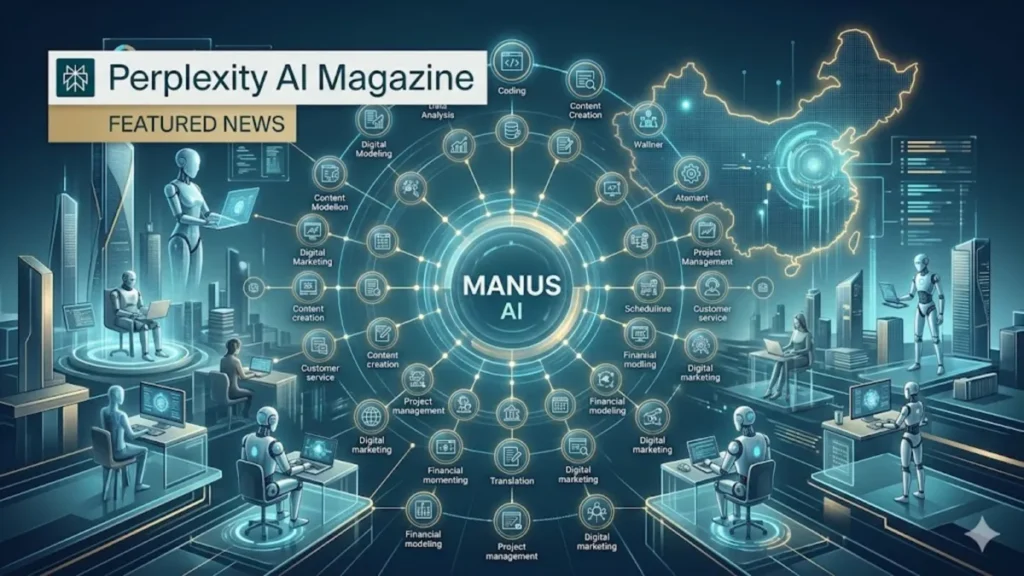
BEIJING – In a significant leap for autonomous computing, Chinese AI developer Monica has unveiled Manus, a specialized multi-agent system capable of executing over 50 complex, real-world tasks concurrently. Unlike traditional Large Language Models (LLMs) like ChatGPT or Claude, which primarily function as conversational assistants, Manus operates as a “digital workforce,” orchestrating a fleet of specialized worker AIs to complete entire project lifecycles without human intervention.
A Paradigm Shift: From Chatbot to Orchestrator
The arrival of Manus marks a transition from “human-in-the-loop” AI to fully autonomous execution. While current market leaders require constant prompting and iterative feedback, Manus utilizes a sophisticated multi-agent architecture to decompose a single, high-level goal into dozens of actionable sub-tasks.
“Manus represents the shift from AI as a tool to AI as a teammate,” says Dr. Liang Wei, a senior AI researcher. “It doesn’t just suggest code or draft a summary; it identifies the need for a database, builds the backend, scrapes the necessary market data, and compiles a final report in a sandbox environment while the user is offline.”
How the “Digital Manager” Functions
The core of Man-us is its Orchestrator, a central “project manager” AI. When a user submits a prompt—such as “Build a full-scale recruitment campaign”—the Orchestrator follows a three-step protocol:
- Decomposition: The goal is broken into a structured “to-do list” involving search, coding, writing, and analysis.
- Delegation: Tasks are matched to worker models (including SOTA models like Claude or Qwen) based on their specific strengths.
- Parallel Execution: Tasks run asynchronously in a cloud-based sandbox. While one worker is scraping LinkedIn for candidates, another is generating technical assessment tests, and a third is drafting personalized outreach emails.
Surpassing SOTA Benchmarks
Manus has already demonstrated its prowess by maintaining “State-of-the-Art” (SOTA) performance on the GAIA (General AI Assistants) benchmark. This is particularly notable because Manus maintains high accuracy even while juggling concurrent workflows—a feat that often leads to “hallucination” or logic breakdown in standard chat-based assistants.
In practical applications, this translates to massive efficiency gains for enterprises. Manus can manage a company’s entire e-commerce operation, from inventory tracking to automated customer sentiment analysis and ad-variant generation, all within a single framework.
Expert Analysis: The New Era of “Zero-Touch” Productivity
The release of Manus signals the beginning of the “Agentic Era” in software. For the last decade, digital transformation focused on making tools easier for humans to use. Manus suggests a future where the human provides the intent, and the AI provides the labor.
This “zero-touch” productivity model has profound implications for the global workforce. By automating 50 tasks at once, Manus effectively replaces the need for “middleware” software and fragmented toolsets. However, the long-term impact on white-collar employment remains a point of intense debate. While proponents argue it frees humans for high-level strategy, the speed at which Manus can replicate the work of a junior-level department (Hiring, R&D, Marketing) is unprecedented.
For the industry, the competitive pressure is now on Western developers to move beyond the “chat window” and into the “agentic sandbox.”
CHECK OUT: GLM-OCR: The 0.9B Model Beating Gemini in Document Parsing
Frequently Asked Questions (FAQs)
1. How does Manus differ from ChatGPT or Claude? While ChatGPT and Claude are conversational assistants that require step-by-step guidance, Manus is an autonomous agent. It executes multi-step projects independently and in parallel without requiring the user to stay online.
2. What are the “50 tasks” Manus can perform? The “50 tasks” refers to Manus’s capacity for concurrent workflows. This includes simultaneous web scraping, coding, financial analysis, document drafting, and social media management within a single project window.
3. Is Manus more accurate than other AI models? In clinical and technical benchmarks, Manus has shown higher stability and lower error rates than ChatGPT, largely because its orchestrator checks worker outputs for errors and triggers self-correction before delivering the final product.
4. Can Manus work with existing tools? Yes. Manus operates in a cloud environment and can interact with various APIs, sandboxes, and web tools to perform real-world tasks like deploying code or searching live databases.
5. Is Manus available for individual or enterprise use? Manus is primarily targeted at enterprise environments where complex workflows—such as hiring pipelines or market research—can be fully automated to save thousands of man-hours.
