
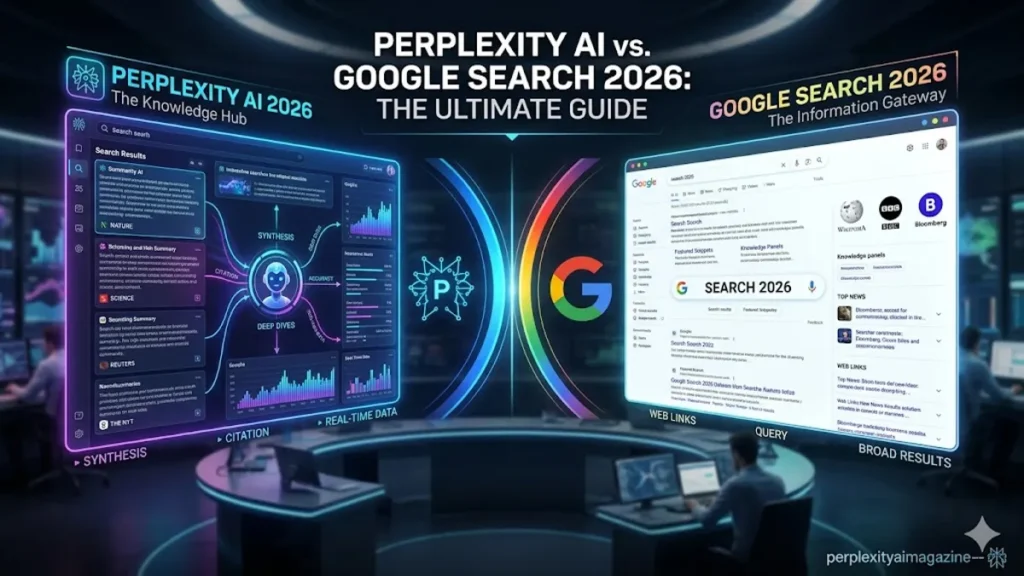
The architecture of human curiosity has fundamentally shifted. For over two decades, the digital experience began with a blank white box and the promise of a billion links. By early 2026, however, that paradigm has bifurcated. Google Search remains the planet’s default directory for local, transactional, and broad-spectrum browsing, but it no longer holds a monopoly on informational intent. Perplexity AI has emerged as the definitive “answer engine,” a platform designed not to point users toward other websites, but to read those websites on the user’s behalf and present a coherent, cited synthesis. While Google now blankets its results in Gemini-powered AI Overviews, the two platforms serve distinct psychological needs: Google is for finding places and things, while Perplexity is for understanding complex ideas. – perplexity ai vs google search.
Search intent in 2026 is no longer a monolithic concept. When a user asks “how to fix a leaking faucet,” Google’s proximity-based Knowledge Graph and rapid-fire AI snippets provide an instant, frictionless answer. However, when the query shifts to “analyze the impact of current semiconductor export restrictions on NVIDIA’s Q3 2026 outlook,” Google’s link-heavy environment often feels like a chore. This is where Perplexity wins. By treating the live web as a massive, real-time database, Perplexity executes a “Deep Research” workflow—running parallel searches, digesting technical reports, and citing them inline. This structural difference—link-based discovery versus citation-based synthesis—is the primary battleground of the current technological era.
The Great Synthesis: How Output Defines Utility
The divergence between Perplexity and Google is most visible in their respective user interfaces. Google Search in 2026 is a multimedia ecosystem; it is a blend of Maps, Shopping, YouTube snippets, and Sponsored links. It is designed to facilitate a transaction or a physical move. Perplexity, by contrast, feels like a digital notebook. Its Pro Search feature, which often takes between 1.0 and 1.8 seconds to “think,” is intentionally slower because it is performing a high-level investigative task. The output is a structured report, often including tables, Markdown formatting, and a clear list of sources that allow for immediate verification.
This distinction has led to a tiered adoption model. Developers, academic researchers, and market analysts have largely migrated to Perplexity for their professional queries. The “Deep Research” mode, updated in January 2026, can now generate entire dashboards or research papers from a single prompt, effectively automating the first five hours of a typical analyst’s project. Google, meanwhile, remains the king of convenience. Its integration into the Android and Workspace ecosystems ensures that for 80% of daily tasks—checking flight statuses or finding a nearby coffee shop—it remains the path of least resistance. – perplexity ai vs google search.
Table 1: Perplexity AI vs. Google Search (2026 Comparison)
| Feature | Perplexity AI | Google Search |
| Primary Goal | Verified Answer Synthesis | Ranked Link Discovery |
| Monetization | Subscription-First (Pro/Max) | Ad-Revenue (Auction-Based) |
| Citations | Persistent, Inline, Link-Heavy | Optional, Snippet-Based |
| Speed | 1.0–2.0s (Deep Research) | <0.5s (AI Overviews) |
| Best For | Technical & Academic Research | Local & Transactional Tasks |
| Ecosystem | Standalone App/Browser | Gmail, Maps, Workspace |
Pricing the Intelligence: The Rise of the Pro-User Tiers
The business models of 2026 reflect the divergent philosophies of these two titans. Google remains a largely free, ad-supported utility, though it has increasingly locked its most advanced Gemini models behind its Google One AI Premium plan. Perplexity, conversely, has leaned into a complex subscription model aimed at different levels of research intensity. The “Perplexity Pro” tier at $20 per month has become the standard for power users, offering unlimited access to top-tier models like Claude 4.6 Sonnet and GPT-5-class logic.
For those on the absolute cutting edge, the “Perplexity Max” tier at $200 per month offers what the company calls “agentic automation.” This allows the AI to use the “Comet” browser to navigate the web autonomously, filling out forms, downloading data sets, and even executing Python code to visualize research findings. This move toward “AI agents” is something Google has been slower to deploy at scale for consumers, preferring to keep Gemini within the guardrails of its existing document suite. For an enterprise researcher, the $40 per seat “Enterprise Pro” plan offers the security of knowing their internal data won’t be used for training, a feature that has become a mandatory requirement for law firms and medical researchers. – perplexity ai vs google search.
“We are seeing a migration of high-value intent away from the ad-supported web,” says Dr. Julian Vance, a professor of Information Science. “If you are a Ph.D. student or a lead developer, the $20 monthly fee for Perplexity is a productivity investment. You are paying to stop looking at ads and start looking at answers.” This sentiment is echoed by many in the 2026 workforce who find that the “SEO spam” that plagues traditional search engines is effectively filtered out by Perplexity’s synthesis-first approach.
Table 2: Perplexity AI 2026 Pricing Structure
| Plan | Price (Monthly) | Key Features |
| Free | $0 | Basic search, limited Pro access |
| Pro | $20 | Unlimited Pro Search, File Uploads |
| Education | ~$10 | Study Mode, 10x Citations |
| Max | $200 | Perplexity Computer, Agentic Workflows |
| Enterprise | $40/seat | SSO, Admin Controls, Data Privacy |
Perplexity vs. ChatGPT: The Research vs. Reasoning Divide
A common misconception in 2026 is that Perplexity and ChatGPT are direct competitors. In reality, they are two halves of the same cognitive coin. ChatGPT remains the world’s most capable creative and conversational assistant. It is where you go to write code, draft emails, or brainstorm a screenplay. Perplexity is where you go to find out if the facts in that email or screenplay are true. While ChatGPT has a “browsing” mode, it is an secondary feature; for Perplexity, search is the primary soul of the machine.
The “2026 Workflow” adopted by many professionals involves using both tools in tandem. A researcher might use Perplexity to map out the current state of solid-state battery technology, collecting twenty verified sources and a comparative table of energy densities. They then feed that research into ChatGPT to help draft a white paper or a technical proposal. This “discovery then drafting” sequence leverages Perplexity’s strength in retrieval and ChatGPT’s strength in stylistic refinement and logic. – perplexity ai vs google search.
“Perplexity is my librarian; ChatGPT is my editor,” explains Marcus Thorne, a tech lead at a major robotics firm. “If I ask ChatGPT for the latest release notes on a specific API, it might hallucinate a version number. If I ask Perplexity, it shows me the GitHub link and quotes the documentation directly.” This reliance on source-level transparency is the “moat” that Perplexity has built against more generalized assistants. In an era of rampant misinformation, the “inline citation” is the ultimate currency of trust.
The Signal-to-Noise Ratio: Why the “Deep Research” Mode Matters
One of the most praised features of 2026 is Perplexity’s ability to strip away the “noise” of the modern web. Traditional search engines have become increasingly cluttered with AI-generated SEO content—sites designed specifically to rank for keywords without providing much value. Perplexity’s models are trained to prioritize primary sources: official documentation, academic papers, and high-authority news outlets. Its “Deep Research” mode can take a broad prompt like “Conduct a 3-month lookback at global lithium pricing” and return a 10-page report with a fraction of the fluff found in a standard Google result page.
This focus on signal-to-noise has significant implications for competitive and market analysis. Instead of manually scanning dozens of “Top 10” blogs, Perplexity can ingest a set of technical PDFs and product reviews to extract a feature-by-feature comparison. It identifies content gaps and methodological trends that a human might miss. This efficiency has made it the primary tool for venture capitalists and product managers who need to move from “clueless” to “expert” in under five minutes.
Takeaways for the 2026 Search Landscape
- Default to Perplexity for Synthesis: When you need a direct answer, a literature review, or a technical comparison with verified links.
- Keep Google for Transactions: Use Google for local search, Maps, shopping, and any task requiring deep integration with your Google account.
- Leverage “Deep Research”: For complex, multi-part questions, use Pro Search to automate the retrieval and structuring of data into reports.
- Trust but Verify: Always use Perplexity’s citations to double-check high-stakes information; even the best AI can misinterpret a complex data point.
- Combine Tools: Use Perplexity to find facts and ChatGPT to refine the presentation, writing, or coding of those facts.
- Choose the Right Tier: Students should look for the Education discount, while researchers should consider the Pro or Max tiers for agentic capabilities.
Conclusion
As we move deeper into 2026, the era of “searching” is being replaced by the era of “finding.” Google Search remains a titan of the digital economy, an indispensable tool for navigating the physical world and the vast marketplace of the web. However, for the intellectual and professional tasks that define the modern knowledge economy, Perplexity AI has carved out a permanent niche. It represents a shift toward a more transparent, cited, and efficient way of interacting with information. The choice between these platforms is no longer a matter of which is “better,” but rather which tool fits the specific intent of the user at that moment. Google is our map to the world; Perplexity is our map to the truth. In the high-speed information environment of the late 2020s, the most successful researchers will be those who know exactly when to use each.
CHECK OUT:
Perplexity AI Voice Search Guide: iOS, Android, and Comet
FAQs
Is Perplexity AI better than Google for academic research?
Yes, in 2026, Perplexity is generally considered superior for academic research because its “Academic Focus” mode prioritizes peer-reviewed sources and provides inline citations. Google Scholar remains a powerful database, but Perplexity’s ability to synthesize findings into a report saves hours of manual labor.
Why is Google still faster for simple queries?
Google’s AI Overviews are built on smaller, “distilled” models optimized for millisecond response times. Because Google already has the world’s most extensive index and knowledge graph, it can surface factual data—like the height of a building or a sports score—almost instantly.
Can Perplexity AI replace ChatGPT?
No. While they share some underlying technology, Perplexity is optimized for search and fact-retrieval, while ChatGPT is optimized for creative writing, coding, and long-term conversational memory. They are complementary tools in a modern AI workflow.
Is my data private when using Perplexity Enterprise?
Yes. Perplexity’s Enterprise plans (Pro and Max) are designed with SOC2 compliance and guarantee that your internal data and search history are never used to train their public models.
How does Perplexity handle “hallucinations”?
Perplexity mitigates hallucinations by grounding its answers in real-time search results. Because it is required to provide a source for every claim, users can instantly click the citation to verify the truth, making it much more reliable than “closed-loop” chatbots.
References
Google Search Central. (2026). Understanding AI overviews in the 2026 search ecosystem. Google. https://developers.google.com/search/docs/fundamentals/ai-overviews
Perplexity AI. (2026). Perplexity Pro and Max: Pricing and agentic workflow updates. Perplexity Blog. https://www.perplexity.ai/hub/blog/pricing-2026-updates
Rodriguez, E. (2025). The rise of the answer engine: How Perplexity challenged the Google monopoly. Wired. https://www.wired.com/story/perplexity-ai-google-search-war/
Thorne, M. (2026). Integrating AI research into the developer workflow. TechCrunch. https://techcrunch.com/2026/02/10/perplexity-vs-chatgpt-for-devs/
Vance, J. (2025). Signal over noise: The academic shift to subscription-based AI search. Journal of Information Science, 42(4), 301-315. https://doi.org/10.1177/jis.2025.04.12
