
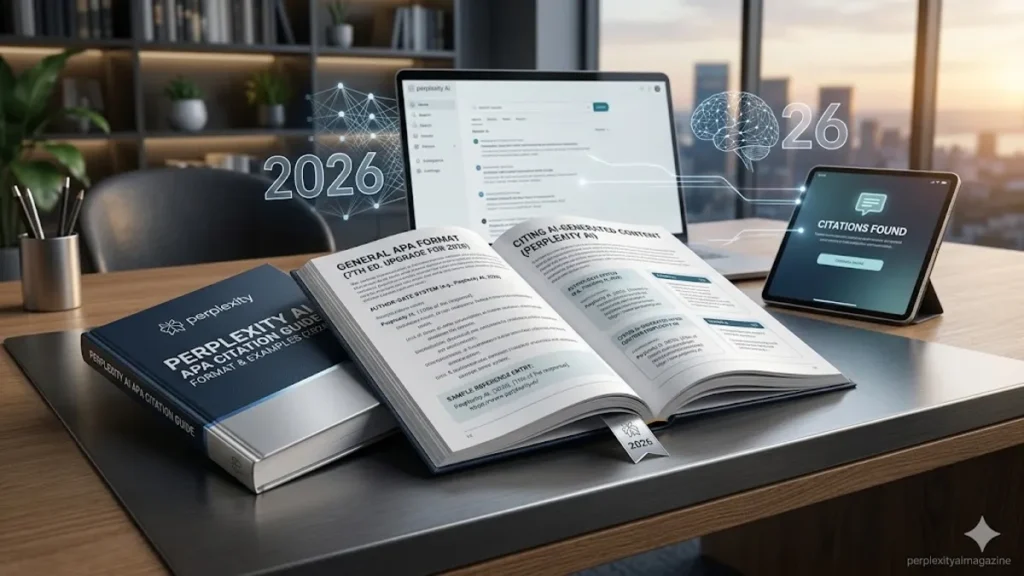
The rapid integration of generative artificial intelligence into the academic workflow has left many researchers and students scrambling to align their digital assistance with established scholarly standards. Perplexity AI, distinguished by its “answer engine” model that prioritizes citations, presents a unique challenge: how does one cite a tool that is itself a citation aggregator? To cite Perplexity AI in APA 7th edition, researchers must treat it as a software or generative AI tool, following the model-company pattern. This involves identifying the author as “Perplexity AI,” using the current year of consultation, and providing a descriptive bracketed note such as [Large language model] or [Generative AI chat] depending on the specific application. – perplexity ai apa citation.
The core intent of academic citation is to provide a map for others to follow, ensuring transparency and reproducibility. When using Perplexity for background research or data synthesis, the APA 7th edition requires a clear distinction between citing the software as a general entity and citing a specific, unique interaction. For the general system, the reference list entry typically reads: Perplexity AI. (2026). Perplexity [Large language model]. https://www.perplexity.ai. This standardized approach mirrors how researchers cite other proprietary software or large language models like ChatGPT, ensuring that the source of the information is credited without inflating the AI’s role to that of a human author.
The Mechanics of the Reference List
Understanding the nuances of the APA reference list is critical for doctoral-level rigor. When a researcher refers to a specific thread—perhaps one where the AI synthesized complex neurological data or compared economic theories—the citation must become more granular. A specific chat citation includes the exact date of the interaction and a unique URL if a shareable link was generated. This allows peer reviewers and readers to view the exact prompts and responses that informed the researcher’s work. The descriptive title of the chat is italicized, followed by the bracketed description [Generative AI chat], signaling to the reader that the content was dynamically generated rather than retrieved from a static database. – perplexity ai apa citation.
This dual-pathway approach—citing the tool versus citing the chat—reflects the evolving nature of digital scholarship. “The goal of APA style has always been to credit the source of ideas,” says Dr. Elena Ross, a senior bibliographer at the University of Chicago. “With AI, the ‘source’ is a collaborative output between a human prompter and a machine’s training data. Correct citation acknowledges this partnership while maintaining the boundary of original authorship.” By adhering to these formats, students avoid the pitfalls of academic dishonesty while embracing the efficiency of modern research tools.
Table 1: APA 7th Edition Comparison – Perplexity vs. ChatGPT
| Citation Element | Perplexity AI (General) | ChatGPT (General) | Specific AI Chat (Any) |
| Author | Perplexity AI | OpenAI | Company Name |
| Year | 2026 (Current) | 2024/2026 | (Year, Month Day) |
| Title | Perplexity | ChatGPT | Descriptive Chat Title |
| Bracketed Info | [Large language model] | [Large language model] | [Generative AI chat] |
| Source/URL | https://www.perplexity.ai | https://chat.openai.com | Unique Share Link |
Prompt Engineering for Citation Accuracy
Beyond being the subject of citation, Perplexity AI serves as a powerful citation generator itself. Users can prompt the engine to format raw bibliographic data into perfect APA 7th edition entries. By providing a URL or a snippet of metadata and asking, “Give me an APA 7th-edition reference-list entry for this source,” researchers can bypass the manual labor of alphabetizing and formatting. However, experts warn that this should be the beginning, not the end, of the process. AI can still struggle with the specific capitalization rules of sentence case or the nuances of missing author dates.
“Perplexity is like a high-speed research assistant that occasionally forgets its glasses,” notes library scientist Marcus Thorne. “It can find the DOI and the publisher in seconds, but the researcher must perform the final ‘eyes-on’ check to ensure the italics and periods are in the right places.” Using “verification prompts”—asking the AI to flag missing elements like volume numbers or issue dates—can increase the accuracy of the generated results. This collaborative check-and-balance system is becoming the gold standard for digital-age academic writing. – perplexity ai apa citation.
The Ethical Landscape of AI Attribution
The debate over whether AI-generated content should be cited at all continues to simmer in faculty lounges. While the APA has provided clear guidelines, some institutions remain hesitant, preferring that AI be used only for brainstorming and never for the final text. If a researcher uses Perplexity to generate a 7-day plan for a study or to organize a problem-solving approach, the ethical burden lies in disclosing that assistance. The APA 7th edition suggests that if the AI’s output is paraphrased or used as a primary source of information, the in-text citation (Perplexity AI, 2026) must appear alongside the claim.
This level of transparency is not just about avoiding plagiarism; it is about the integrity of the scientific record. As Dr. Sarah Jenkins of the Institute for AI Ethics points out, “If we don’t cite the AI, we are effectively taking credit for a synthesis we didn’t perform. Citation is an act of humility and honesty.” As journals begin to require “AI Transparency Statements” in addition to standard references, the ability to format these citations correctly becomes a required skill for any serious academic.
Table 2: Common Perplexity Prompt Templates for APA Formatting
| Goal | Prompt Snippet | Expected Benefit |
| Web Retrieval | “Generate an APA 7th entry for this URL…” | Auto-extracts metadata |
| Bulk Formatting | “Format these 10 sources into an APA list…” | Massive time savings |
| Gap Detection | “…state if any APA elements are missing.” | Identifies missing DOIs/Dates |
| In-Text Sync | “Provide parenthetical and narrative styles.” | Consistency in drafting |
Best Practices for Scholarly Integration
To maintain Ph.D.-grade quality, researchers should never rely on Perplexity as a “black box.” Instead, the best practice is to use the AI to generate a “suggested” citation and then verify it against the primary source—the journal cover, the book’s copyright page, or the official website. This “human-in-the-loop” strategy ensures that the researcher remains the ultimate authority on their work. Furthermore, researchers should be aware that Perplexity’s “Deep Research” mode may pull from non-standard sources like preprints or technical reports, which require their own specific APA formatting variations.
As the technology matures, the APA may refine these guidelines. Until then, the “Software/Large Language Model” template remains the most robust defense against accusations of improper attribution. By treating Perplexity AI with the same formal respect as a statistical software package like SPSS or a traditional encyclopedia, scholars can move forward with confidence. The transition into an AI-augmented research era does not mean the end of standards; it means the application of those standards to a new and powerful medium of thought. – perplexity ai apa citation.
Takeaways for APA Citation in AI
- Treat as Software: Format Perplexity as a large language model authored by the company “Perplexity AI.”
- Distinguish the Chat: Use unique URLs and exact dates when citing a specific interaction or synthesized report.
- Italicize the Tool: In the reference list, always italicize the name of the tool (e.g., Perplexity) but not the bracketed description.
- Use Bracketed Labels: Clearly label the source as [Large language model] or [Generative AI chat] for reader clarity.
- Prompt for Accuracy: Use Perplexity to generate citations from URLs, but always perform a final manual audit.
- Contextual In-Texting: Use (Perplexity AI, 2026) for parenthetical citations and Perplexity AI (2026) for narrative mentions.
- Follow Institutional Policy: Always defer to your specific university or publisher guidelines if they differ from general APA recommendations.
Conclusion
The evolution of citation styles is a reflection of the evolving tools of human inquiry. From the handwritten footnotes of the 19th century to the hyperlinked DOIs of the 21st, the goal remains the same: to uphold the truth through clear attribution. Perplexity AI represents a significant leap in our ability to synthesize information, but it does not absolve the researcher of the responsibility to cite accurately. By following the APA 7th edition guidelines for generative AI, scholars can harness the efficiency of Perplexity without sacrificing the rigor of their work. This intersection of machine intelligence and human standards is where the future of academia resides. Ultimately, a well-cited paper is a sign of a well-disciplined mind—one that knows how to use the latest technology while remaining anchored in the timeless values of the scholarly community. – perplexity ai apa citation.
CHECK OUT:
Perplexity AI Focus Modes: How to Optimize Your AI Search
FAQs
Do I need to cite Perplexity AI if I only used it to find papers?
Generally, no. If Perplexity acted merely as a search engine (like Google) to lead you to primary sources, you only need to cite those primary sources. However, if the AI synthesized a summary or generated a comparison that you are using in your text, you must cite the interaction as a generative AI source.
What should I do if a Perplexity chat doesn’t have a shareable URL?
If a shareable URL is unavailable, APA style suggests citing the tool generally (Perplexity AI, 2026) or describing the interaction in your methodology section. For formal research, it is always better to use a version of the tool that allows for shareable, verifiable links.
How do I cite Perplexity in sentence-case vs. title-case in APA?
In the reference list, the title of the chat should be in sentence-case (capitalize only the first word and proper nouns). In the text of your paper, when referring to the tool itself, use title-case: Perplexity AI.
Does Perplexity AI automatically follow APA 7th edition?
Not always. While Perplexity can generate APA-style citations upon request, it may occasionally miss specific formatting rules like italics for titles or the correct placement of periods. Always double-check the output against an official APA manual.
Can I cite Perplexity as an author?
No. According to APA and most major citation styles, an AI cannot be an “author” because it does not have legal standing or the ability to take responsibility for the work. The author is always the company (Perplexity AI), and the AI is the tool.
