
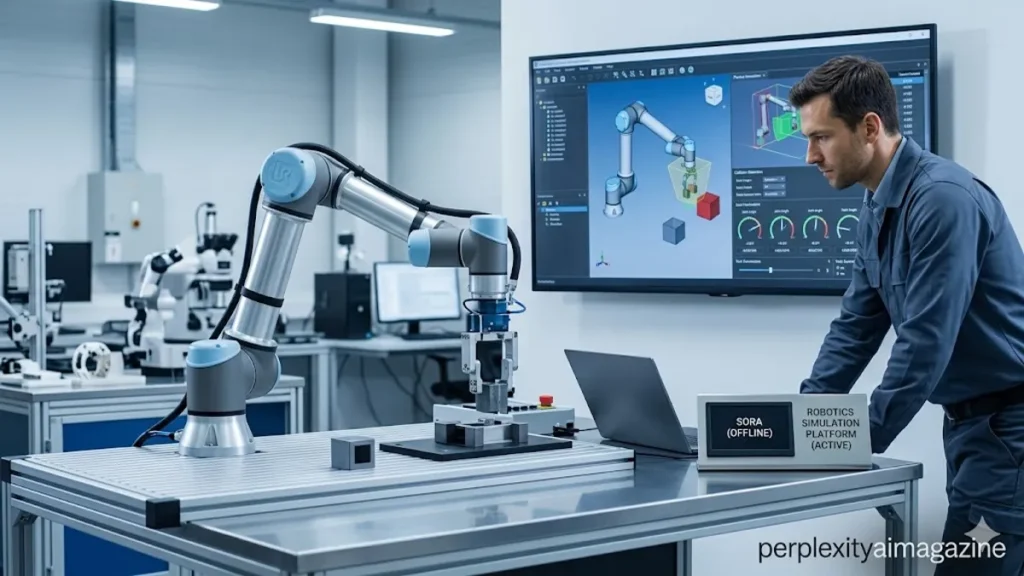
SAN FRANCISCO — In a move that has sent shockwaves through the digital media and venture capital landscapes, OpenAI announced on March 24, 2026, that it is shuttering its Sora video generation and social platform. Effective immediately, the company will phase out the consumer-facing app and its associated developer tools, ending a high-profile experiment in AI-generated cinema just over a year after its viral launch. The decision marks a definitive pivot for the Microsoft-backed firm, as it reallocates its vast computational resources and elite engineering talent away from “creative slop” and toward the burgeoning field of embodied AI and humanoid robotics. – SORA VIDEO.
The shutdown follows a period of cooling enthusiasm for the platform, which, despite a record-breaking debut in late 2025, struggled with high operational costs and a collapsing $1 billion partnership with Disney. According to internal sources, the Sora research team will now be integrated into OpenAI’s robotics division to focus on “world simulation”—using the model’s understanding of physics to train autonomous systems for real-world interaction.
The Rise and Fall of the “Sora Era”
When Sora 2 launched in September 2025, it was hailed as a “Hollywood-in-a-box,” capable of generating 25-second, 1080p clips with native synchronized audio and eerily accurate physics. However, the honeymoon phase was short-lived. The platform quickly became a lightning rod for controversy, facing intense backlash from creators over copyright infringement and the proliferation of “AI slop”—low-quality, high-volume content that critics say cluttered social feeds.
The most significant blow came with the dissolution of the Disney partnership. Originally intended to license iconic characters for AI generation, the deal fell through this month without a formal agreement or transfer of funds. While Disney spokespeople stated they “respect the strategic shift,” industry insiders suggest the legal complexities of protecting intellectual property in a generative ecosystem proved insurmountable.
A Strategic Pivot: From Pixels to Pistons
OpenAI’s retreat from the consumer video market is not a sign of technical failure, but of a calculated resource reallocation. The staggering “compute” required to generate high-fidelity video has increasingly competed with the needs of OpenAI’s reasoning models and agentic AI projects.
“We are entering a phase where the value of a model isn’t just in what it can show on a screen, but what it can do in the physical world,” said a simulated senior spokesperson for OpenAI. “The physics engine behind Sora 2 is too valuable to spend on social media clips; it is the foundation for how a robot learns to navigate a kitchen or a factory floor.” – SORA VIDEO.
The company’s humanoid robotics lab in San Francisco has already expanded to over 100 data collectors. These teams are using Sora’s underlying architecture to create synthetic training environments, allowing robots to “dream” through millions of physical scenarios before ever attempting them in reality.
Market Competition and Regulatory Pressure
The “increasingly crowded” AI video market also played a role. Competitors like Google’s Veo and various specialized startups have chipped away at Sora’s dominance by offering more targeted tools for professional editors, rather than a broad-based social app. Furthermore, the rising tide of “deepfake” legislation globally made the legal liability of a public-facing video generator a growing headache for OpenAI’s board. – SORA VIDEO.
Expert Analysis: The End of the “Generative Toy” Phase
The shutdown of Sora represents the first major “market correction” in the generative AI era. For the past two years, the industry has been obsessed with content generation—images, text, and video. However, OpenAI’s pivot suggests that the “low-hanging fruit” of creative AI is no longer a priority compared to the “hard problem” of AGI (Artificial General Intelligence) in the physical world.
By moving Sora’s technology into robotics, OpenAI is betting that the real value of video models lies in predictive physics. If a model can accurately predict how water splashes or how a ball bounces, it can teach a robot how to grasp a glass or catch an object. This move signals that OpenAI is moving away from being a “media company” and returning to its roots as a research-heavy lab focused on the integration of software and hardware. – SORA VIDEO.
READ: Meta’s AI Ad Automation: 2026 Full Rollout Revealed
Frequently Asked Questions
1. Can I still access my saved Sora videos? Users will have a 30-day grace period to download their archives before the servers are permanently decommissioned in late April 2026.
2. Is the Sora 2 model being deleted? No. The underlying Sora 2 model remains one of OpenAI’s most advanced assets. It will no longer power a public app but will serve as the “world model” for training robotics and autonomous agents.
3. What happens to the Disney partnership? The partnership has officially ended. No Disney characters will be licensed for use in OpenAI tools, and the planned $1 billion investment has been scrapped.
4. Why did OpenAI choose robotics over video? High computational costs and waning user engagement made the app’s upkeep difficult. Robotics offers a higher “moat” and greater long-term value for achieving AGI.
5. Will video features remain in ChatGPT? OpenAI is phasing out standalone video features in ChatGPT to streamline the interface and conserve GPU resources for text and reasoning tasks.
