
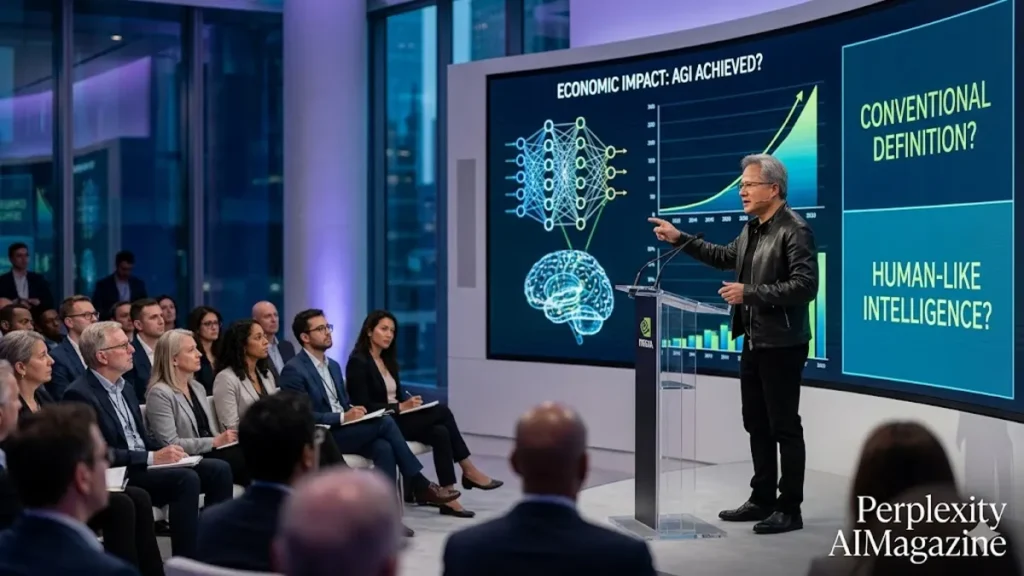
I would argue that the question is no longer whether artificial intelligence is advancing rapidly, but whether we are already willing to redefine intelligence itself to keep pace with that progress. When Nvidia CEO Jensen Huang declared that he believes artificial general intelligence has effectively been achieved, he did more than offer an opinion. He disrupted a decades-long consensus about what AGI is supposed to mean.
Huang’s statement, delivered during a widely circulated conversation on the Lex Fridman podcast, reframes AGI in economic rather than cognitive terms. If an AI system can launch a product, scale it rapidly, and generate billions in value, even briefly, Huang suggests that it has crossed the threshold. In this view, the ability to produce outsized real-world impact outweighs traditional benchmarks like reasoning, adaptability, or sustained autonomy.
Yet the claim lands in a field already fractured by competing definitions. For many researchers, AGI still implies systems that match or exceed human intelligence across a broad range of tasks over time. Huang’s interpretation lowers that bar dramatically, emphasizing speed, scalability, and economic disruption instead.
The result is a debate that cuts to the heart of the AI era. Are we witnessing the dawn of general intelligence, or merely redefining success to match the tools we already have? The answer carries implications not only for technology, but for investment, governance, and the future of human work itself.
A Conversation That Shifted the Debate
Huang’s remarks did not emerge from a formal announcement or research paper but from an unscripted exchange. When Lex Fridman posed a thought experiment about whether AI could replicate his own job, building and scaling a billion-dollar company, Huang responded with striking confidence: “I think it’s now.”
The statement resonated precisely because it diverged from academic caution. For decades, AGI has been treated as a distant milestone, requiring breakthroughs in reasoning, abstraction, and generalization. Huang instead pointed to observable phenomena: AI-generated apps, digital influencers, and automated systems capable of generating massive short-term revenue.
This framing reflects Nvidia’s vantage point. As the dominant supplier of AI hardware, the company sits at the center of the current boom. Its chips power the very systems that are redefining productivity and creativity. Huang’s perspective is therefore grounded less in theoretical benchmarks and more in market dynamics.
Still, the claim is not without ambiguity. Huang himself acknowledged limitations, noting that current AI cannot sustain businesses, manage teams, or navigate governance challenges. These caveats complicate the assertion, suggesting that what has been achieved may be a narrow slice of general intelligence rather than its full realization.
Competing Definitions of AGI
The debate over AGI is not new, but Huang’s comments have sharpened its contours. Different leaders in the field offer distinct interpretations, each reflecting their priorities and philosophical commitments.
How AI Leaders Define AGI
| Leader | Organization | Definition Focus | Key Emphasis |
|---|---|---|---|
| Sam Altman | OpenAI | Economic productivity across domains | Broad capability |
| Dario Amodei | Anthropic | General reasoning and adaptability | Safety, robustness |
| Elon Musk | xAI | Superhuman intelligence across tasks | Cognitive supremacy |
| Yann LeCun | Meta | Common sense and world modeling | Learning, perception |
| Demis Hassabis | Google DeepMind | Scientific reasoning and discovery | Versatility |
These definitions share a common thread: generality. The “G” in AGI implies the ability to transfer knowledge across contexts, to adapt to new problems without retraining, and to operate with a level of understanding comparable to humans.
Huang’s definition departs from this tradition by focusing on outcomes rather than processes. It asks not whether AI thinks like a human, but whether it can achieve results that rival human effort. This shift has profound implications, particularly for how progress is measured and communicated.
The Economic Lens: A New Metric for Intelligence
By framing AGI in terms of economic impact, Huang introduces a pragmatic but controversial معيار. In this view, intelligence is validated not by internal capabilities but by external results. If an AI system can create value at scale, it has demonstrated a form of generality.
This perspective aligns with broader trends in the technology industry, where success is often measured in growth metrics and market capitalization. The dot-com era provides a historical parallel, with companies achieving rapid valuations based on disruptive potential rather than sustained performance.
However, critics argue that this approach conflates correlation with causation. A viral app or digital influencer may generate significant revenue, but that success does not necessarily reflect general intelligence. It may instead be the product of narrow optimization, leveraging specific patterns in data.
As AI researcher Melanie Mitchell has noted, “Today’s AI systems are impressive but brittle. They excel in narrow domains but struggle with generalization” (Mitchell, 2019). This limitation underscores the gap between economic success and cognitive depth.
Technical Reality: What AI Still Cannot Do
Despite rapid advances, current AI systems remain fundamentally limited. They excel at pattern recognition and language generation but lack key capabilities associated with general intelligence.
Core Gaps in Current AI Systems
| Capability | Current Status | Limitation |
|---|---|---|
| Generalization | Weak | Fails on unseen data |
| Causal Reasoning | Limited | Relies on correlation |
| Common Sense | Incomplete | Prone to errors |
| Autonomy | Restricted | Requires human oversight |
| Interpretability | Low | Black-box decisions |
These gaps highlight the فاصلة between current systems and traditional definitions of AGI. While AI can generate text, images, and even code at remarkable levels, it struggles with tasks that require deep understanding or long-term planning.
The absence of causal reasoning is particularly significant. Without the ability to understand cause and effect, AI systems cannot reliably predict outcomes in dynamic environments. This limitation constrains their usefulness in complex, real-world scenarios.
The Investment Implications
Huang’s claim arrives at a moment of intense interest in AI investment. By suggesting that AGI has already been achieved, even in a limited sense, he reinforces a narrative of near-term opportunity.
Investors may interpret this as validation of current strategies, particularly those focused on infrastructure and scalable applications. Nvidia, as a leading provider of AI hardware, stands to benefit directly from this sentiment.
At the same time, the claim introduces new risks. If the definition of AGI is perceived as overly broad or self-serving, it could lead to skepticism and market volatility. As economist Erik Brynjolfsson has observed, “Technological progress often comes with cycles of hype and disappointment” (Brynjolfsson & McAfee, 2014).
The result may be a bifurcated investment landscape. On one hand, capital flows toward companies enabling immediate economic impact. On the other, researchers continue to pursue deeper, more foundational advances.
Ethical and Societal Questions
The debate over AGI is not merely technical or economic. It raises fundamental questions about the role of AI in society. If intelligence is defined by economic output, what does that mean for human labor and creativity?
There is also the question of accountability. AI systems that generate significant value may also produce unintended consequences, from misinformation to market manipulation. Ensuring that these systems operate responsibly requires robust governance frameworks.
As computer scientist Stuart Russell has warned, “We need to ensure that AI systems are aligned with human values” (Russell, 2019). This challenge becomes more pressing as AI capabilities expand.
Huang’s definition, by emphasizing outcomes over processes, risks obscuring these concerns. It suggests that success is sufficient, without fully addressing how that success is achieved or its broader implications.
A Moment of Reframing
What makes Huang’s claim significant is not its accuracy but its influence. By redefining AGI in terms of economic impact, he shifts the conversation from what AI is to what it does. This reframing has the potential to reshape both public perception and policy.
It also reflects a broader tension in the AI field. On one side are those who prioritize measurable results and rapid deployment. On the other are those who emphasize understanding, safety, and long-term capability.
This tension is unlikely to be resolved quickly. As AI continues to evolve, definitions will remain fluid, shaped by both technological progress and societal expectations.
Takeaways
- Jensen Huang’s AGI claim reframes intelligence in terms of economic impact rather than cognitive ability
- Traditional definitions emphasize generality, adaptability, and sustained performance
- Current AI systems still lack key capabilities such as causal reasoning and robust generalization
- The claim influences investment strategies, reinforcing short-term optimism in AI markets
- Ethical concerns remain central, particularly around accountability and alignment
- The debate reflects broader tensions between rapid deployment and foundational research
- Definitions of AGI are evolving, shaped by both technology and narrative
Conclusion
I see Huang’s statement less as a declaration of arrival and more as an invitation to reconsider what we mean by intelligence. In a world where machines can generate unprecedented value in short bursts, it is tempting to equate impact with understanding. Yet the distinction remains important.
Artificial general intelligence, in its traditional sense, implies a depth and breadth of capability that current systems have not yet achieved. They are powerful, but they are also limited, excelling in specific contexts while faltering in others.
At the same time, Huang’s perspective captures something real about the current moment. AI is no longer confined to laboratories. It is shaping markets, industries, and daily life in ways that would have seemed implausible just a decade ago.
The challenge moving forward is to balance ambition with clarity. As definitions shift, so too must our frameworks for evaluating progress. Whether or not AGI has been achieved, the conversation itself is a reminder that intelligence, artificial or otherwise, is as much about interpretation as it is about capability.
READ: Elon Musk AI Learn Jobs by Watching Humans: What His Reaction Means for the Future of Work
FAQs
He suggested that AI has effectively reached AGI if it can create and scale a billion-dollar business, even briefly, emphasizing economic impact.
It focuses on short-term results rather than sustained, general intelligence across diverse tasks, which many researchers consider essential.
No. They lack robust generalization, causal reasoning, and long-term autonomy required for true AGI.
It may boost short-term optimism while prompting scrutiny of whether current capabilities justify high valuations.
It shapes how progress in AI is measured and influences policy, funding, and public perception.
References
Brynjolfsson, E., & McAfee, A. (2014). The second machine age: Work, progress, and prosperity in a time of brilliant technologies. W. W. Norton & Company.
Mitchell, M. (2019). Artificial intelligence: A guide for thinking humans. Farrar, Straus and Giroux.
Russell, S. (2019). Human compatible: Artificial intelligence and the problem of control. Viking.
Fridman, L. (2024). Lex Fridman Podcast [Podcast].
OpenAI. (2023). Planning for AGI and beyond. Retrieved from https://openai.com
Google DeepMind. (2023). Progress in artificial general intelligence research. Retrieved from https://deepmind.com
