

I have often thought of cloud storage as invisible infrastructure. It sits quietly behind everything we do, storing documents, photos, and fragments of our lives without demanding attention. But the dominance of mainstream platforms like Google Drive, Dropbox, and OneDrive has begun to raise questions. Who controls the data? How secure is it? And what alternatives exist for those seeking more privacy or flexibility? – Cloud Storage Alternatives.
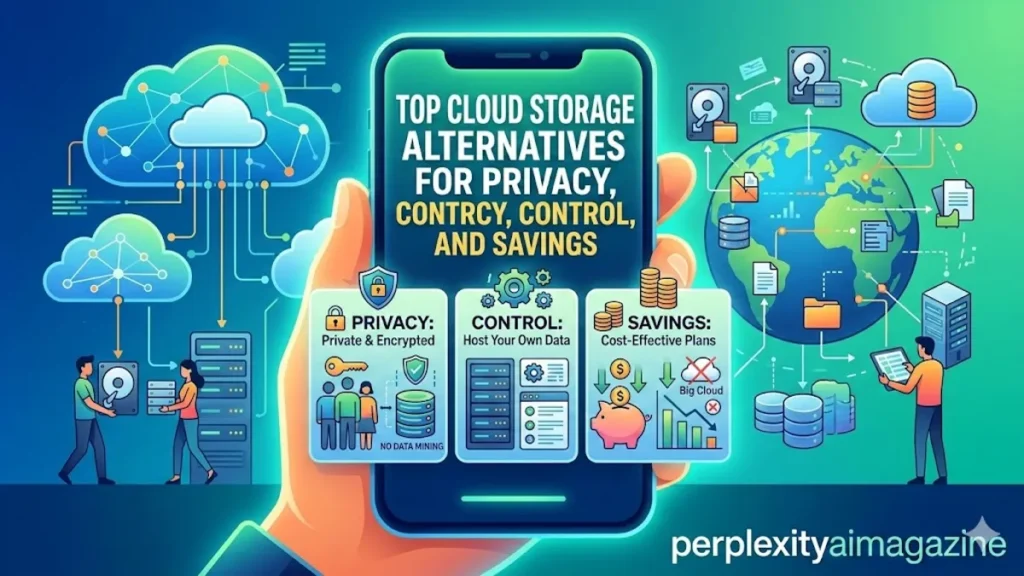
If you are looking for cloud storage alternatives, the answer is no longer limited to a handful of niche tools. Today’s landscape includes privacy-first services, lifetime pricing models, and fully self-hosted systems that allow users to reclaim ownership of their data. These alternatives range from encrypted platforms like Proton Drive and Sync.com to customizable solutions like Nextcloud and Synology NAS.
The shift is not accidental. As digital storage needs grow and concerns over surveillance and data monetization intensify, users are exploring options that align with their values. Some prioritize end-to-end encryption. Others want affordability or complete control through self-hosting.
This article examines the evolving ecosystem of cloud storage alternatives, comparing their strengths, limitations, and real-world applications. It also explores how these services reflect broader changes in technology, where control, privacy, and flexibility are becoming just as important as convenience.
The Rise of Cloud Storage Alternatives
When I look at the evolution of cloud storage, I see a story shaped by trust. Early adoption was driven by convenience. Files could be accessed anywhere, synced instantly, and shared effortlessly. But as platforms scaled, concerns about data ownership began to surface.
According to a 2023 report by the European Data Protection Board, users increasingly demand “greater transparency and control over personal data stored in cloud environments” (EDPB, 2023). This shift has fueled the rise of alternative services.
Privacy-focused platforms have gained traction by offering end-to-end encryption. Meanwhile, self-hosted solutions appeal to those who want full autonomy. Cost-conscious users are drawn to lifetime pricing models that eliminate recurring fees.
Cybersecurity expert Bruce Schneier has argued, “Data is the pollution problem of the information age, and protecting privacy is the environmental challenge” (Schneier, 2015). That perspective captures why alternatives matter.
The modern cloud is no longer a monolith. It is a spectrum of choices, each reflecting different priorities. Understanding those priorities is the first step in choosing the right solution.
Hosted Alternatives: Privacy Meets Convenience
Hosted cloud storage alternatives aim to balance usability with enhanced privacy. Unlike self-hosted systems, they remove the burden of infrastructure while offering stronger security features than mainstream providers.
Proton Drive stands out for its end-to-end encryption. Built by the team behind Proton Mail, it ensures that even the provider cannot access user data. Plans begin around €3.99 per month for 200GB, with higher tiers integrating email, VPN, and password management tools.
Sync.com takes a similar approach but emphasizes zero-knowledge encryption across all plans. This means files are encrypted before they leave the user’s device. The service offers competitive pricing, with 2TB plans starting around $8 per month.
pCloud introduces a different model. It offers lifetime storage plans, allowing users to pay once for long-term access. While encryption is optional through its Crypto add-on, the platform is known for speed and media playback features.
Hosted Cloud Comparison
| Service | Free Tier | Paid Starting | Key Strength | Encryption |
|---|---|---|---|---|
| Proton Drive | 1GB | €3.99/month | Privacy ecosystem | End-to-end |
| Sync.com | 5GB | $8/month | Zero-knowledge default | End-to-end |
| pCloud | 10GB | $399 lifetime | Lifetime pricing | Optional |
| MEGA | 20GB | Varies | Generous free plan | End-to-end |
Each service reflects a different philosophy. Some prioritize security, others affordability, and some aim to balance both.
Self-Hosted Storage: Control at a Cost
There is a moment when convenience gives way to control. For those willing to manage their own infrastructure, self-hosted cloud storage offers unparalleled flexibility.
Nextcloud is the most prominent example. It allows users to create a private cloud on personal hardware or a virtual private server. The platform supports file sharing, collaboration tools, and integrations with office suites like OnlyOffice.
Setting up Nextcloud requires technical knowledge. Users must configure servers, manage domains, and ensure security through firewalls and HTTPS. Yet the reward is complete ownership.
Seafile and Synology NAS offer similar capabilities with varying levels of complexity. Synology, in particular, provides a user-friendly interface for those less comfortable with command-line tools.
Technology researcher Cory Doctorow has noted, “When you control your own infrastructure, you control your own destiny online” (Doctorow, 2020).
Self-Hosted vs Hosted Comparison
| Feature | Hosted Services | Self-Hosted Solutions |
|---|---|---|
| Setup | Easy | Complex |
| Control | Limited | სრული control |
| Cost | Subscription | Hardware + maintenance |
| Privacy | High (varies) | Maximum |
| Scalability | Fixed plans | Unlimited |
Self-hosting is not for everyone. But for those who value autonomy, it represents the ultimate alternative.
Security: The Defining Factor
Security is the central argument for cloud storage alternatives. The distinction between server-side and client-side encryption defines how data is protected.
Sync.com uses AES-256 encryption with zero-knowledge architecture. Files are encrypted before upload, ensuring that even the provider cannot access them. Proton Drive follows a similar model, extending encryption to file names and metadata.
pCloud offers flexibility but requires an additional subscription for its Crypto feature. Without it, files are encrypted on the server rather than the client.
According to the National Institute of Standards and Technology, AES-256 encryption remains “the gold standard for securing sensitive data” (NIST, 2020).
Security also extends beyond encryption. Features like two-factor authentication, file versioning, and secure sharing links play critical roles.
The choice of service often depends on how much trust users are willing to place in providers. For some, zero-knowledge encryption is non-negotiable. For others, convenience outweighs absolute privacy.
Cost Models and the Economics of Storage
Cloud storage pricing has evolved significantly. Subscription models dominate, but alternatives are emerging.
pCloud’s lifetime plans challenge traditional pricing. A one-time payment of $399 for 2TB appeals to users seeking long-term savings. However, it requires trust in the company’s longevity.
IDrive offers a hybrid approach, focusing on backup rather than synchronization. Plans start as low as $9.95 per year for 500GB, making it one of the most affordable options.
Proton Drive bundles multiple services into a single subscription. This approach adds value but may not suit users who only need storage.
Economist Hal Varian has observed, “Pricing models shape user behavior as much as technology itself” (Varian, 2019). In cloud storage, this is evident.
The choice between subscription and lifetime plans reflects broader financial considerations. Users must weigh upfront costs against long-term value.
Backup vs Sync: A Crucial Distinction
One of the most overlooked aspects of cloud storage is the difference between backup and synchronization. These concepts are often conflated, but they serve distinct purposes.
Synchronization mirrors files across devices. Changes made in one location are reflected everywhere. While convenient, this approach can propagate errors or deletions.
Backup services like IDrive operate differently. They preserve multiple versions of files, allowing recovery even after deletion. This makes them essential for data protection.
According to a 2022 report by Backblaze, accidental deletion remains one of the leading causes of data loss (Backblaze, 2022).
Understanding this distinction is critical. Sync is about accessibility. Backup is about सुरक्षा.
Many users benefit from combining both approaches, using sync for daily work and backup for long-term protection.
Free Storage Options in 2026
Free cloud storage remains a key entry point for users. While limited in capacity, it provides a way to test services before committing.
MEGA leads with 20GB of free storage, offering end-to-end encryption by default. pCloud and Icedrive provide 10GB, with varying levels of security.
Proton Drive and Sync.com offer smaller free tiers but emphasize privacy. These options cater to users who prioritize security over space.
The trade-off is clear. Free plans often come with limitations in bandwidth, features, or support. Yet they remain valuable for light usage.
As digital storage demands grow, free tiers serve as stepping stones rather than long-term solutions.
Takeaways
- Cloud storage alternatives prioritize privacy, control, and affordability
- Hosted services balance convenience with enhanced security features
- Self-hosted solutions offer სრული control but require technical expertise
- Encryption type determines how secure your data truly is
- Pricing models vary widely, from subscriptions to lifetime plans
- Backup and sync serve different purposes and should be used together
- Free storage options provide entry points but have limitations
Conclusion
I have come to see cloud storage not as a single solution, but as a set of choices shaped by priorities. Convenience, privacy, cost, and control all pull in different directions. The rise of alternatives reflects a broader shift in how users think about their data.
For some, the appeal lies in privacy-first platforms that shield information from even the provider. For others, it is the independence of self-hosting, where control comes at the cost of complexity. And for many, it is simply about finding a better value.
The future of cloud storage will likely remain fragmented. No single service can satisfy every need. Instead, users will continue to mix and match solutions, building systems that reflect their own priorities.
In that sense, the cloud is no longer just a place to store files. It is a reflection of how we choose to live with technology.
READ: IsItDownRightNow: How It Works, Accuracy, and Real Limitations
FAQs
What is the best alternative to Google Drive?
It depends on your priorities. Proton Drive and Sync.com are strong for privacy, while pCloud offers lifetime pricing and flexibility.
Is self-hosted cloud storage safe?
Yes, if properly configured. Security depends on server setup, encryption, and regular updates.
What is zero-knowledge encryption?
It means only the user can access their data. Even the service provider cannot decrypt stored files.
Are lifetime cloud storage plans worth it?
They can be cost-effective long term but require trust in the provider’s sustainability.
What is the difference between backup and sync?
Sync mirrors files across devices, while backup stores copies for recovery, even after deletion.
