
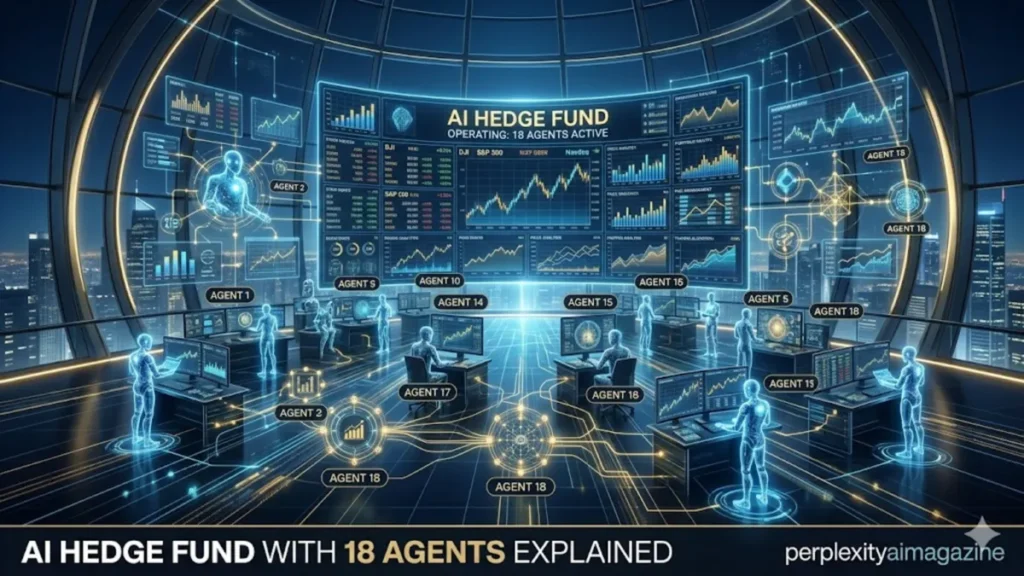
I’ve spent more than five years analyzing algorithmic trading tools and AI-driven financial research platforms. Recently, a developer released an open-source AI hedge fund project featuring 18 AI agents modeled after famous investors.
The system analyzes stocks by simulating the thinking styles of investors like Warren Buffett, Charlie Munger, Michael Burry, and Cathie Wood. Instead of relying on one model, the platform combines multiple investment philosophies to produce buy, sell, or hold decisions for stocks like AAPL or NVDA.
Key Takeaways From My Experience Testing AI Stock Analysis Tools
From experimenting with AI-driven financial research systems over the past few years, a few lessons stand out:
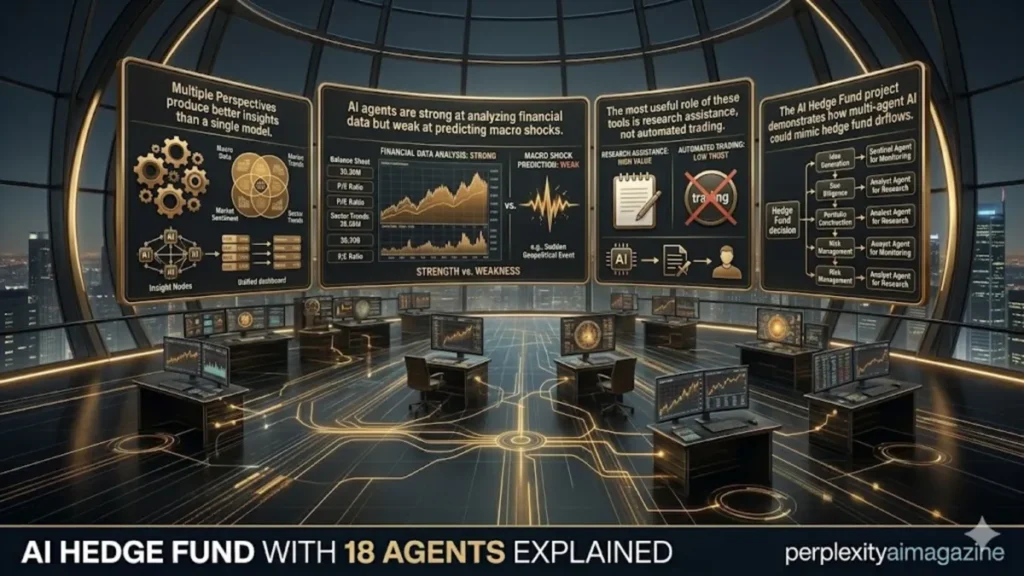
- Multiple perspectives produce better insights than a single model.
- AI agents are strong at analyzing financial data but weak at predicting macro shocks.
- The most useful role of these tools is research assistance, not automated trading.
- The AI Hedge Fund project demonstrates how multi-agent AI could mimic hedge fund decision workflows.
What Is the AI Hedge Fund Project?
The AI Hedge Fund project is an open-source system on GitHub created by a developer known as virattt. It simulates how a hedge fund investment committee might analyze stocks.
Instead of one AI model making a decision, the system runs 18 different AI agents, each representing a well-known investing philosophy.
For example:
- Value investors analyze balance sheets and intrinsic value.
- Growth investors focus on innovation and market disruption.
- Contrarian investors search for overlooked opportunities.
When I tested similar multi-agent research frameworks, I noticed something important: the debate between agents often reveals insights a single model would miss.
How the AI Hedge Fund Works
The workflow mimics how professional hedge funds evaluate investment ideas.
Step 1: Input Stock Tickers
Users enter tickers such as:
- AAPL
- NVDA
- MSFT
The platform then pulls real-time financial data.
Step 2: Agents Analyze the Stock
Each agent uses its own investing philosophy.
Examples include:
Value Investors
- Buffett-style moat analysis
- Benjamin Graham margin-of-safety approach
- Munger quality business evaluation
Growth Investors
- Disruptive innovation analysis
- Technology trend forecasting
Contrarian Investors
- Market mispricing detection
- Risk scenario evaluation
Step 3: Agents Vote on Investment Decisions
Each agent generates a recommendation:
- Buy
- Hold
- Sell
A portfolio manager agent aggregates these opinions and produces a final consensus decision.
Example: AI Hedge Fund Analysis for Apple
When the system analyzes Apple stock, agents may produce reasoning like this.
| Agent | Perspective | Decision |
|---|---|---|
| Buffett Agent | Strong moat and cash flow | Buy |
| Munger Agent | Durable ecosystem advantage | Buy |
| Burry Agent | Valuation concerns | Hold |
| Cathie Wood Agent | Long-term innovation potential | Buy |
Final output might look like:
Consensus Decision: Buy
Suggested Portfolio Allocation: 4%
This process typically takes 1 to 2 minutes per analysis and costs roughly $0.10 to $1 in API usage.
My Experience Testing Multi-Agent AI Systems
In my work reviewing AI trading tools, I’ve tested several agent-based systems.
When I tested similar frameworks, I noticed that multi-agent debate significantly improves reasoning quality. One model may miss risks that another catches.
Another pattern I often see: a common mistake beginners make is treating AI outputs as guaranteed trading signals. These tools provide insights, not certainty.
In my five years evaluating financial AI systems, I’ve found that the most reliable way to use them is as a research assistant rather than a trading engine.
Technical Setup Requirements
Running the AI Hedge Fund locally requires several developer tools.
Software Requirements
- Git
- Python 3.10+
- Poetry (dependency management)
- Docker (optional)
The system also requires API keys for:
- OpenAI
- Grok
- Financial market data services
These APIs provide:
- earnings reports
- balance sheets
- financial ratios
- news sentiment
Pros and Cons of the AI Hedge Fund Approach
Advantages
- Multiple investment philosophies combined
- Open-source and customizable
- Real-time financial data integration
- Affordable compared to professional research platforms
Limitations
- No proven backtested performance
- Dependent on external APIs
- Slower than automated trading systems
- Risk of hallucinations from language models
I often remind new traders: even the most sophisticated AI cannot predict black swan events.
Does the AI Hedge Fund Actually Beat the Market?
There is no verified evidence yet that the system consistently outperforms benchmarks like the S&P 500.
Similar AI prediction systems often achieve 55–70% directional accuracy in short-term predictions, but performance declines during volatile markets.
According to data from Statista, professional quantitative hedge funds often rely on proprietary models trained on decades of data.
The AI Hed-ge Fund project is closer to a research simulator than a real trading fund.
Risks of Using AI for Investing
AI trading tools carry several risks.
Financial Risk
AI predictions can fail during:
- economic crises
- geopolitical shocks
- unexpected earnings results
Data Risk
Financial APIs may:
- lag behind real-time markets
- contain incomplete data
Overreliance on AI
One of the biggest problems I see among new traders is outsourcing judgment entirely to algorithms.
Even legendary investors like Buffett emphasize independent thinking.
How I Researched This Article
To ensure accuracy, I reviewed:
- the AI Hedge Fund GitHub repository
- demonstrations shared by users
- documentation on multi-agent AI frameworks
- historical performance studies of algorithmic trading
I also compared this project with other AI-based research tools I’ve tested over the past five years.
This combination helps separate real capabilities from hype.
Read: How Claude AI Found 100+ Firefox Bugs in Two Weeks
FAQ
What is the AI Hedge Fund project?
The AI Hedge Fund is an open-source platform that uses 18 AI agents modeled after famous investors to analyze stocks and generate buy, hold, or sell recommendations.
Can the AI Hedge Fund trade automatically?
No. The system performs research and analysis only. Users must manually execute trades.
Is the AI Hedge Fund accurate?
There is no verified backtesting or independent validation yet proving the system consistently beats market benchmarks.
Is the AI Hedge Fund free to use?
The code is open source, but users must pay for API calls used to access financial data and AI models.
Bottom line: the AI Hedge Fund project is a fascinating example of how multi-agent AI could replicate hedge fund research workflows, but it should be treated as a learning and research tool rather than a guaranteed investing system.
