
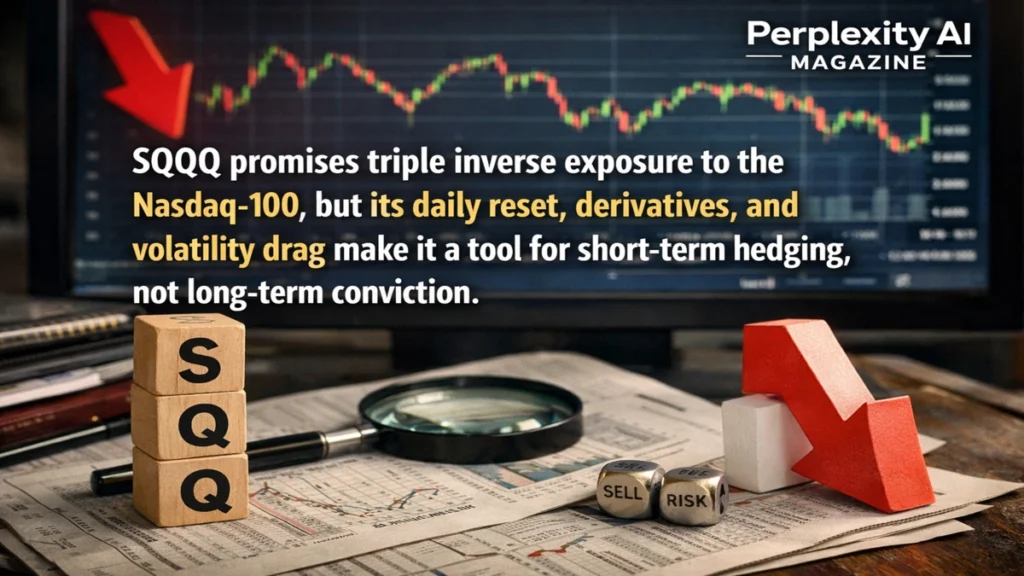
When I look at the search term “SQQQ,” I see less a ticker symbol and more a question about fear, timing, and control. SQQQ, formally ProShares UltraPro Short QQQ, is designed to deliver three times the inverse of the Nasdaq-100’s daily performance, and it attracts attention precisely when markets feel unstable. In early 2026, as technology stocks swing between optimism and anxiety, many investors turn to SQQQ hoping for protection or quick profits. I have found that the confusion around this ETF rarely comes from its price and almost always from its mechanics. SQQQ resets its leverage every day, a design choice that can magnify gains during sharp sell-offs but quietly erode value when markets churn or rebound. Understanding that structure, rather than predicting a crash, is the real starting point for anyone considering how or whether to use SQQQ.
In early 2026, SQQQ trades around the mid-$60 range, close to the lower end of its recent price band after earlier spikes tied to volatility in technology shares. That price level alone, however, tells very little. The defining feature of SQQQ is not where it trades, but how it behaves over time. It is engineered to reset its leverage daily, which means it can perform very differently than many investors intuitively expect if held for more than a short period.
The search intent behind “SQQQ” reflects confusion as much as opportunity. Some users see it as crash insurance. Others treat it as a speculative bet on short-term market declines. What often goes missing in both cases is a clear understanding of how leverage, daily resets, and compounding interact. This article explains what SQQQ is, how it works, when it can be useful, and why it so often disappoints investors who hold it too long.
What SQQQ Is in Simple Terms
SQQQ is not a stock and it is not a traditional short position. It is an exchange-traded fund that uses derivatives to target approximately negative three times the Nasdaq-100’s daily return. If the Nasdaq-100 falls 1 percent in a single trading day, SQQQ aims to rise about 3 percent that same day, before fees and expenses. If the Nasdaq-100 rises 1 percent, SQQQ aims to fall about 3 percent.
The key word in that description is daily. SQQQ resets its exposure at the end of each trading session. Every morning, it begins again with the same objective: deliver roughly minus three times that day’s move. It does not aim to deliver minus three times the return over a week, a month, or a year.
This design makes SQQQ powerful during sharp, sustained sell-offs that unfold over a short window. It also makes the fund vulnerable to value erosion when markets are choppy, trend upward, or reverse suddenly. Understanding that reset mechanism is essential before using the product.
Read: PLTR Stock Analysis and Palantir AI Outlook
The Early 2026 Market Snapshot
In late January 2026, SQQQ trades around $64 to $65 per share. Over the prior year, it has ranged from the low $60s to dramatically higher levels during periods of intense volatility. At the same time, the Nasdaq-100 has been supported by continued enthusiasm around artificial intelligence, even as intermittent pullbacks have shaken confidence.
Technically, SQQQ is trading below its medium- and long-term moving averages, a sign that bearish momentum has faded relative to earlier spikes. For traders, this often signals consolidation rather than opportunity. For longer-term holders, it is a reminder that time works against leveraged inverse products when markets drift upward.
Price levels can change quickly with SQQQ. What matters more is the environment. SQQQ thrives on rapid, directional declines. It struggles in sideways or gradually rising markets, regardless of whether prices feel high or low.
How the Daily Reset Changes Outcomes
The most misunderstood aspect of SQQ-Q is the effect of daily compounding. Because the fund resets every day, its performance over multiple days depends on the path the Nasdaq-100 takes, not just the start and end points.
Consider a simple example. If the Nasdaq-100 falls 5 percent one day and rises 5 percent the next, it does not return to the same level. The loss and gain apply to different bases. SQQQ magnifies that effect. A sequence of up-and-down moves can steadily erode the fund’s value even if the index ends near flat over several days.
This phenomenon, often called volatility drag, is not a flaw. It is a mathematical consequence of daily leverage. The more volatile the market, the faster that drag can appear. This is why SQQQ can lose money over time even when an investor’s broader bearish thesis feels correct.
Why “SQQQ” Is Such a Popular Search Term
The keyword “SQQQ” attracts attention during moments of fear. It spikes when the Nasdaq drops sharply, when interest rates shift expectations, or when headlines suggest trouble for technology stocks. Retail traders are drawn to it because it is accessible, liquid, and dramatic.
It is also popular because it feels intuitive. If you believe technology stocks will fall, buying an inverse ETF seems straightforward. What is less intuitive is how quickly the product’s design can turn against that belief if the timing is off.
From a content perspective, “SQQQ” sits at the intersection of education and caution. It is a product that demands explanation more than promotion. Most losses occur not because investors misunderstand the market, but because they misunderstand the instrument.
The Core Risks Embedded in SQQQ
SQQQ concentrates several risks into a single ticker. The first is direction risk. If the Nasdaq rises, SQQQ falls, often quickly. The second is timing risk. Even if the Nasdaq eventually declines, SQQQ can lose value first if the path includes rebounds or sideways movement.
The third is volatility risk. High volatility accelerates compounding effects, which can erode returns in unpredictable ways. The fourth is behavioral risk. SQQQ invites emotional decision-making because of its speed and leverage.
These risks do not mean SQQQ is inherently bad. They mean it is specialized. Using it without acknowledging these risks is like driving a race car without understanding the brakes.
When SQQQ Can Be Useful
SQQQ can make sense as a short-term hedge. Investors with heavy exposure to Nasdaq-linked stocks sometimes use it to offset downside risk during clearly defined periods of uncertainty, such as major economic announcements or earnings-heavy weeks.
It can also be used for short-term bearish trades when technical signals confirm a downtrend. In those cases, traders typically treat positions as lasting days, not weeks, and use strict exit rules to protect gains.
In both cases, the defining feature is intention. SQQQ works best when it is part of a plan with a clear time horizon and risk limit.
When SQQQ Tends to Fail Investors
SQQQ most often fails investors who treat it as long-term insurance. Holding it for weeks or months in anticipation of a market crash exposes the holder to steady decay if the crash does not arrive quickly.
It also fails those who buy it too early. Markets can stay resilient longer than expected. During that time, SQQQ can lose substantial value, making it harder to benefit even if a decline eventually occurs.
Finally, SQQQ punishes indecision. Without predefined exits, small losses can grow quietly through compounding, turning a hedge into a drag on overall portfolio performance.
SQQQ Versus TQQQ
SQQQ is often discussed alongside TQQQ, the 3x leveraged long Nasdaq-100 ETF. In a single day, they behave like mirror images. Over longer periods, both can lose value due to daily resets, especially in volatile markets.
This surprises many investors. They assume one side must win. In reality, both can suffer if the market swings back and forth. The lesson is that leverage magnifies not just direction, but also the cost of uncertainty.
A Practical Comparison Table
| Scenario | Nasdaq-100 behavior | SQQQ result |
|---|---|---|
| Sharp sell-off | Rapid decline | Strong short-term gains |
| Gradual uptrend | Slow rise | Steady decay |
| Sideways market | Choppy movement | Value erosion |
| Fast rebound | Sudden rally | Rapid losses |
This table reflects behavior, not guarantees. It illustrates why environment matters more than conviction.
Expert Perspectives on Leveraged ETFs
Market educators and regulators have consistently emphasized that leveraged and inverse ETFs are designed for short-term use. They stress that holding periods matter as much as market direction.
Portfolio managers often describe these products as tools, not investments. Used correctly, they can solve specific problems. Used casually, they can create new ones.
The consensus across professional commentary is clear. The danger lies not in leverage itself, but in misunderstanding how leverage interacts with time.
Practical Rules Traders Follow
Experienced SQQQ traders tend to follow a few shared rules. They define their holding period before entering. They size positions conservatively. They use stop-losses and profit targets rather than relying on hope.
They also respect market context. In trending markets, leveraged products behave more predictably. In choppy markets, many traders step aside entirely.
These rules do not guarantee success. They reduce the odds of misunderstanding.
Takeaways
• SQQQ targets roughly minus three times the Nasdaq-100’s daily move
• Daily resets make long-term holding risky
• Volatility drag can erode value quickly
• Best suited for short-term hedging or trading
• Poor fit for long-term crash protection
• Discipline matters more than prediction
Conclusion
SQQQ is one of the most misunderstood tools in modern markets. It is often treated as a simple bet against technology stocks when it is, in reality, a precision instrument designed for short-term use. Its daily reset structure means it rewards correct timing and punishes patience.
For traders who understand its mechanics and respect its risks, SQQQ can be effective during sharp market downturns. For investors who hold it without a plan, it can quietly erode capital even when their broader market concerns feel justified.
The story of SQQQ is not about whether markets will fall. It is about how leverage and time interact. In that sense, SQQQ is less a prediction and more a test of discipline.
Frequently Asked Questions
Is SQQQ suitable for long-term investing?
No. It is designed for daily performance and can lose value over time due to compounding effects.
How does SQQQ make money?
It uses derivatives to target roughly minus three times the Nasdaq-100’s daily return.
Why can SQQQ fall even if tech stocks later drop?
Daily resets and interim rallies can erode value before a decline occurs.
Is SQQQ a good hedge?
It can be a short-term hedge but is inefficient for long-term protection.
What is the biggest risk with SQQQ?
Holding it too long without a defined exit strategy.
