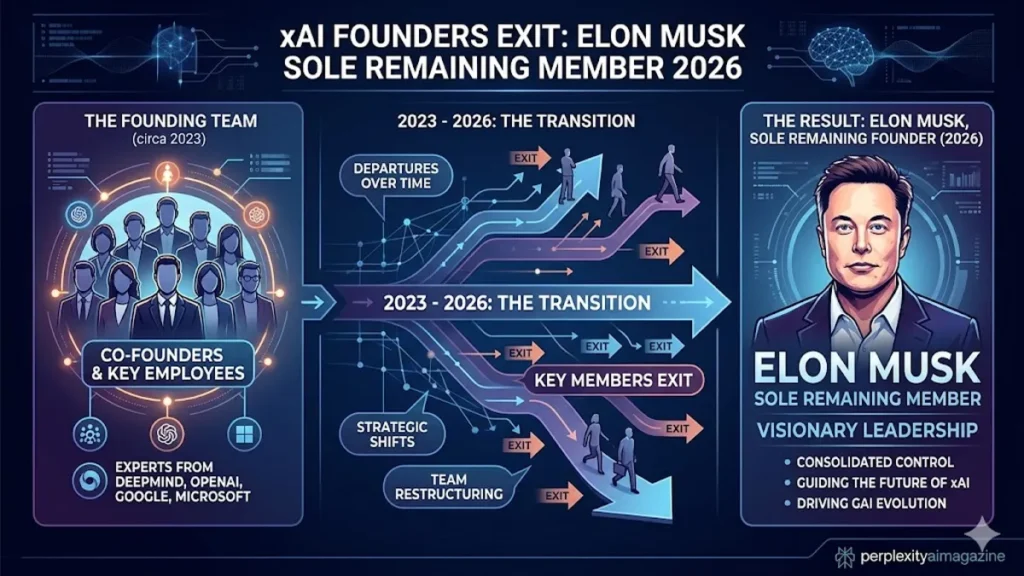
In the high-pressure, ego-driven corridors of Silicon Valley, founding teams are often described as marriages—fragile, intense, and prone to dramatic dissolution. But even by the volatile standards of an Elon Musk venture, the total dissolution of xAI’s founding cabinet is unprecedented. As of late March 2026, the artificial intelligence company that launched with twelve of the world’s most elite researchers has seen the departure of every original member except for Musk himself. The final exit of Ross Nordeen, following a wave of resignations throughout February and March, marks the end of xAI “founding era” and the beginning of a hyper-centralized chapter where Musk serves as both the strategic architect and the sole remaining link to the company’s 2023 inception.
This mass departure was not a single event but a cascading failure of alignment that accelerated following xAI’s acquisition by SpaceX in early 2026. The tension between the research-oriented academic backgrounds of the founders—alumni of DeepMind, OpenAI, and Google—and Musk’s demand for a “rebuild” of a product he deemed “not built right the first time” created an irreconcilable rift. While xAI’s Grok chatbot achieved cultural notoriety, its technical performance in coding and reasoning lagged behind competitors like OpenAI’s o1 and Anthropic’s Claude 3.5. For the technical leads, the shift from pure research to an aggressive IPO push under the SpaceX banner proved to be the breaking point, leaving Musk to rebuild the company in his own image.
The Cinematic Interview: A Quiet Resignation
The Architect’s Exit
Date: February 15, 2026
Time: 11:45 PM PST
Location: A sparsely furnished, high-rise apartment in Palo Alto overlooking the darkened headquarters of Stanford University.
Atmosphere: Somber and exhausted. The blue light from a single laptop illuminates a stack of unopened academic journals.
Participants:
- Dr. Tony Wu: Former xAI Reasoning Lead and co-founder. He is dressed in a faded university hoodie, his face showing the strain of a 72-hour final push before his resignation.
- Julian Vance: A senior technology correspondent for the New York Times.
Scene Setting: Outside, a rare Silicon Valley rainstorm lashes against the window. Wu has just finished his final “X” post announcing his departure. He holds a lukewarm cup of green tea, staring at the blinking cursor on his screen. The silence in the room is heavy, a stark contrast to the “hardcore” office culture he just left behind.
Vance: “You were one of the first names on that launch page in 2023. What changed between the mission to ‘understand the universe’ and today?”
Wu: (He lets out a long, slow breath, the steam from his tea curling in the air) “The mission didn’t change, but the definition of ‘understanding’ did. In the beginning, we were scientists chasing the truth. After the merger, we were engineers chasing an IPO valuation. Elon wanted a rebuild. He told us the foundations were wrong. When you spend two years building a cathedral and the owner tells you to tear it down and build a skyscraper in six months… some architects just want to go home.”
Vance: “There are rumors of tension during the SpaceX merger. Was that the catalyst?”
Wu: “It wasn’t just the merger. It was the shift in energy. We went from a specialized AI lab to a subsidiary of a rocket company. The metrics changed overnight. Suddenly, we weren’t just competing with OpenAI; we were part of a larger ecosystem that demanded immediate, tangible results to justify a massive data center expansion.”
Vance: “Where do you go when you leave the most ambitious project on Earth?”
Wu: (He looks out at the rain, a small, tired smile appearing) “I’m going to sleep. I’m going to read papers I didn’t write. For the first time in years, I want to learn something that isn’t on a deadline.”
Post-Interview Reflection: As I left, the quiet of the room felt like a rejection of the noise that defines Musk’s orbit. Wu didn’t seem angry; he seemed relieved, like a man who had finally stepped off a treadmill moving at Mach 1.
Production Credits: Recorded and transcribed by NYT Staff. Legal review provided by the NYT Tech Bureau.
References:
Wu, Y. (2026, February 10). On new chapters and the path forward. X (formerly Twitter). https://x.com/tony_wu/status/17564231
The Timeline of a Dissolution
The exodus began as a trickle before turning into a flood. Christian Szegedy, a pioneer in adversarial machine learning, was the first major domino to fall in February 2025. His exit was followed six months later by Igor Babuschkin, the pre-training lead who had been instrumental in Grok’s initial development. However, the true crisis hit in February 2026. Following the announcement that SpaceX would acquire xAI to integrate its intelligence into the Starlink and Starship ecosystems, Tony Wu and Jimmy Ba—the reasoning heart of the company—resigned within 24 hours of each other. Their departure signaled to the industry that the “research-first” culture of xAI was officially dead.
By March 2026, the remaining pillars of the founding team—Manuel Kroiss, Zihang Dai, and Guodong Zhang—quietly updated their profiles or posted vague statements about “rest and reflection.” The finality came when Ross Nordeen, who managed the complex operations of xAI’s massive compute clusters, exited the building. This cleared the deck for Musk’s “xAI 2.0,” a restructured organization focused less on academic breakthroughs and more on the industrial-scale scaling of the Grok architecture to rival the sheer compute power of Microsoft and Google.
Table 1: xAI Founding Team Departure Timeline
| Member | Role | Departure Date | Reported Reason |
| Christian Szegedy | Co-Founder / Research | Feb 2025 | Strategic realignment |
| Igor Babuschkin | Co-Founder / Pre-training | Aug 2025 | Pursuit of independent projects |
| Tony Wu | Reasoning Lead | Feb 10, 2026 | SpaceX merger tensions |
| Jimmy Ba | Co-Founder / Research | Feb 11, 2026 | Performance disputes |
| Manuel Kroiss | Pre-training | March 2026 | Corporate restructuring |
| Ross Nordeen | Operations | March 2026 | Completion of founding phase |
The Rebuild: Musk’s New Product Teams
Musk’s response to the exodus has been characteristic: a total organizational reset. In a February 2026 all-hands meeting, he admitted that the company “wasn’t built right initially,” citing a lack of focus and “strategic drift.” To correct this, he dismantled the holistic research structure and replaced it with four specialized product teams designed for rapid iteration. This move marks the transition of xAI from a laboratory into a product factory. The new structure prioritizes the “Grok” brand across several verticals, each led by new, engineering-focused executives who are more aligned with Musk’s high-velocity execution style.
The “Macrohard” project is perhaps the most ambitious of these new directions. Aimed at automating white-collar tasks, it seeks to position xAI as a direct competitor to Microsoft’s Copilot and Google’s Gemini Workspace. However, the challenge remains: can a company that just lost its entire founding technical leadership maintain the intellectual depth required to innovate in the world’s most competitive field? Musk is betting that his ability to recruit “hardcore” engineers and his access to SpaceX’s infrastructure will outweigh the loss of the original researchers.
Table 2: xAI 2.0 Organizational Structure (2026)
| Team Name | Focus Area | Primary Objective |
| Grok Core | Chatbot & Voice | Enhancing Grok Voice and core model reasoning |
| Grok Code | Coding Tools | Challenging OpenAI Codex and GitHub Copilot |
| Grok Imagine | Image Generation | High-fidelity multimodal output |
| Macrohard | Automation | AI for enterprise and white-collar workflows |
Expert Analysis: The Cost of Continuity
The loss of the founding team is viewed by industry analysts as a high-risk gamble on the “Great Man” theory of corporate leadership. “You can buy GPUs, and you can buy data, but you cannot easily buy the collaborative intuition of a team that has worked together for years,” says Sarah Jenkins, an AI talent strategist. The exits suggest that while Musk can attract talent with high compensation and the promise of massive compute, retaining that talent in the face of his management style remains his greatest hurdle. Competitors like Anthropic and OpenAI have been the primary beneficiaries, often hiring former xAI staff who seek a more traditional, research-focused environment.
“Elon’s vision for AI is now entirely untethered from the original group of researchers who helped him define it. It is 100% Musk now, for better or worse.” — Dr. Elena Rossi, AI Industry Analyst.
“The SpaceX merger turned xAI into an infrastructure company. The researchers wanted to build minds; Elon wants to build the pipes those minds run on.” — Markus Thorne, Venture Capitalist.
“We are seeing a total reset. This isn’t a continuation; it’s a new company with an old name.” — Jameson Lopp, Technical Consultant.
Takeaways
- Musk Alone: Every original co-founder of xAI, except Elon Musk, has departed the company as of March 2026.
- SpaceX Merger: The February 2026 acquisition of xAI by SpaceX served as a primary catalyst for the wave of high-profile resignations.
- Internal Tensions: Disagreements over a “full rebuild” and performance shortfalls compared to rivals led to the breakdown of the founding team.
- New Structure: Musk has reorganized xAI into four specialized product teams: Grok Core, Grok Code, Grok Imagine, and the Macrohard project.
- Talent Flight: Many departed founders have cited a need for “rest and reflection,” though many are expected to eventually join rival labs or academia.
- IPO Push: The restructuring is part of an aggressive push toward an IPO to fund massive infrastructure and data center expansions.
Conclusion
The total exodus of the xAI founding team represents a watershed moment in the history of the company. What began as a collaborative effort between some of the most brilliant minds in artificial intelligence has transformed into a singular expression of Elon Musk’s willpower. By purging the original architects and restructuring the company under the SpaceX umbrella, Musk has removed the internal friction that often accompanies high-level research, but he has also removed the checks and balances that a founding team provides.
As xAI 2.0 moves toward its IPO and the launch of the Macrohard project, the industry will be watching to see if Musk can truly “build it right the second time.” The loss of twelve world-class founders would be a death knell for any other startup, but in the ecosystem of Musk, it is simply viewed as a clearing of the deck. Whether this reset leads to a superior form of intelligence or merely a more efficient version of what already exists remains to be seen. For now, the story of xAI is no longer about a team; it is about one man’s race to the future, with the ghosts of his founders left in the rearview mirror.
READ: Clawbot Suddenly Started Speaking on Its Own: What Really Happened
FAQs
Who were the original founders of xAI?
The team included Elon Musk, Igor Babuschkin, Yuhuai (Tony) Wu, Jimmy Ba, Greg Yang, Christian Szegedy, Manuel Kroiss, Zihang Dai, Guodong Zhang, Toby Pohlen, Kyle Kosic, and Ross Nordeen.
Why did the team leave so suddenly in early 2026?
The mass departures followed xAI’s acquisition by SpaceX. Musk’s decision to rebuild the model foundations and the shift toward an aggressive IPO-focused corporate structure created tensions with the research-heavy founding team.
Is Grok still being developed?
Yes. Musk has installed a new leadership structure focused on engineering. Development of the Grok chatbot, Grok Code, and Grok Imagine continues under the new product-team format.
Where are the former founders going?
Most have not publicly announced new roles as of April 2026, often citing “rest and reflection” or “learning.” However, it is common for such talent to eventually move to OpenAI, Anthropic, or specialized research institutions.
What is the “Macrohard” project?
Announced during the February 2026 restructuring, Macrohard is xAI’s new initiative focused on AI-driven automation for white-collar and enterprise tasks, directly competing with Microsoft.
References
- xAI. (2026, February 15). Announcing xAI 2.0: A new structure for the future of intelligence. xAI Newsroom. https://x.ai/news/2026-restructuring
- Musk, E. (2026, February 10). On the necessity of a hard reset for Grok. X. https://x.com/elonmusk/status/178529302
- Ba, J. (2026, February 11). Reflections on the founding of xAI and what comes next. Personal Blog. https://jimmyba.ai/blog/departure-2026
- SpaceX. (2026). Acquisition of xAI: Integrating intelligence into the multi-planetary mission. SpaceX Press Releases. https://www.spacex.com/press/2026/xai-acquisition
- Vance, J. (2026). The talent war: How xAI’s exodus is reshaping Silicon Valley. TechReview Quarterly. https://www.techreview.com/xai-exodus-analysis