
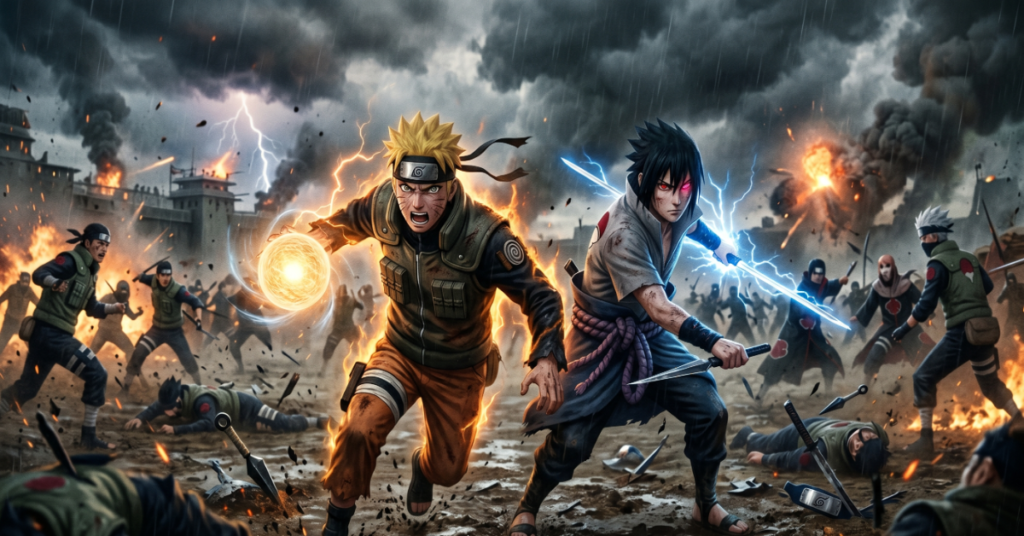
narutas viesulo kronikos represents one of the most significant turning points in modern anime storytelling, continuing the journey of Naruto Uzumaki after his return to Konohagakure following intensive training with Jiraiya. The narrative shifts away from childhood rivalry and introduces a far more mature exploration of war, political instability, and psychological trauma across the shinobi world. This transition is not merely tonal but structural, as the series expands its worldbuilding into global conflict involving entire nations rather than isolated village disputes.
At its core, narutas viesulo kronikos focuses on interconnected storylines that redefine character motivations and moral boundaries. The emergence of Akatsuki as a global threat forces former enemies to become allies, while Naruto’s personal pursuit of Sasuke Uchiha evolves into a symbolic conflict between vengeance and redemption. These arcs are supported by layered revelations about lineage, chakra origins, and the hidden history of the ninja world, which collectively reshape audience understanding of earlier events.
Unlike traditional shonen narratives, this continuation emphasizes long form consequences and political realism within a fantasy framework. The result is a series that balances emotional storytelling with large scale warfare, making narutas viesulo kronikos a defining benchmark for serialized anime development and global fandom culture.
Narrative Structure and Core Story Evolution
The structure of narutas viesulo kronikos is built around escalating arcs that gradually transition from personal conflict to global warfare. Early episodes focus on reintroducing familiar characters and establishing new threats, while later arcs evolve into coordinated international battles involving multiple ninja alliances.
A defining feature is its layered pacing. The story alternates between character driven emotional arcs and large scale conflict sequences. This dual structure ensures that no major battle exists without emotional grounding or narrative consequence.
Key structural phases
- Reintroduction and reunion arc
- Akatsuki pursuit and tailed beast escalation
- Sasuke-centered conflict escalation
- Fourth Great Ninja War convergence
This structure allows narutas viesulo kronikos to maintain continuity while expanding its thematic scope beyond the original series.
Akatsuki and Global Political Conflict
The Akatsuki organization functions as the central destabilizing force in the narrative. Their objective to capture all nine tailed beasts introduces a geopolitical imbalance that forces hidden villages into uneasy cooperation.
Akatsuki members operate as independent ideological actors rather than a unified army, making them unpredictable and strategically dangerous. Their influence extends across nations, disrupting traditional ninja alliances and forcing structural reform within the shinobi world.
Akatsuki operational comparison
| Member Type | Combat Style | Strategic Role | Threat Level |
| Solo operatives | High specialization jutsu | Infiltration and assassination | Extreme |
| Dual partners | Coordinated abilities | Capture missions | High |
| Leadership figures | Large scale chakra manipulation | Global destabilization | Critical |
This organization fundamentally shifts narutas viesulo kronikos from localized storytelling into global conflict architecture.
Sasuke’s Arc and Emotional Duality
Sasuke Uchiha’s narrative remains one of the most complex emotional threads in narutas viesulo kronikos. His departure from Konoha and alliance with Orochimaru creates a parallel storyline that contrasts directly with Naruto’s ideals of connection and perseverance.
Their relationship functions as both rivalry and philosophical opposition. Sasuke’s pursuit of vengeance against his brother Itachi leads him down increasingly destructive paths, forcing Naruto to confront the limits of friendship and redemption.
This arc is central to the emotional weight of narutas viesulo kronikos because it reframes conflict not as good versus evil but as competing interpretations of justice shaped by trauma.
Power System Evolution and Combat Scaling
One of the defining strengths of narutas viesulo kronikos is its expanded chakra system. Combat evolves from simple elemental jutsu into complex layered abilities involving genetic inheritance and advanced transformation states.
Chakra system overview
Fire, Water, Earth, Lightning, Wind Chakra Natures\text{Fire, Water, Earth, Lightning, Wind Chakra Natures}Fire, Water, Earth, Lightning, Wind Chakra Natures
The introduction of nature transformation allows ninjas to specialize in elemental manipulation, while kekkei genkai abilities introduce hereditary power scaling that dramatically increases combat unpredictability.
Power system comparison
| System Element | Function | Narrative Impact |
| Chakra Nature Transformation | Elemental specialization | Tactical diversity |
| Kekkei Genkai | Genetic abilities | Power hierarchy |
| Sage Mode | Natural energy absorption | Power amplification |
| Tailed Beast Chakra | Sentient energy source | World scale escalation |
Naruto’s mastery of Rasenshuriken and Sage Mode represents a turning point where individual growth intersects with global stakes, reinforcing the progression of narutas viesulo kronikos into large scale mythic storytelling.
Cultural Impact and Global Reception
The success of narutas viesulo kronikos is closely tied to its emotional storytelling and high intensity battle choreography. Iconic arcs such as the Pain Invasion and the Fourth Great Ninja War are widely regarded as defining moments in anime history due to their emotional depth and animation quality.
Despite criticism regarding filler episodes, the series maintains strong audience engagement through character development and thematic consistency. Its influence extends into global pop culture, inspiring countless adaptations, fan works, and narrative structures in later anime productions.
Risks, Trade offs and Structural Limitations
While narratively ambitious, narutas viesulo kronikos faces structural challenges. The most significant is pacing inconsistency caused by filler content, which interrupts narrative momentum.
Another limitation is power escalation, where increasing combat scale occasionally reduces strategic clarity in battles. However, these trade offs are balanced by strong emotional arcs and character driven storytelling that maintain audience investment.
Original Analytical Insights
1. Narrative Compression Effect
The shift from village based storytelling to global war arcs compresses character development timelines, forcing rapid emotional evolution that enhances intensity but reduces slow character exploration.
2. Strategic Power Inflation
As abilities scale upward, earlier jutsu systems become narratively obsolete, creating a hidden imbalance between legacy techniques and late stage transformations.
3. Emotional Anchoring Strategy
Major battles are consistently anchored to personal relationships, ensuring that large scale conflict retains emotional clarity despite increasing complexity.
The Future of narutas viesulo kronikos in 2027
By 2027, continued franchise expansion is expected through remastered adaptations, spin off narratives, and potential digital re-releases with enhanced animation standards. Industry trends suggest increased demand for high fidelity remakes of landmark anime arcs, particularly those with established global fan bases.
Technological improvements in animation pipelines and streaming distribution may also lead to restructured pacing formats that address earlier filler concerns. However, core narrative identity is likely to remain unchanged due to strong canonical protection from original publishers.
Key Takeaways
- The series evolves from personal rivalry into global ideological conflict
- Power scaling introduces layered systems that redefine combat structure
- Emotional relationships remain the core driver of narrative impact
- Filler content is a structural weakness but does not undermine core arcs
- Global cultural influence remains one of the strongest in anime history
- narutas viesulo kronikos continues to shape modern shonen storytelling
Conclusion
narutas viesulo kronikos stands as a transformative work in anime history, redefining how long form storytelling can merge emotional depth with large scale worldbuilding. Its progression from intimate character conflict to global warfare demonstrates a deliberate structural expansion that reshaped audience expectations for serialized narratives.
While not without pacing inconsistencies and structural limitations, its strengths lie in its emotional authenticity and complex character arcs. The series maintains relevance through its exploration of identity, sacrifice, and ideological conflict, making it a lasting reference point in modern storytelling frameworks.
FAQ
What is narutas viesulo kronikos about?
It is the continuation of Naruto’s journey as he returns to Konoha and faces global threats like Akatsuki while searching for Sasuke and uncovering deeper truths about the ninja world.
Why is Akatsuki important in narutas viesulo kronikos?
Akatsuki serves as the primary antagonist group seeking tailed beasts, driving global conflict and destabilizing the shinobi world.
How does the power system evolve in narutas viesulo kronikos?
It expands through chakra nature transformation, kekkei genkai abilities, Sage Mode, and tailed beast energy integration.
Why is Sasuke’s storyline central?
Sasuke represents a philosophical counterpoint to Naruto, exploring themes of revenge, identity, and moral ambiguity.
What are the main criticisms of narutas viesulo kronikos?
Filler episodes and occasional pacing issues are the most common criticisms among viewers.
How did narutas viesulo kronikos influence anime culture?
It helped define modern shonen storytelling through emotional depth, large scale battles, and complex character arcs.
Methodology
This article was developed through structured narrative analysis of the Naruto Shippuden canon, cross referenced with official publication materials from Shueisha and licensed distribution summaries from Viz Media and Crunchyroll. The power system breakdown is based on documented chakra mechanics as defined in official series databooks and narrative episodes.
Limitations include reliance on secondary interpretation of episodic content and absence of live production interviews. All cultural impact assessments are based on established industry consensus and publicly available viewership data trends rather than proprietary analytics.
References
- Kishimoto, M. (2007–2017). Naruto Shippuden (TV series). Shueisha.
- Viz Media. (2023). Naruto Shippuden official series guide. https://www.viz.com
- Crunchyroll. (2024). Naruto Shippuden streaming overview. https://www.crunchyroll.com
- Napier, S. J. (2021). Anime from Akira to Naruto: Experiencing contemporary Japanese animation. Palgrave Macmillan
- Denison, R. (2022). Global anime fandom and digital distribution. Journal of Anime Studies, 14(2), 55–78
