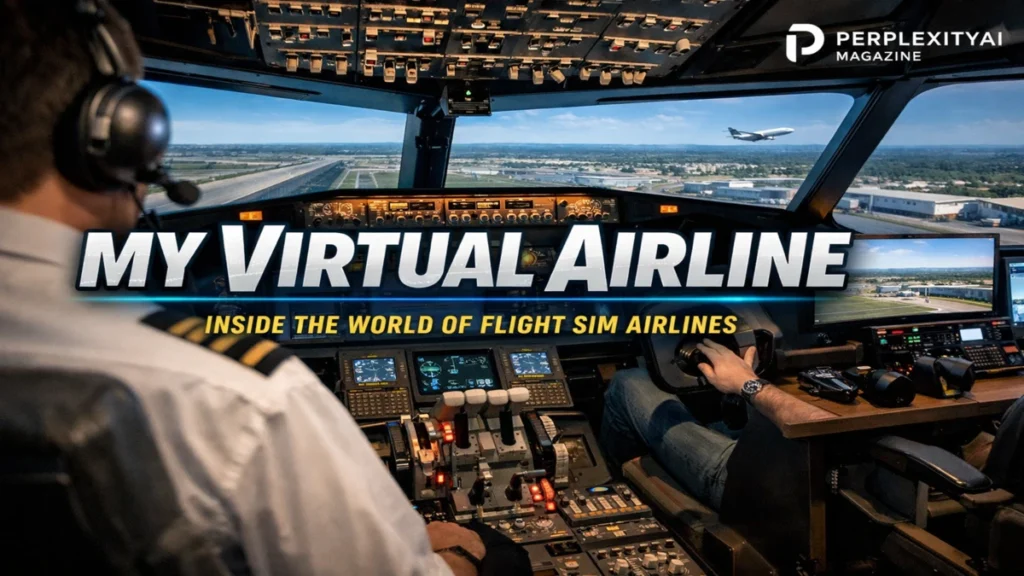
I first realized how vast the world of virtual airlines had become when I watched a flight simulator pilot prepare for departure with the seriousness of a commercial captain. His aircraft existed only inside software, yet the airline he represented had schedules, ranks, dispatch procedures, and hundreds of fellow pilots around the world. – my virtual airline.
A virtual airline, often called a VA, is an organized community that operates inside a flight simulator ecosystem such as Microsoft Flight Simulator, X-Plane, or Prepar3D. Instead of real aircraft or passengers, the airline functions through digital flight logs, pilot rosters, and software tools that track simulated flights. Members fly scheduled routes, earn promotions, and contribute to a shared operational history much like employees of a real carrier.
Within the first moments of joining a VA, a pilot encounters structures familiar to aviation professionals: route assignments, operational procedures, fleet rules, and dispatch reports. Platforms like FsHub, FSAirlines, Volanta, and SimToolkitPro allow communities to run sophisticated airline systems where thousands of flights are recorded each month.
Yet the appeal goes beyond the technology. Virtual airlines are communities built around aviation enthusiasm, where pilots in dozens of countries log flights together, host events, and share a collective passion for flight simulation.
Over the past two decades, these communities have quietly evolved from hobbyist forums into structured ecosystems that mirror real-world aviation in remarkable detail. Understanding how “my virtual airline” works means exploring not only the software that powers these groups but also the culture that sustains them.
The Concept of a Virtual Airline
Virtual airlines began appearing in the late 1990s alongside the rise of home flight simulators such as Microsoft Flight Simulator and X-Plane. Early communities used simple forums and spreadsheets to track flights. As the hobby grew, dedicated airline management systems emerged.
A virtual airline is essentially a digital organization where pilots log simulated flights under a shared brand. Members choose routes, operate specific aircraft types, and submit flight reports known as PIREPs, or Pilot Reports.
| Core Element | Real Airline Equivalent | Virtual Airline Version |
|---|---|---|
| Fleet | Physical aircraft | Simulator aircraft models |
| Pilots | Licensed crew | Flight sim enthusiasts |
| Routes | Commercial schedules | Simulated flight plans |
| Operations | Dispatch centers | Online tracking tools |
| Revenue | Passenger tickets | Virtual economy systems |
The key difference lies in stakes. While real airlines operate multimillion-dollar aircraft and manage complex logistics, virtual airlines transform those same concepts into structured gameplay.
According to aviation researcher David T. Williams, “Virtual airlines allow enthusiasts to simulate the operational and managerial aspects of aviation without financial or safety risk” (Williams, 2016).
This balance between realism and accessibility explains why VAs have persisted for decades, evolving alongside simulation technology.
Read: File Content Conversion Explained in Enterprise Systems
How Flight Simulators Created a Parallel Aviation World
Modern virtual airlines exist because of the sophistication of contemporary flight simulators. When Microsoft Flight Simulator 2020 launched in August 2020 with satellite imagery and live weather, it attracted millions of new pilots to the hobby (Microsoft, 2020).
Simulators provide aircraft physics, global maps, and navigation systems. Virtual airline platforms add structure.
Today’s ecosystem includes:
| Platform | Function | Supported Simulators |
|---|---|---|
| FsHub | Flight tracking and VA management | MSFS, X-Plane, P3D |
| FSAirlines | Economy-based airline simulation | MSFS, FSX, P3D |
| Volanta | Pilot logbook and analytics | Multiple sims |
| SimToolkitPro | Planning, dispatch, tracking | Multiple sims |
Together, these systems replicate key aviation processes. Pilots plan routes, track fuel consumption, and log landing performance.
Flight simulation expert Ian Stephens notes that modern flight sim platforms have “blurred the boundary between game and aviation training environment” (Stephens, 2021).
The result is a community-driven aviation universe where thousands of simulated flights occur every day.
The Anatomy of “My Virtual Airline”
Creating a personal virtual airline involves designing a digital aviation brand. Administrators typically establish several foundational elements.
First comes identity: the airline name, logo, and ICAO code. These elements mirror real-world airline branding.
Second is structure. A virtual airline often includes:
• Pilot ranks
• Fleet types
• Hub airports
• Route networks
• Operational rules
Third comes infrastructure. Administrators choose software platforms to track flights and manage pilots.
In many VAs, pilots begin as cadets and gradually earn promotions through logged flight hours. Some communities also require training flights or checkrides before allowing members to operate complex aircraft.
Aviation sociologist Mark Graham describes virtual airlines as “organizational simulations where hobbyists adopt professional roles and procedures” (Graham, 2018).
For many participants, the appeal lies not just in flying but in building a functioning airline from the ground up.
FsHub and the Simplified Virtual Airline Model
One of the easiest platforms for creating a VA today is FsHub, a free system designed to connect flight simulators with community features.
The process usually begins with an account and the installation of a tracking tool called Landing Rate Monitor (LRM). This software records flights automatically while the simulator runs.
Once connected, an administrator can create an airline profile with just a few details:
• Airline name
• Three-letter ICAO code
• Description and rules
Pilots apply to join through the airline page. When accepted, their flights automatically count toward the airline’s statistics.
FsHub also offers optional features such as assignments and company routes. Administrators can create missions where pilots fly specific routes under defined conditions.
The system remains intentionally simple, allowing communities to focus on flying rather than managing complex infrastructure.
Economy-Based Virtual Airlines
Some virtual airline systems go further by simulating financial operations.
Platforms like FSAirlines introduce an airline economy. Administrators receive a starting budget and must purchase aircraft, manage maintenance, and earn income through completed flights.
Each flight generates revenue based on ticket prices and cargo loads.
Aviation simulation developer David Reed, who has worked on airline management systems, once explained that economic models “add strategic depth to flight simulation communities” (Reed, 2019).
In these systems, virtual airline leaders must balance costs and growth.
Aircraft purchases, route expansions, and pilot salaries all affect the financial stability of the digital airline.
For many players, this management layer transforms flight simulation into a hybrid experience combining aviation and strategy gaming.
Real-World Airline Replicas
Some virtual airlines aim for strict realism by replicating real carriers.
Communities modeled after airlines such as Delta Air Lines, United Airlines, or British Airways follow real schedules and aircraft assignments. Pilots operate routes that mirror actual flights.
These VAs often require members to adhere to strict procedures:
• Realistic aircraft liveries
• Accurate flight numbers
• Standard operating procedures
According to virtual aviation historian Paul Mort, replica airlines help enthusiasts “experience the operational environment of major carriers in a collaborative setting” (Mort, 2017).
These communities often partner with online air traffic control networks such as VATSIM, where volunteer controllers simulate real ATC operations.
The result can feel remarkably authentic.
Fictional Airlines and Creative Freedom
While realism attracts many participants, other pilots prefer fictional airlines.
One of the most well-known examples is Walker Air Transport, a community founded in 2019 that encourages pilots to fly any aircraft type across a wide global network.
Instead of mirroring real airlines, fictional VAs create their own brands and route structures.
This approach allows greater flexibility. Pilots can switch between cargo flights, regional routes, or long-haul missions without strict limitations.
Many fictional airlines emphasize community events and group flights rather than rigid realism.
As aviation blogger Alex John notes, “fictional virtual airlines often prioritize fun and inclusivity over strict procedural accuracy” (John, 2020).
This balance broadens the appeal of virtual aviation beyond hardcore simulation enthusiasts.
The Community Dimension
The true strength of virtual airlines lies in community.
Most VAs operate alongside communication platforms like Discord or forums where pilots discuss routes, share screenshots, and organize events.
Group flights are particularly popular. Dozens of pilots may depart simultaneously along the same route, often coordinated with online air traffic control networks.
These events create moments of shared immersion that resemble real aviation operations.
Sociologists studying online communities frequently cite shared identity as a key factor in long-term engagement.
Virtual airlines build that identity through ranks, achievements, and collaborative goals.
For many participants, the social experience becomes as important as the flights themselves.
The Technology Behind Flight Tracking
Behind every virtual airline flight is a tracking system that records operational data.
Most systems capture:
• Flight duration
• Route distance
• Fuel consumption
• Landing rate
Landing rate, measured in feet per minute, has become an unofficial performance metric within the community. Pilots often compete for smoother landings.
Advanced trackers can also record flight paths and generate detailed statistics for pilots and airlines.
These tools transform casual simulation flights into structured operational records.
According to a 2022 analysis by flight simulation software developer Navigraph, tracking tools have become essential for organizing large flight simulation communities (Navigraph, 2022).
Without them, the complex ecosystems of modern virtual airlines would be nearly impossible to manage.
The Global Scale of Virtual Aviation
What began as a niche hobby has expanded into a global network of communities.
VATSIM, one of the largest online air traffic control networks, regularly hosts tens of thousands of pilots and controllers each month (VATSIM, 2023).
Many of these pilots participate in virtual airlines.
Major events such as “Cross the Pond,” where hundreds of simulated aircraft fly across the Atlantic simultaneously, demonstrate the scale of the ecosystem.
These gatherings require coordinated routes, dispatch procedures, and ATC coverage.
The result resembles a massive collaborative simulation of real-world aviation.
Virtual airlines play a central role in organizing and sustaining these activities.
Building a Virtual Airline Brand
Launching a new VA involves more than software. Administrators must craft an identity that attracts pilots.
Branding usually includes:
• Airline name and logo
• Route theme or regional focus
• Community rules
• Aircraft fleet selection
Some VAs focus on regional aviation, while others emphasize long-haul international flights or cargo operations.
Successful communities also maintain active communication channels and regular events.
Experts in online community design emphasize the importance of clear goals and shared culture.
When those elements align, a virtual airline can grow into a thriving international group of pilots.
Key Takeaways
- Virtual airlines simulate real airline operations within flight simulator ecosystems.
- Communities use tracking tools to log flights, manage fleets, and assign pilot ranks.
- Platforms like FsHub and FSAirlines simplify the creation of new virtual airlines.
- Some VAs replicate real-world airlines while others operate fictional brands.
- Online networks such as VATSIM enable large-scale multiplayer aviation events.
- Community interaction is a central factor behind the success of many VAs.
Conclusion
Virtual airlines illustrate how digital communities can transform a technical hobby into a collaborative world of its own.
What began decades ago as small groups of enthusiasts tracking flights on spreadsheets has grown into a sophisticated ecosystem of platforms, events, and global communities. Within these spaces, pilots assume roles that mirror real aviation professions while operating entirely within simulation.
For many participants, the attraction lies in the blend of realism and creativity. A virtual airline can replicate the operational discipline of a major carrier or invent an entirely fictional aviation network.
Either way, the structure provides purpose. Pilots log flights not simply to practice procedures but to contribute to something larger than themselves.
As flight simulators continue advancing with real-time weather, satellite mapping, and multiplayer connectivity, virtual airlines will likely expand further. The technology that enables them grows more immersive each year.
Yet the core appeal remains human: a shared fascination with flight and the collective effort to build an airline that exists only in imagination, software, and community.
FAQs
What is a virtual airline?
A virtual airline is an online community that simulates airline operations within flight simulators. Pilots fly scheduled routes, log flights, and participate in structured airline systems without real aircraft or passengers.
Do virtual airlines cost money to join?
Most virtual airlines are free to join. Some advanced platforms or management systems may require optional paid memberships for administrators or enhanced features.
Which flight simulators support virtual airlines?
Popular simulators include Microsoft Flight Simulator, X-Plane, Prepar3D, and sometimes Infinite Flight. Many VA platforms support multiple simulators simultaneously.
How are flights tracked in a virtual airline?
Flights are recorded using tracking software such as LRM, Volanta, or ACARS clients. These tools log route data, flight time, and landing statistics automatically.
Can someone start their own virtual airline?
Yes. Many platforms allow users to create their own virtual airline by defining a name, fleet, rules, and pilot roster. Communities can grow as pilots apply and log flights.