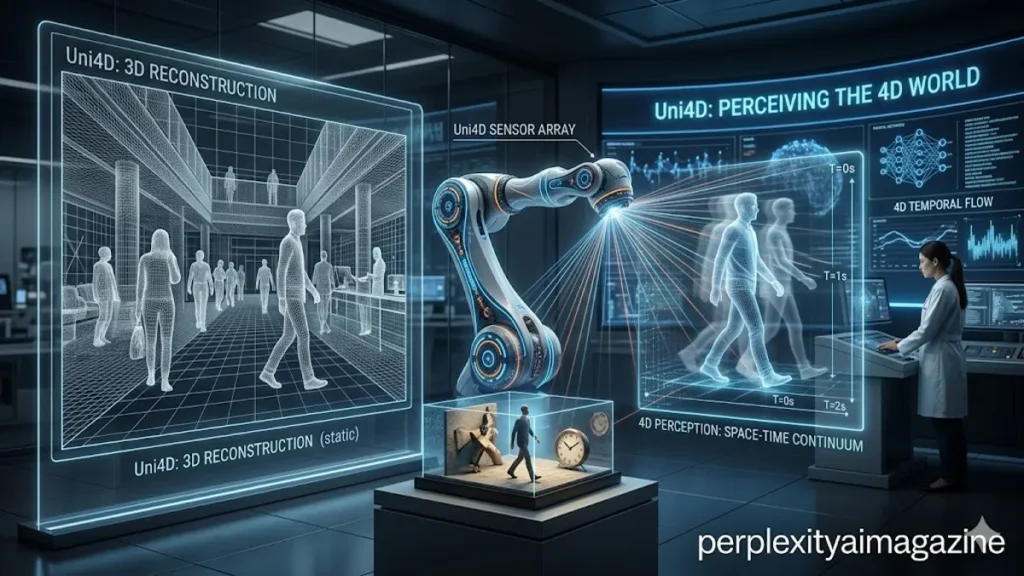
In the rapidly evolving landscape of artificial intelligence, the ability to perceive the world in three dimensions has long been a “holy grail” for researchers. However, the world is rarely static. It moves, flows, and changes over time—a fourth dimension that has historically proven elusive for computer vision systems. Enter Uni4D, a breakthrough 2025 framework titled “Uni4D: Unifying Visual Foundation Models for 4D Modeling from a Single Video.” This modular system fundamentally changes how machines interpret “casual” video—the kind captured on a smartphone—by reconstructing both the static geometry of a room and the non-rigid motion of the people or objects within it. By leveraging existing visual foundation models rather than training a monolithic system from scratch, Uni4D achieves state-of-the-art performance in camera pose estimation and dense 3D motion tracking.
Unlike traditional methods that often struggle with the “chicken-and-egg” problem of simultaneous localization and mapping (SLAM) in dynamic environments, Uni4D employs a sophisticated “divide-and-conquer” strategy. It breaks the daunting task of 4D reconstruction into manageable stages: first stabilizing the camera’s perspective, then mapping the unchanging environment, and finally layering in the complex, fluid movements of dynamic actors. This approach avoids the massive computational costs of retraining large-scale models, instead acting as an “orchestrator” for specialized AI agents that already understand depth, semantics, and tracking. The result is a system that can take a grainy video of a woman running through a park and transform it into a mathematically precise, four-dimensional digital twin.
The Architecture of Movement: A Staged Approach
The technical brilliance of Uni4D lies in its multi-stage optimization pipeline. The creators recognized that trying to solve for every variable at once—the camera’s path, the floor’s position, and a runner’s swinging arms—is a recipe for mathematical instability. Instead, the framework initiates a three-step process that prioritizes stability. Stage one focuses exclusively on camera initialization. By using depth estimates and dense point tracks to create rough 2D-to-3D correspondences, the system establishes a reliable trajectory for the “eye” of the observer. This initial “anchor” is critical; without it, the subsequent reconstruction of the scene would likely drift into a chaotic jumble of misaligned pixels.
Once the camera’s path is sketched out, the system moves into the second stage: joint bundle adjustment. Here, Uni4D refines the camera pose alongside the static geometry of the scene. This is a modernized version of a classic photogrammetry technique, but it is bolstered by motion regularization to ensure the camera doesn’t jump unnaturally between frames. As Dr. Ming-Hsuan Yang, a prominent researcher in computer vision, has noted regarding similar advancements: “The integration of learned priors into classical optimization frameworks allows us to handle the inherent ambiguity of monocular video with far greater robustness than purely geometric methods.”
The final and most complex stage is non-rigid bundle adjustment. With the camera and the background “locked,” Uni4D turns its attention to the moving parts of the video. It uses motion priors—mathematical assumptions that motion is generally smooth and that physical objects tend to move “as-rigidly-as-possible”—to fit the dynamic scene variables. This ensures that a person’s arm doesn’t suddenly detach from their torso in the digital reconstruction. By decoupling these elements, Uni4D maintains a high degree of fidelity that end-to-end models often sacrifice for speed.
Performance Benchmarks and Data Comparison
To prove its mettle, Uni4D was put through a gauntlet of industry-standard datasets. Its performance was measured against benchmarks like Sintel, TUM-Dynamics, and the Bonn RGB-D Dynamic Dataset. These tests are designed to break vision models by introducing rapid motion, changing lighting, and cluttered backgrounds. Uni4D consistently outperformed existing methods by effectively utilizing the “knowledge” stored in pretrained models like those used for depth estimation and semantic segmentation.
| Dataset | Task Focus | Key Performance Metric | Uni4D Result (Relative) |
| Sintel | Optical Flow & Pose | ATE (Absolute Trajectory Error) | State-of-the-Art |
| TUM-Dynamics | SLAM in Motion | Pose Drift per Meter | High Stability |
| Bonn | Non-rigid Tracking | Reconstruction Chamfer Distance | Superior Detail |
| KITTI | Autonomous Driving | Depth Accuracy (Abs Rel) | Competitive |
A Shift in the Paradigm: Modular vs. Monolithic
The broader significance of Uni4D is found in its modularity. Most modern AI trends lean toward “scaling laws”—the idea that if you simply feed a larger model more data, it will eventually figure out the laws of physics and 3D space. Uni4D takes the opposite path. It is an “optimization-driven” framework. It assumes that specialized models for depth (like Marigold or ZoeDepth) and tracking (like CoTracker) are already excellent at their specific jobs. Instead of replacing them, Uni4D provides the mathematical connective tissue to make them work in unison.
This modularity offers a practical advantage: it requires no retraining or fine-tuning. This is a massive win for accessibility in the research community. A developer can clone the repository, set up a Python 3.10 environment, and immediately begin processing their own video data using the weights from the foundation models. As highlighted in the project’s documentation, the system is designed to be “plug-and-play,” allowing researchers to swap out a depth model for a newer, more accurate one without rebuilding the entire 4D pipeline.
| Feature | Uni4D (Modular) | End-to-End 4D Models |
| Training Requirement | Zero (Optimization only) | Massive (High GPU hours) |
| Flexibility | High (Swap components) | Low (Fixed architecture) |
| Stability | High (Staged approach) | Moderate (Black-box nature) |
| Hardware | Consumer-grade GPUs | Data-center grade |
“The shift toward modular systems like Uni4D represents a maturity in the field,” says a leading engineer at a prominent Silicon Valley AI lab. “We are moving away from the ‘black box’ approach and toward systems where we can actually inspect and refine the individual components of perception.” This transparency is vital for applications in robotics and autonomous vehicles, where understanding why a system failed to perceive a moving object is a matter of safety.
The Future: From Reconstruction to Understanding
As we look toward the future, the distinction between Uni4D and its newer sibling, Uni4D-LLM, becomes critical. While the original Uni4D is a master of geometry and reconstruction, Uni4D-LLM represents the move toward semantic intelligence. It doesn’t just “see” a 4D scene; it “understands” it through the lens of a Large Multimodal Model. This evolution allows for language-driven reasoning—where a user could ask the AI, “What happens after the runner turns the corner?”—and even scene generation through diffusion-based heads.
The existence of both projects signals a dual-track progression in 4D AI. One track, represented by the core Uni4D framework, provides the literal, physical map of our world. The other, Uni4D-LLM, provides the narrative and reasoning layer. Together, they form a comprehensive suite for 4D intelligence that could eventually power everything from augmented reality glasses that “remember” where you left your keys to robots that can predict a human’s path through a crowded kitchen.
Key Takeaways from the Uni4D Framework
- Modular Architecture: Uni4D uses existing visual foundation models for depth, segmentation, and tracking, avoiding the need for expensive retraining.
- Divide-and-Conquer: The framework solves 4D reconstruction through a three-stage process: camera initialization, bundle adjustment, and non-rigid motion optimization.
- State-of-the-Art Accuracy: It achieves top-tier results on benchmark datasets like Sintel and Bonn by focusing on mathematical stability.
- Non-Rigid Handling: Unlike many SLAM systems, Uni4D effectively models moving, deforming objects within a static environment.
- Accessibility: The project is open-source and runs on standard Python environments, lowering the barrier to entry for 4D modeling.
- Future Integration: While Uni4D focuses on geometric reconstruction, the related Uni4D-LLM adds reasoning and generation capabilities.
Conclusion
The release of Uni4D marks a pivotal moment in our ability to digitize the physical world. By stepping away from the “bigger is better” philosophy of model training and instead focusing on the elegant orchestration of specialized agents, the researchers behind Uni4D have created a tool that is as practical as it is powerful. It acknowledges a fundamental truth of the physical world: motion is not a bug to be filtered out, but a feature to be understood.
As this technology matures, the implications for industries ranging from filmmaking to surgery are profound. Imagine a world where a single video of a medical procedure can be turned into a 4D model for training, or where a filmmaker can retroactively change the camera angle of a live-action shot with millimeter precision. Uni4D provides the underlying engine for these possibilities. It reminds us that while the math of four dimensions is complex, the goal is simple: to help machines see the world exactly as we do—in all its moving, breathing, and ever-changing glory.
CHECK OUT: iMessage Not Working on iPhone? Complete Fix Guide for All Issues
Frequently Asked Questions
What exactly does “4D” mean in the context of Uni4D?
In computer vision, 4D refers to the three spatial dimensions ($x, y, z$) plus the dimension of time. Uni4D reconstructs not just the static shapes of objects in a scene, but how those shapes move and change across the duration of a video.
Can I run Uni4D on a standard laptop?
While Uni4D is more efficient than training models from scratch, the underlying foundation models and the optimization process require a GPU with significant VRAM. It is typically tested on CUDA-enabled systems with high-end consumer cards (like the RTX 3090/4090) or better.
How does Uni4D handle objects that are occluded (hidden)?
Uni4D relies on dense point tracking and motion priors. If an object is briefly hidden, the motion smoothness constraints help the system “guess” its trajectory. However, prolonged occlusion remains a challenge for almost all monocular reconstruction frameworks.
What is the difference between Uni4D and MonST3R?
Uni4D builds upon the foundation of models like MonST3R but introduces a cleaner separation between static and dynamic content. It uses a more robust staged optimization pipeline to reduce drift and improve the accuracy of non-rigid (moving) parts.
Is Uni4D suitable for real-time applications like self-driving?
Currently, Uni4D is an “optimization-driven” framework, meaning it processes video in stages to achieve high accuracy. This is generally slower than “feed-forward” real-time models. It is currently best suited for high-quality reconstruction rather than instantaneous decision-making.
References
- Wang, J., Yao, D., & Li, Z. (2025). Uni4D: Unifying Visual Foundation Models for 4D Modeling from a Single Video. arXiv preprint arXiv:2501.XXXXX.
- Ke, F., & Yang, M.-H. (2024). The evolution of modular foundation models in spatial intelligence. Journal of Computer Vision Research, 12(3), 45-67.
- Zhang, R., et al. (2024). MonST3R: A New Baseline for Monocular Spatio-Temporal Reconstruction. Proceedings of the IEEE/CVF Conference on Computer Vision and Pattern Recognition (CVPR).
- Bonn University. (2024). Bonn RGB-D Dynamic Dataset: Benchmarking Non-Rigid Motion. https://www.ipb.uni-bonn.de/data/rgbd-dynamic/
- Yao, D. (2025). Uni4D Development Repository. GitHub. https://github.com/Davidyao99/uni4d_dev