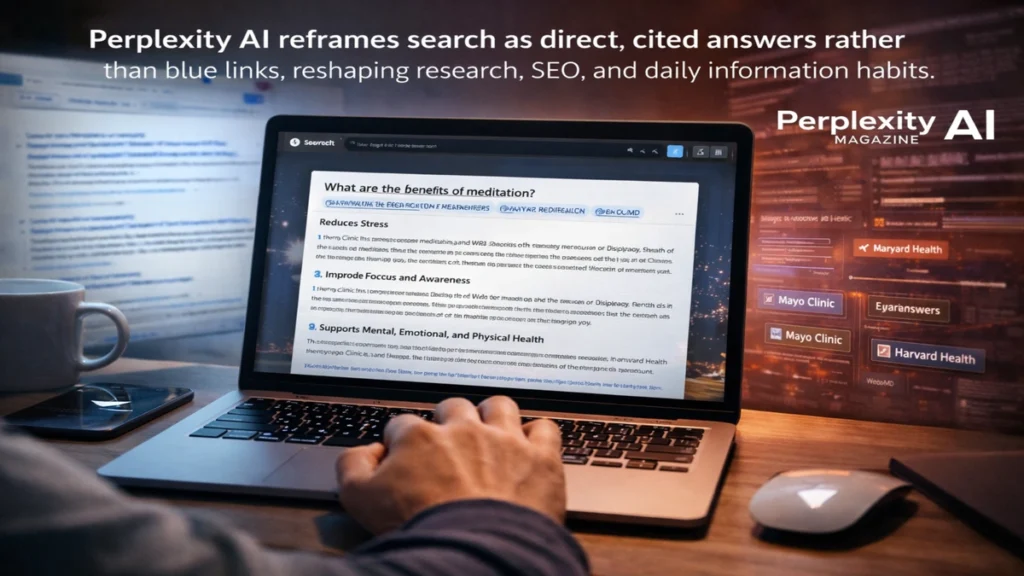
When people search for “perplexity search engine,” they are rarely looking for a definition alone. They want to know whether this new, AI-native approach to search can genuinely replace or outperform traditional engines like Google. They want to understand how it works, why it feels different, and whether its answers can be trusted. In short, they are asking whether search itself is changing.
Perplexity AI entered the public conversation as an answer engine rather than a directory of the web. Instead of presenting users with a ranked list of links and ads, it responds with concise, conversational summaries supported by citations. The goal is not to send users elsewhere, but to resolve their question as directly as possible. This model appeals to researchers, students, developers, and professionals who are tired of tab overload and fragmented information.
Within the first moments of using Perplexity, the shift is clear. Questions are asked in natural language. Responses arrive as synthesized explanations that pull from multiple sources at once. Links still matter, but they are supporting evidence rather than the main event. For many users, this feels closer to consulting a knowledgeable assistant than operating a search engine.
At the same time, Perplexity does not exist in a vacuum. It competes with deeply entrenched systems, especially Google, which dominates global search and offers an ecosystem of maps, shopping, video, and local services. Understanding Perplexity therefore requires more than feature lists. It requires examining how search intent, trust, advertising, and verification are evolving in an AI-driven web.
What the Perplexity Search Engine Is
Perplexity is an AI-native search engine developed by Perplexity AI. It combines large language models with real-time web search to generate direct answers to user queries. Unlike traditional engines, it does not treat links as the primary output. Instead, it synthesizes information from multiple sources into a single response, then cites those sources inline or at the end.
Under the hood, Perplexity relies on a mix of external and proprietary models, including GPT-4 class systems, Claude, Gemini, and its own Sonar models. These models are not used in isolation. They are grounded by live web retrieval, which helps ensure answers reflect current information rather than static training data.
This hybrid approach addresses one of the central criticisms of generative AI: hallucination. By anchoring responses in verifiable sources, Perplexity aims to preserve the reliability of traditional search while improving speed and clarity. Users can click through citations to check original material, maintaining a path to primary sources.
The result is a tool that positions itself as an answer engine rather than a navigation engine. It assumes users want resolution first and exploration second.
Read: Comet AI Browser Explained: Smart Search, Automation, and Risks
Why People Search for Perplexity
Interest in Perplexity has grown alongside frustration with conventional search experiences. Many users report that search result pages feel cluttered, ad-heavy, and increasingly optimized for transactions rather than understanding. Perplexity’s clean interface and ad-light experience stand in contrast.
Another driver is the rise of complex, multi-part questions. Whether learning a new programming language, researching health topics, or comparing technologies, users often need synthesized explanations rather than isolated facts. Perplexity is designed for this depth, offering follow-up questions and conversational refinement without restarting the search. – perplexity search engine.
Content creators and SEO professionals also search for Perplexity to understand how AI-driven search affects visibility. As answer engines reduce clicks, traditional ranking strategies face disruption. Understanding how Perplexity sources and cites content has become part of modern search strategy discussions.
How Perplexity Presents Results
The most visible difference between Perplexity and traditional search engines is presentation. Instead of a search engine results page, users see a single, structured answer.
Result Presentation Comparison
| Feature | Perplexity | Traditional Search |
|---|---|---|
| Primary output | Synthesized answer | List of links |
| Citations | Inline or grouped | Indirect via ranking |
| Ads | Minimal in core search | Prominent |
| Follow-up | Conversational | New query required |
This structure reduces friction. Users spend less time scanning and more time understanding. It also shifts responsibility. Because the answer is synthesized, users may attribute more authority to it. This makes transparent citation critical.
Perplexity Versus Google
Comparisons between Perplexity and Google are inevitable. Google remains the default gateway to the web for billions of users, offering unmatched breadth and integration with services like Maps, YouTube, and Shopping. Its strength lies in discovery, local intent, and commercial queries.
Perplexity, by contrast, focuses on comprehension. It excels when users want an explanation, a comparison, or a concise overview grounded in sources. Many power users now treat Perplexity as an answer layer and Google as an index and services layer.
Core Differences in Use
| Task | Better with Perplexity | Better with Google |
|---|---|---|
| Deep research | Yes | Sometimes |
| Learning concepts | Yes | Moderate |
| Local businesses | No | Yes |
| Shopping and ads | No | Yes |
| Maps and media | No | Yes |
As search fragments into specialized tools, this division of labor may become more common rather than competitive.
Transparency and Citations
One of Perplexity’s defining features is its emphasis on citations. Each answer is supported by links to source material, allowing users to verify claims. This transparency appeals to academics, journalists, and professionals who need traceable information.
Media scholar Ethan Mollick has noted that citation-backed AI answers represent a meaningful step toward trustable AI systems, because they preserve the ability to audit claims. This design choice also aligns with educational norms, where sources matter as much as conclusions.
By contrast, AI summaries in traditional search often lack clear attribution. While the underlying results still exist, the summary itself can feel opaque. Perplexity’s insistence on visible sources differentiates it in an increasingly crowded AI search landscape.
Deep Research and Advanced Modes
Perplexity offers advanced research modes designed for longer, more complex investigations. These modes expand the number of sources consulted and produce structured reports rather than brief answers. For users conducting literature reviews, market research, or technical comparisons, this feature reduces manual aggregation.
This capability positions Perplexity closer to a research assistant than a quick-answer tool. It also reinforces its appeal among professionals who need synthesis rather than speed alone.
AI researcher Andrej Karpathy has remarked that tools which combine retrieval, reasoning, and synthesis represent the next stage of knowledge work. Perplexity’s Deep Research features fit squarely within this vision.
Ads, Monetization, and User Experience
Perplexity’s core search experience remains largely ad-free. This is not an accident. By prioritizing answers over clicks, the platform de-emphasizes advertising as the organizing principle of search.
This choice affects user trust. Without sponsored placements at the top of results, users perceive answers as less commercially biased. At the same time, it raises questions about sustainability. Perplexity has explored subscriptions and premium features as alternative revenue models.
The contrast with ad-driven search highlights a philosophical divide. One model optimizes for attention and transactions. The other optimizes for resolution and clarity.
SEO and Content Strategy Implications
For publishers and marketers, Perplexity changes the incentives of search visibility. Ranking is no longer about being first on a page, but about being cited in an answer. This rewards clarity, authority, and factual reliability.
Content that is well-structured, sourceable, and focused on answering specific questions is more likely to be surfaced. Clickbait and thin content are less useful to an answer engine.
SEO strategist Lily Ray has argued that AI search favors expertise over optimization tricks. In this environment, content quality becomes a prerequisite rather than an advantage.
Limitations and Criticisms
Despite its strengths, Perplexity is not a universal replacement for traditional search. It lacks robust support for local intent, visual discovery, and transactional workflows. Users looking for nearby restaurants, images, or real-time events often return to Google.
There is also the risk of over-trust. Because answers are concise and confident, users may accept them without checking sources. While citations are present, they require active engagement.
Finally, Perplexity’s reliance on external models and web sources means it inherits their biases and limitations. Transparency mitigates this, but does not eliminate it.
Takeaways
• Perplexity reframes search as direct answers rather than link navigation
• Citations are central to its trust model
• It excels at research, learning, and complex questions
• Google remains stronger for local, visual, and transactional search
• SEO strategies must adapt to answer-first discovery
• Users benefit most when verification habits remain strong
Conclusion
The rise of the Perplexity search engine reflects a deeper shift in how people want to interact with information. As the web grows noisier, the demand for clarity increases. Perplexity responds by placing synthesis, citation, and conversation at the center of search.
It does not replace the web. It reframes access to it. For many users, especially those engaged in learning and research, this reframing feels overdue. At the same time, Perplexity’s limitations remind us that no single tool can satisfy every form of intent.
The future of search is unlikely to belong to one engine alone. Instead, it will be shaped by a constellation of tools, each optimized for different needs. In that ecosystem, Perplexity stands as a clear signal that answers, not links, are becoming the currency of understanding.
Frequently Asked Questions
Is Perplexity a replacement for Google?
No. It complements Google by focusing on answers and research rather than discovery and services.
Does Perplexity show sources?
Yes. Most answers include clear citations linking to original sources.
Is Perplexity free to use?
Yes, with optional paid features for advanced research and capabilities.
What makes Perplexity different from chatbots?
It grounds answers in real-time web search and citations, not just model knowledge.
Who benefits most from Perplexity?
Students, researchers, developers, and professionals seeking fast, verified explanations.