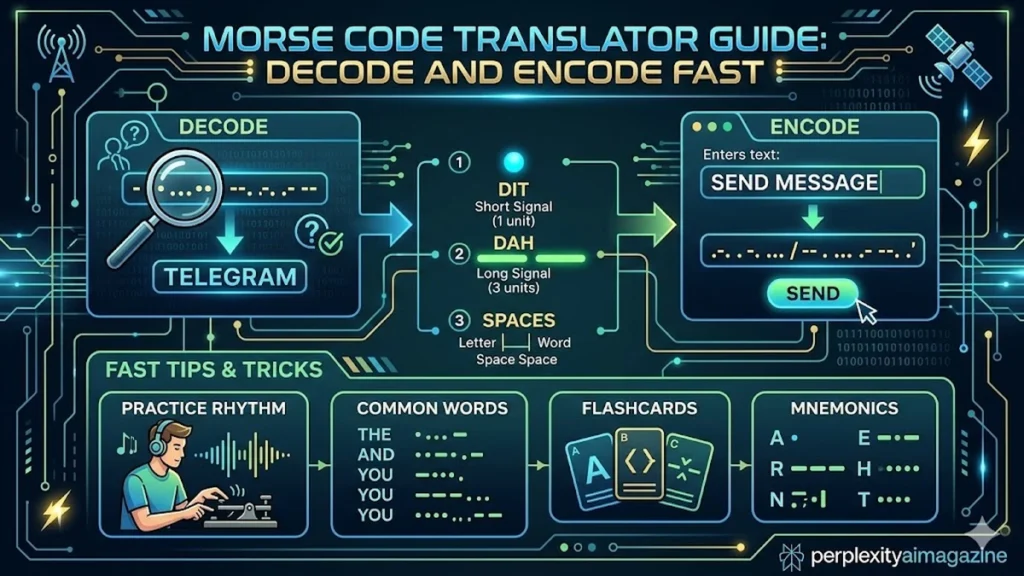
If you are looking for a Morse code translator, the process is straightforward. Type your message into a web tool and it instantly converts letters and numbers into dots and dashes. Paste Morse code back into the same tool and it decodes the symbols into readable text. Most platforms also let you play the message as beeps, flash it as light or download it as an audio file for sharing or study.
I have always been struck by how something invented in the 1830s feels so native to the browser era. Morse code reduces language to timing: short signals called dots and longer signals called dashes. A dot lasts one unit of time, a dash lasts three. Spaces separate letters and longer pauses separate words. That rhythmic structure, once carried by telegraph wires, now moves effortlessly through speakers, phone vibrations and digital interfaces. Online translators have revived Morse not as a relic but as a practical skill for students, amateur radio operators and curious learners. What began as a telegraph breakthrough has evolved into a widely accessible digital utility, proving that the simplest communication systems often endure the longest.
The Origins of Morse Code
Morse code was developed in the 1830s by Samuel F. B. Morse, a portrait painter who turned his attention to electromagnetism after learning about recent scientific advances during a sea voyage. By 1835 to 1837, he had built early telegraph prototypes. His original system used numbers and a dictionary lookup, but it soon evolved into a direct letter-based code.
Alfred Vail, Morse’s assistant, played a crucial role in refining the system in 1838. Working at his family’s ironworks, Vail simplified the code into the efficient dot-and-dash structure that operators could recognize by sound. Frequent letters such as E were assigned shorter signals, making transmission faster and more practical. By 1840, Morse secured a patent for the telegraph system. In 1844, Congress funded a line between Washington and Baltimore. On May 24 of that year, Morse sent the first public message: “What hath God wrought!”
Telegraph networks expanded rapidly. By 1854, more than 23,000 miles of telegraph lines stretched across the United States, transforming communication and commerce.
Read: Steal a Brainrot Unblocked Strategy Guide
International vs. American Morse Code
Two primary Morse systems emerged during the 19th century: American Morse and International Morse. American Morse, sometimes called Railroad Morse, was developed first. It included variable-length dashes and internal spaces within characters. While effective on early mechanical telegraphs, it was more complex and prone to ambiguity over long distances.
International Morse Code, standardized in 1851, simplified the system. Dashes were set at a uniform length of three units, and characters no longer included internal spacing irregularities. The streamlined structure made International Morse easier to transmit accurately over radio and across national borders. By 1912, international agreements mandated its use for radio communication. American Morse gradually faded from mainstream use, lingering mainly in railroad systems and historical reenactments.
Today, International Morse Code is the global standard used in aviation, amateur radio and emergency signaling. Most online translators default to this version while occasionally offering an option to switch to American Morse for historical reference.
Understanding the Structure of Morse Code
Morse code is best understood through timing rather than symbols alone. A dot represents one unit of time. A dash represents three units. The silence between elements within a character equals one unit. The silence between letters equals three units. The silence between words equals seven units.
This structure creates rhythm. The famous distress signal “SOS” is written as … — …, but it is the distinct timing pattern that makes it recognizable even in noisy conditions.
Below is a reference chart for common letters and numbers in International Morse Code.
Letters A–M
| Letter | Morse | Letter | Morse |
|---|---|---|---|
| A | .- | H | …. |
| B | -… | I | .. |
| C | -.-. | J | .— |
| D | -.. | K | -.- |
| E | . | L | .-.. |
| F | ..-. | M | — |
| G | –. |
Letters N–Z
| Letter | Morse | Letter | Morse |
|---|---|---|---|
| N | -. | V | …- |
| O | — | W | .– |
| P | .–. | X | -..- |
| Q | –.- | Y | -.– |
| R | .-. | Z | –.. |
| S | … | ||
| T | – |
Numbers 0–9
| Number | Morse |
|---|---|
| 0 | —– |
| 1 | .—- |
| 2 | ..— |
| 3 | …– |
| 4 | ….- |
| 5 | ….. |
| 6 | -…. |
| 7 | –… |
| 8 | —.. |
| 9 | —-. |
These standardized patterns allow translators to function reliably across languages and platforms.
How Online Morse Code Translators Work
Modern Morse code translators perform two core tasks: encoding and decoding. Encoding converts plain text into dot-and-dash sequences. Decoding reverses the process. Many web tools support both directions instantly.
Most translators also provide audio playback. Users can adjust speed, typically measured in words per minute, and modify tone frequency. Light-flash simulations mimic visual signaling. Some tools allow downloading the generated audio file as an MP3 or WAV format.
Advanced translators incorporate artificial intelligence for audio decoding. Users can upload recordings, and the tool analyzes tone frequency, filters background noise and estimates transmission speed before converting the pattern into text. Confidence scores may accompany the output, indicating potential inaccuracies when recordings are distorted.
Copy-and-paste functionality simplifies sharing. A student can translate a message, copy the Morse sequence and paste it into a classroom project within seconds.
Basic Usage Steps
Using a Morse translator effectively requires proper formatting. To encode text, type a word such as “HELLO.” The output becomes “…. . .-.. .-.. —.” Letters are separated by spaces.
To decode Morse input, ensure spacing follows standard rules. Separate letters with spaces and words with a slash. For example, “…. . .-.. .-.. — / .– — .-. .-.. -..” translates to “HELLO WORLD.”
When practicing, begin at a slower speed and gradually increase the words-per-minute setting. Adjusting tone frequency can improve clarity, especially when using headphones.
Most tools handle A–Z letters, numbers and common punctuation marks. However, formatting errors are common. A missing space between letters can cause decoding confusion.
Decoding Morse From Audio Recordings
Audio decoding presents unique challenges. When recordings are clear and transmitted at steady speed, automated tools can analyze the beeps and convert them into text. These platforms detect tone frequencies, adapt to speeds ranging from five to 60 words per minute and filter noise.
If the audio quality is poor, manual decoding may be more accurate. Start by slowing playback using a media player with speed control. Mark short beeps as dots and long beeps as dashes. Identify pauses to separate letters and words. Cross-reference the pattern with a Morse chart.
Headphones improve tone isolation. Audio editing software can amplify faint signals before decoding. Mobile apps such as GGMorse offer real-time decoding for practice and convenience.
Accuracy depends on rhythm consistency. Even small variations in timing can alter interpretation, which is why patience remains essential when working with imperfect recordings.
Prosigns and Abbreviations in Morse Communication
Morse code developed a vocabulary of prosigns and abbreviations to speed communication. Prosigns are procedural signals sent without spaces between letters. They control message flow.
| Prosign | Meaning | Usage |
|---|---|---|
| AR | End of message | Signals completion |
| BT | Break | Separates text |
| CQ | Calling any station | General broadcast |
| KN | Go only to specific station | Invites reply |
| R | Received | Acknowledgment |
| SK | End of contact | Conversation close |
| K | Go ahead | Open reply |
Common abbreviations reduce frequent phrases. “73” means best regards. “88” conveys affection. “QTH” refers to location. “TNX” means thanks. “UR” stands for your or you are.
Use prosigns as a single uninterrupted unit. Abbreviations follow normal spacing. Translators often support these conventions automatically.
The Continuing Relevance of Morse Code
Although Morse code no longer dominates global communication, it persists in aviation identifiers, amateur radio and emergency contexts. Its simplicity and resilience make it valuable when digital systems fail.
In amateur radio communities, Morse remains a respected skill. Even after licensing requirements relaxed in many countries, enthusiasts continue to practice and compete in high-speed transmission.
Educators also use Morse as a teaching tool for rhythm recognition and signal processing. The code’s binary simplicity introduces fundamental principles of encoding, timing and noise filtering, concepts central to modern digital communication.
Online translators bridge historical and contemporary use. They make experimentation easy and preserve access to a system that once transformed global society.
Practical Tips for Accurate Translation
Use International Morse for most applications. Verify spacing when decoding typed sequences. Slow playback speed when learning and increase gradually. Use headphones for audio clarity.
If decoding fails, double-check for missing spaces or inconsistent timing. For advanced decoding, enhance audio signals before uploading them to a tool.
Practice with simple words first. Consistency improves recognition faster than speed drills alone.
Takeaways
- Morse code translates language into timed dots and dashes.
- Online translators instantly encode and decode text and audio.
- International Morse Code is the modern global standard.
- Proper spacing is critical for accurate decoding.
- Audio decoding tools analyze tone frequency and speed.
- Prosigns and abbreviations accelerate communication.
- Morse remains relevant in radio, aviation and emergency signaling.
Conclusion
Morse code has traveled from telegraph wires to touchscreen browsers without losing its core identity. Its structure is elegant: time divided into units, signals separated by silence, meaning carried in rhythm. Online Morse code translators have not replaced that structure. They have amplified it, making experimentation accessible to anyone with an internet connection.
I find something grounding in that continuity. The same pattern that once clicked through copper wires now hums through laptop speakers. Students decode “SOS” for the first time, hobbyists practice call signs, and educators demonstrate how communication can be reduced to pulses. In an age of instant messaging and fiber optics, Morse code reminds us that clarity does not depend on complexity. Sometimes it depends on learning to listen.
FAQs
What is a Morse code translator?
It is a digital tool that converts text into Morse code and decodes Morse symbols back into readable language.
How do I separate words in Morse?
Use a slash between words and spaces between letters when typing Morse into a translator.
Which Morse system should I use?
International Morse Code is the standard for modern use.
Can translators decode audio recordings?
Yes. Many tools analyze uploaded audio files and convert detected signals into text.
Why is Morse code still used?
It remains valuable in amateur radio, aviation identifiers and emergency signaling because of its simplicity and reliability.