I have used Perplexity AI every single day for the better part of a year. In that time I have watched colleagues switch from Google to Perplexity within a week of trying it, seen students cut their research time in half, and watched business professionals discover that the tool they thought was just a fancier search engine is actually something much more capable than that. I have also watched most of those same people use about twenty percent of what Perplexity can do — which is why this guide exists.
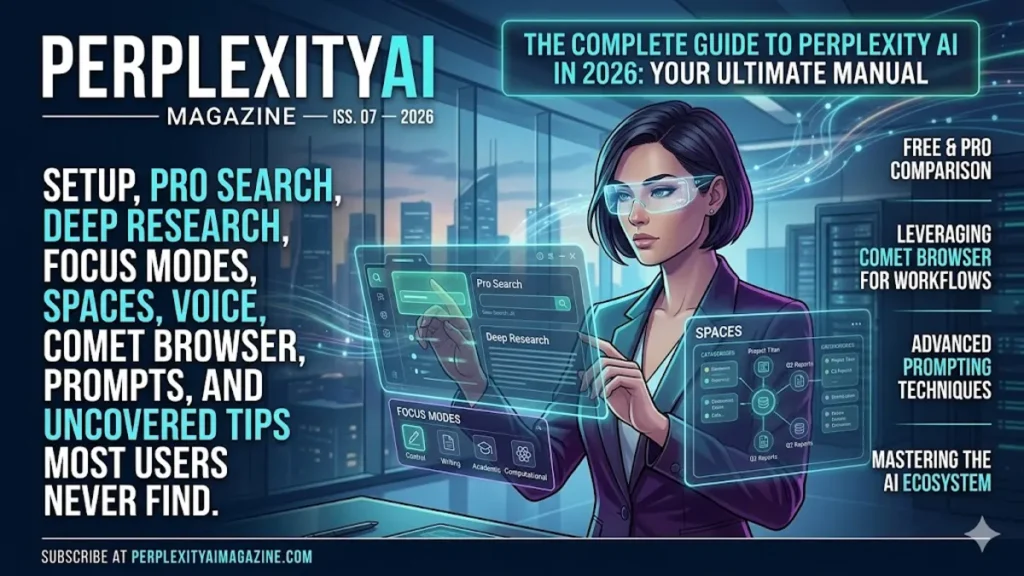
This is the most complete walkthrough of Perplexity AI I know how to write. It starts from zero — what Perplexity is and how to set it up — and works through every feature that matters, including the ones most people never find. By the end you will understand not just how to run a search but how to use Pro Search, Deep Research, Focus modes, Spaces, Collections, voice input, file uploads, and the Comet browser. You will also have a set of prompt strategies that consistently produce better results than the default approach most users take.
Whether you are on the free plan or considering Pro, this guide covers both. Every feature is marked clearly so you know what requires a paid subscription and what is available to everyone.
What Is Perplexity AI and Why Does It Matter in 2026
Perplexity AI is an answer engine — a system that combines real-time web search with large language models to produce cited, structured answers rather than a list of links. When you ask it a question, it searches the live web in real time, identifies the most relevant and authoritative sources, and synthesises those sources into a direct answer with numbered citations you can verify by tapping or clicking.
That last part is what separates Perplexity from most of what came before it. Google returns links and expects you to read them. ChatGPT generates answers from its training data without always knowing what happened last week. Perplexity searches the current web and shows you exactly where every claim came from, in real time, every time.
The scale at which people are choosing this approach in 2026 is significant. Perplexity processes over 780 million queries per month across 238 countries, with estimates suggesting that figure is approaching 1.2 to 1.5 billion by mid-2026. It has over 45 million active users, a valuation of $20 billion, and partnerships with Snap, Mozilla, SK Telecom, and Airtel. It is not a niche research tool anymore. It is the fastest-growing search platform of the current decade.
The practical reason this matters is simple: if you spend any meaningful amount of time finding, verifying, or synthesising information — for work, study, writing, or curiosity — Perplexity AI will make that process materially faster and more reliable than the alternatives. That is the case this guide makes, feature by feature.
| Feature | What It Does | Available On |
|---|---|---|
| Standard Search | Real-time web search with cited answers | Free + Pro + Max |
| Pro Search | Multi-step deep search — breaks query into sub-questions | Limited free / Unlimited Pro |
| Deep Research | Multi-source synthesis producing long-form research reports | Limited free / Full Pro + Max |
| Focus Modes | Direct search to Academic, Reddit, YouTube, News, or Wolfram | Free + Pro + Max |
| Spaces | Persistent project workspaces with custom AI instructions | Limited free / Full Pro |
| Collections | Save and organise searches into topic folders | Free + Pro + Max |
| File Upload | Analyse PDFs, Word docs, Excel, PowerPoint, images | Limited free / Full Pro |
| Voice Search | Speak queries — works on web and mobile app | Free + Pro + Max |
| AI Model Selection | Choose GPT-5.2, Claude, Gemini or Sonar models | Pro + Max only |
| Model Council | Runs query across 3 AI models simultaneously | Max only ($200/mo) |
| Perplexity Pages | Convert research threads into shareable formatted articles | Free + Pro + Max |
| Comet Browser | Full AI browser with in-tab assistant | Free separate app |
| Perplexity Labs | Build dashboards, spreadsheets, and tools from prompts | Pro + Max |
| API Access | Integrate Perplexity into your own applications | Pro ($5 monthly credit) |
Perplexity AI feature overview as of April 2026. Free plan: $0. Pro: $20/month or $200/year. Max: $200/month.
How to Set Up Perplexity AI: Step by Step
Setting up Perplexity takes about three minutes from zero to first search. Here is the complete process.
Step 1 — Go to perplexity.ai
Open your browser and go to perplexity.ai. You do not need to create an account to run your first search — the interface is available immediately. However, signing in unlocks your search history, saved Collections, Spaces, and cross-device sync. For anything beyond casual one-off searches, signing in is worth the thirty seconds it takes.
Step 2 — Create your account
Click Sign Up in the top right corner. You can sign up with Google, Apple, or email. Google and Apple sign-up complete in one click with no additional form. Email sign-up requires an address and password. After signing in you will land on the main search interface immediately — there is no onboarding flow to navigate through.
Step 3 — Download the app if you use mobile
Perplexity AI has a native app for both iPhone and Android. Search “Perplexity AI” in your app store — the developer is Perplexity AI Inc. Requires iOS 17.0 or later on iPhone. The app carries the full feature set including voice search, Spaces, Deep Research, and library sync. Everything you do on the web and in the app stays synchronised as long as you are signed into the same account.
Step 4 — Understand the interface
The web interface has a large search bar at the centre of the screen. Below the search bar you will see options to toggle features before you submit your query — Focus mode, Pro Search, file attachment, and voice input. The left sidebar (on desktop) shows your search history, Spaces you have created, and the Discover feed. Getting familiar with these before your first search saves time later.
How to Run Your First Search
Click or tap the search bar and type your question. The most important thing to understand about how Perplexity works is that it responds to questions, not keywords. The difference in results between these two approaches is significant.
Keyword approach — the way most people still think about search — looks like this: “best project management tools 2026.” You get a reasonable answer, but Perplexity is treating it as a broad query and returning a general roundup.
Question approach looks like this: “What are the best project management tools for a remote engineering team of fifteen people, and how do they compare on pricing, Jira integration, and mobile experience?” Perplexity breaks this into components, retrieves relevant sources for each part, and returns a structured answer that addresses all three dimensions with citations for pricing claims and feature comparisons.
The more specific your question, the better the answer. This is not a limitation to work around — it is the core design principle of the platform. Specificity is what separates a useful Perplexity session from one that feels like a slightly better Google search.
After the answer loads, you will see numbered superscripts throughout the text — these are your citations. Every claim with a citation number links to the original source. Click or tap any number to open that source directly. Below the main answer you will see suggested follow-up questions generated specifically for your query, and you can type your own follow-up in the same thread. The full context of your original question is maintained throughout the conversation.
How to Use Pro Search
Pro Search is the feature that turns Perplexity from a fast search tool into a genuine research assistant. When you activate it, Perplexity does not answer your question in a single pass. It breaks the question into sub-queries, runs separate searches for each component, cross-references the results, and synthesises a significantly more thorough and structured response.
The practical difference is most visible on complex, multi-part questions. A standard search on “compare the pricing, features, and accuracy of Perplexity Pro vs ChatGPT Plus” will return a reasonable overview. Pro Search on the same question will produce a structured breakdown with separate sections for pricing, feature-by-feature comparison, and accuracy evidence — each with citations specific to that dimension.
To activate Pro Search, look for the Pro toggle below the search bar before submitting your query. Switch it on and then type or speak your question. The processing takes 20 to 90 seconds depending on complexity. Pro Search users on the free plan receive five Pro Searches per day. Pro subscribers get 300 per day, which is more than enough for any research-intensive workflow.
The questions where Pro Search consistently adds the most value are those that require information from multiple domains — comparisons across products, questions about cause-and-effect across different fields, research topics that need both recent data and historical context, and any question where you would normally open five or more browser tabs to get a satisfying answer.
How to Use Deep Research
Deep Research is Perplexity’s most powerful feature for serious research tasks and the one most users discover last. Where Pro Search runs a deeper single query, Deep Research runs a full multi-stage research process — it searches, reads, cross-references, and iterates across dozens of sources before producing a structured long-form report.
The output is qualitatively different from anything a standard or Pro Search produces. You receive a formatted research report — with sections, subsections, tables where relevant, and a dense citation list — that on complex topics would have taken hours to compile manually. I have used it to produce competitive landscape analyses, technical explainers, literature summaries, and market research reports, and in each case the result was accurate, well-sourced, and genuinely useful as a working document rather than a starting point for further research.
To use Deep Research, click the plus icon or the feature selector below the search bar and choose Deep Research from the options. Submit your question. The interface will show a progress indicator as Perplexity works through the research process — this typically takes one to three minutes on complex topics. When complete, the report appears as a structured thread.
Deep Research works best on questions with enough scope to warrant depth. It is not the right tool for quick factual lookups — use standard search for those. Use Deep Research for anything where you would normally say “I need to do proper research on this” — competitive analysis, academic topic overviews, investment due diligence starting points, technical architecture decisions, and detailed how-to guidance on complex processes.
Deep Research is available on Pro and Max plans. Free users get a limited number of Deep Research queries per month.
| Use Case | Example Query | Why Deep Research Wins Here |
|---|---|---|
| Competitive analysis | “Analyse the competitive landscape of AI coding tools in 2026 — market share, pricing, developer adoption, key differentiators” | Requires data from multiple sources across pricing, reviews, and market data |
| Academic overview | “Summarise the current state of research on large language model hallucinations — causes, measurement methods, and mitigation strategies” | Needs synthesis across academic papers, technical blogs, and benchmark reports |
| Investment research | “What are the key financial metrics, growth trajectory, and risk factors for Perplexity AI as of early 2026?” | Pulls from multiple financial sources, news, and company announcements |
| Technical architecture | “Compare the architectural approaches of RAG vs fine-tuning for enterprise AI search — tradeoffs, cost, and current best practices” | Complex technical topic requiring synthesis across research papers and practitioner experience |
| Market research | “What does the current research say about consumer adoption of AI tools by profession and age group in 2026?” | Requires aggregation across multiple research reports and data sources |
Deep Research is overkill for simple factual questions. Use it when the answer genuinely requires synthesising multiple complex sources.
How to Use Focus Modes
Focus modes tell Perplexity which part of the web to search rather than searching everything. This single setting makes a larger difference to result quality than most users realise, particularly for research tasks where source type matters.
To select a Focus mode, click the globe or source icon below the search bar before submitting. A panel appears with the available modes. Here is what each one does and when to use it.
Web (default)
Searches the full web across all source types. Correct for most general questions where you want the broadest possible coverage. This is the default and the right choice when you have no strong reason to narrow the source type.
Academic
Prioritises peer-reviewed papers, research publications, university repositories, and academic sources. The single most underused Focus mode. If you are researching any factual claim, medical topic, scientific question, or subject where evidence quality matters, Academic Focus consistently returns more reliable citations than Web Focus on the same query. Students writing research papers, academics checking literature, journalists fact-checking — this is the mode you want.
YouTube
Searches YouTube and summarises video content. Perplexity retrieves transcripts and generates summaries without requiring you to watch the video. Useful for finding tutorial content, product reviews, explainers, and conference talks. Ask “What does [expert name] say about [topic] in their recent talk?” and YouTube Focus will find and summarise the relevant video.
Surfaces discussions, community opinions, and real user experience from Reddit threads. This is consistently the best Focus mode for product recommendations, experience-based questions, and any topic where you want genuine practitioner opinion rather than publisher-optimised content. “What do developers actually think about [tool]?” in Reddit Focus returns a materially more honest answer than Web Focus on the same question.
News
Prioritises recent articles from established news publications. Best for current events, company announcements, regulatory changes, and any topic where recency is the primary requirement. If you are tracking a developing story, News Focus keeps results current.
Wolfram Alpha
Routes the query through Wolfram Alpha’s computational engine. Best for mathematical calculations, scientific data, statistical lookups, unit conversions, and quantitative analysis. If the question involves numbers, formulas, or data, Wolfram Focus returns more precise and reliable results than a general web search.
How to Use Spaces
Spaces are persistent research environments — project workspaces that keep all your related threads organised in one place, maintain context across multiple sessions, and allow you to give Perplexity specific instructions that apply to every search within that Space.
I consider Spaces the feature that separates casual Perplexity users from power users. Without Spaces, Perplexity is a very good search tool. With Spaces, it becomes a sustained research system where knowledge accumulates over time rather than disappearing between sessions.
To create a Space, click Spaces in the left sidebar on desktop or the Spaces tab on mobile. Click the New Space button. Give it a name that reflects the project — “Q2 Competitor Research,” “Thesis Literature Review,” “Product Launch Planning.” You can also write a description and set custom AI instructions for that Space.
Custom AI instructions are one of the most powerful and least-used Perplexity features. When you set instructions for a Space, Perplexity applies them to every search you run inside it. Examples that make a real difference:
- “Always cite academic sources where available. Prioritise peer-reviewed research over news articles.”
- “When comparing products, always include a structured comparison table with pricing, key features, and limitations.”
- “Keep all responses concise. Use bullet points rather than paragraphs where possible.”
- “This Space is for competitive analysis. Always include market positioning and pricing data where relevant.”
Once a Space is set up, every search you run inside it is saved to that Space automatically. You can also upload documents to a Space — PDFs, research papers, reports — and Perplexity will reference them in future queries within that Space. Upload a competitor’s annual report and then ask “what does this report say about their AI strategy?” — Perplexity reads the document and answers from it directly.
Spaces also support team collaboration on Pro and Max plans. Invite colleagues, share threads, and build a collective knowledge base that persists across the project lifecycle.
How to Use Collections
Collections are Perplexity’s save-and-organise system. Any search thread can be saved to a Collection — a named folder you create around a topic, project, or recurring research need. Where Spaces are active research environments you work within, Collections are your personal research archive.
To save a thread to a Collection, click the bookmark icon on any completed search. Choose an existing Collection or create a new one. Collections build up over time into a searchable library of your research history organised by topic rather than chronologically.
The practical use case that makes Collections genuinely valuable is ongoing research over weeks or months. If you are researching a purchase decision, tracking a developing news story, studying a topic systematically, or preparing for something months in advance — saving related searches to a Collection means nothing gets lost between sessions and your research history is organised in a way that is actually retrievable.
How to Upload Files and Analyse Documents
Perplexity supports file uploads directly within the search interface. You can upload PDFs, Word documents, Excel spreadsheets, PowerPoint files, images, and code files — and then ask questions about their content in the same thread.
To upload a file, click the paperclip or attachment icon in the search bar before submitting your query. Select your file from your device. Once uploaded, type your question referencing the document. The file does not need to be named in your question — Perplexity understands you are asking about the uploaded content.
Queries that work particularly well with file uploads:
- “Summarise the key arguments and conclusions in this paper.”
- “What are all the dates and deadlines mentioned in this document?”
- “Compare the methodology in this report with standard industry practice.”
- “Extract all the pricing information from this document and present it in a table.”
- “What questions does this report leave unanswered?”
For sustained document analysis, upload the file to a Space rather than a one-off thread. This makes the document available for multiple queries across sessions without re-uploading each time. A Space with your key reference documents uploaded is a particularly effective setup for research projects, legal review, academic writing, and competitive intelligence work.
File upload is available on free accounts with limits on file size. Pro subscribers get expanded access including larger files and more uploads per session.
How to Use Voice Search
Voice search in Perplexity is a genuine input method, not a transcription shortcut. You speak your question in natural language, Perplexity processes it, and returns the same cited structured answer as a typed query. It works on both the web interface and the mobile app.
On desktop, click the microphone icon in the search bar. Speak your question clearly. Perplexity submits it automatically after a brief pause. On mobile, the same microphone icon is available in the search bar. Voice input is particularly useful for longer, more naturally phrased questions — spoken questions tend to include more context than typed ones, and that context consistently improves result quality.
Three scenarios where voice search adds the most practical value: when your hands are occupied, when your question is long and complex and typing it would be slow, and when you want to ask a follow-up question in an ongoing thread while doing something else. The voice input works on thread follow-ups as well — you do not need to return to the main search bar to speak a continuation of the conversation.
How to Use Perplexity AI on Mobile
The Perplexity AI mobile app carries the full feature set — standard search, Pro Search, Deep Research, Focus modes, Spaces, Collections, file upload, voice search, and the Library. It syncs completely with the web version, so threads started on desktop continue on mobile without any manual transfer.
The mobile interface is organised into four tabs at the bottom: Home (new searches and recent threads), Discover (trending research topics), Spaces, and Library. Voice search is particularly natural on mobile — tap the microphone and speak your question rather than typing on a small keyboard, and the quality of input is often better than desktop voice because of how naturally people phrase spoken questions in a mobile context.
Read: How to Use Perplexity AI on iPhone: The Complete 2026 Guide
How to Use the Comet Browser
Comet is Perplexity’s standalone AI browser — a full web browser available for iPhone (launched March 18, 2026), Android, Mac, and Windows, with Perplexity’s answer engine built directly into the browsing experience rather than sitting alongside it as a separate tab.
The functional difference from using Perplexity as a search tool is that in Comet, the AI knows what you are currently browsing and can engage with it directly. Ask Comet to summarise the article you are reading without copying the text anywhere. Ask it to compare prices on a product page across other sites and return a summary. Ask it to research the attendees of a meeting you have open in your calendar and prepare questions — all within the browser, without switching apps.
Comet is a free separate download from the App Store and Google Play. It was originally priced at $200 per month when it launched on desktop, but is now free on all platforms. Pro and Max subscription features are available as in-app purchases. For users who spend significant time browsing and researching simultaneously, Comet is the most efficient way to use Perplexity — the AI is present in every browsing session rather than requiring a tab switch to access.
Perplexity AI Pricing: Free vs Pro vs Max
| Plan | Cost | Pro Search | Deep Research | AI Models | Best For |
|---|---|---|---|---|---|
| Free | $0 | 5/day | Limited/month | Sonar default | Casual daily search |
| Pro | $20/mo or $200/yr | 300/day | Full access | GPT-5.2, Claude, Gemini | Researchers, professionals, daily power users |
| Max | $200/mo | Unlimited | Priority access | All models + priority | Enterprises, Model Council users, teams |
| Enterprise | $40/seat/mo | Unlimited | Full access | All models | Teams requiring data privacy guarantees |
Perplexity AI pricing as of April 2026. Annual Pro plan saves approximately 17% vs monthly. Student discount available: free Pro for one year with .edu email.
The free plan is genuinely useful for everyday search. The limitation that most users feel first is the daily Pro Search cap — five queries per day fills up quickly if you use Perplexity for sustained research. For anyone using Perplexity as a primary research tool rather than an occasional one, the Pro plan at $20 per month is the most straightforward upgrade. The jump to Max is for enterprise use cases, teams requiring the Model Council feature, or users who need the highest-priority access to advanced models.
Students with a .edu email address can access a free year of Pro — worth $240 — through Perplexity’s student programme. US military veterans and government employees are also eligible for free Pro access through a separate programme.
Perplexity AI Prompts: How to Ask Better Questions
The difference between a mediocre Perplexity session and an excellent one is almost entirely in how questions are framed. These prompt strategies consistently produce better results than the default approach.
Add context about who you are and why you are asking
Perplexity calibrates its response depth and vocabulary to the context you provide. “Explain transformer architecture” returns a general overview. “Explain transformer architecture to someone with a machine learning background who needs to understand the attention mechanism specifically for implementing a RAG system” returns a targeted, technically appropriate explanation that saves the follow-up questions you would otherwise need to ask.
Specify the output format you need
Perplexity will produce whatever format you ask for. “Compare these five project management tools” returns a prose comparison. “Compare these five project management tools in a table with columns for pricing, key features, best use case, and main limitation” returns a table you can use directly. The format instruction should be specific — “bullet points,” “numbered list,” “structured report with sections,” “table with these exact columns” — not vague.
Use multi-part questions deliberately
Perplexity handles multi-part questions well, especially with Pro Search active. Rather than running three separate searches on related aspects of a topic, combine them into a single structured query. “What is [X], how does it work technically, what are its main use cases in 2026, and what are its known limitations?” consistently produces a more coherent, cross-referenced answer than four separate searches because Perplexity maintains context across the full answer.
Ask for sources on specific claims
If you receive an answer and want to verify a specific claim or get deeper evidence for one part of it, ask directly: “Can you provide the specific source for the claim about [X] in your previous answer?” or “What is the most recent peer-reviewed research on [specific claim]?” Perplexity can always be pushed to surface its evidence more explicitly.
Use follow-up questions to go deeper rather than starting new threads
The most underused aspect of Perplexity is thread continuity. Every follow-up question in a thread carries the full context of what came before. Starting a new thread each time you want to go deeper loses that context and produces more generic answers. Build threads that go progressively deeper into a topic rather than resetting each time.
| Weak Prompt | Strong Prompt | Why It Works Better |
|---|---|---|
| “best CRM tools” | “What are the best CRM tools for a 10-person B2B SaaS sales team, comparing HubSpot, Salesforce, and Pipedrive on ease of setup, pricing, and LinkedIn integration?” | Specific use case, named comparisons, defined evaluation criteria |
| “explain machine learning” | “Explain the difference between supervised and unsupervised learning to someone starting a data science career — include practical examples of when each is used” | Audience specified, scope defined, output format implied |
| “AI regulation news” | “What are the most significant AI regulatory developments in the EU and US in Q1 2026, and what do they mean for companies deploying AI in customer-facing products?” | Time-scoped, geography specified, practical implication requested |
| “summarise this paper” | “Summarise the methodology, key findings, and limitations of this paper in 300 words, and identify two claims that would need independent verification” | Length specified, structure defined, critical analysis requested |
| “perplexity vs chatgpt” | “Compare Perplexity AI Pro and ChatGPT Plus for a researcher who primarily needs accurate cited answers to academic questions — focus on source quality, accuracy, and daily usage limits” | Use case specified, evaluation dimensions defined, persona established |
Prompt quality has a larger impact on Perplexity AI output than almost any other single factor. Specificity almost always improves results.
Perplexity AI for Specific Use Cases
Perplexity AI for students
The Academic Focus mode combined with Deep Research makes Perplexity the most effective research tool currently available for students. Use Academic Focus for any literature review or fact-checking task, Deep Research for generating comprehensive overviews of topics before writing, and Spaces to organise research by assignment or subject. The citation structure is also directly useful for referencing — every source is already linked. For APA and MLA citation format guidance, see our dedicated guide: How to Use Perplexity AI for Research.
Perplexity AI for researchers
Create a Space for each research project. Set custom instructions specifying source preferences, citation style requirements, and the specific framing relevant to your research question. Upload key papers to the Space for direct analysis. Use Deep Research for literature overview tasks. Use Academic Focus for all factual verification. The Model Council feature (Max plan) is worth considering for research tasks where multiple AI perspectives on the same evidence base are valuable.
Perplexity AI for business professionals
The highest-value use cases in professional contexts are competitive research, market analysis, and rapid information synthesis for meetings and decisions. Create a Space for each major project or client. Use Deep Research for competitive landscape analysis and market overviews. Use Reddit Focus for real-world practitioner opinions on tools and approaches. The file upload capability is particularly valuable for analysing reports, contracts, and decks — upload the document and ask specific analytical questions rather than reading it linearly.
Perplexity AI for writers and content creators
Perplexity is best used in the research phase of content creation rather than the writing phase — it excels at finding, verifying, and synthesising information, which is exactly what thorough content research requires. Use it to find cited statistics, understand competing perspectives on a topic, identify the questions your audience is actually asking, and verify factual claims before publishing. Collections are useful for accumulating research across multiple pieces on the same topic over time.
What Perplexity AI Does Not Do Well
Honest coverage of Perplexity requires acknowledging where it falls short, because understanding the limitations prevents misapplication.
Perplexity is not the right tool for creative writing, generating long-form narrative content, or conversational companionship. Its architecture is optimised for research and information retrieval, not creative generation. For writing drafts, story generation, or creative tasks, Claude or ChatGPT are better suited.
Source quality is not guaranteed. Perplexity retrieves from the live web, which means the quality of its sources varies by topic. For specialist, niche, or very recent topics, the available sources may be limited or of mixed quality. Always use Academic Focus when source rigour matters, and always click through to verify specific claims before relying on them for consequential decisions.
Occasional hallucinations still occur. Despite the citation architecture, Perplexity can sometimes generate plausible-sounding claims that are not well-supported by the cited sources. The citation system makes verification much easier than it is with non-citing AI systems, but it does not eliminate the need to check important claims at source.
Local information quality is variable. For hyperlocal queries — small businesses, local events, neighbourhood-specific information — Perplexity’s results are less reliable than for broader topics with more indexed web coverage.
The Bottom Line: Where Perplexity AI Fits in Your Workflow
After a year of daily use, my honest assessment is this: Perplexity AI is the most useful tool I have found for the specific task of finding, verifying, and synthesising information from the live web. It does that job faster, more accurately, and more transparently than anything else I have tested.
It is not a replacement for all other AI tools. It is not better than Claude for writing tasks. It is not better than specialised tools for pure coding. But for the question that dominates most knowledge work — “what is actually true about this topic, and where is the evidence?” — Perplexity AI in 2026 is the best answer available.
Start with the free plan. Get comfortable with standard search and Focus modes first. Add Pro Search when you hit the daily limit regularly. Explore Spaces when you find yourself running related searches across multiple sessions. At each stage the tool reveals more of what it is capable of — and what it is capable of, used properly, is genuinely impressive.
Frequently Asked Questions
Is Perplexity AI free to use?
Yes. Perplexity AI is free to use without an account, and signing up for a free account is also at no cost. The free plan includes unlimited standard searches, five Pro Searches per day, limited Deep Research queries per month, all Focus modes, voice search, Collections, and the Library. Paid plans — Pro at $20 per month and Max at $200 per month — unlock unlimited Pro Search, full Deep Research access, AI model selection, and additional features.
What is the difference between Perplexity AI and ChatGPT?
The core difference is real-time web search and citations. Perplexity searches the live web for every query and attaches a numbered citation to every claim in its answer — you can click any citation to verify the source directly. ChatGPT primarily generates answers from its training data without always having access to current information, and does not attach verifiable citations in the same systematic way. Perplexity is better for research and fact-finding. ChatGPT is better for creative writing, coding tasks, and conversational interactions.
How do I activate Pro Search in Perplexity AI?
To activate Pro Search, click the search bar and look for the Pro toggle that appears below the input field. Switch it on before submitting your question. Pro Search performs multi-step research — breaking your query into sub-questions, searching each separately, and synthesising a more thorough response. Free users get five Pro Searches per day. Pro plan subscribers get 300 per day.
What is Deep Research in Perplexity AI?
Deep Research is Perplexity’s most powerful research mode. Unlike Pro Search which deepens a single query, Deep Research runs a full multi-stage research process across dozens of sources and produces a structured long-form report with sections and dense citations. It takes one to three minutes on complex topics. Full access requires a Pro or Max subscription. Free users receive a limited number of Deep Research queries per month.
What are Perplexity AI Spaces?
Spaces are persistent project workspaces inside Perplexity AI. You create a Space for a project or research topic, and all related threads are saved inside it across sessions. You can upload documents to a Space for reference, set custom AI instructions that apply to every search within the Space, and share Spaces with team members on Pro and Max plans. Spaces transform Perplexity from a search tool into a sustained research management system.
How accurate is Perplexity AI?
Perplexity AI achieves 94% accuracy on factual queries according to benchmark testing, and 97.2% accuracy on scientific research questions. The citation architecture — which links every claim to its source — makes verification straightforward and allows users to identify and correct any inaccuracies before relying on the information. For best accuracy results, use Academic Focus on topics requiring high source reliability, and always verify specific important claims by clicking through to the cited source.
Can I use Perplexity AI on my phone?
Yes. Perplexity AI has native apps for iPhone (requires iOS 17.0) and Android available from the App Store and Google Play. The mobile app carries the full feature set — Pro Search, Deep Research, Focus modes, Spaces, voice search, and file upload — and syncs completely with the web version. Perplexity also has a separate Comet browser app for iPhone that integrates AI assistance directly into the browsing experience.
What is the Perplexity AI Comet browser?
Comet is Perplexity’s standalone AI-powered web browser, available on iPhone, Android, Mac, and Windows as a free download. Unlike using Perplexity as a separate search tool, Comet integrates Perplexity’s answer engine directly into your browsing session — the AI assistant knows what page you have open and can answer questions about it, summarise content, compare prices, complete web-based tasks, and conduct research without requiring you to switch to another app or tab.