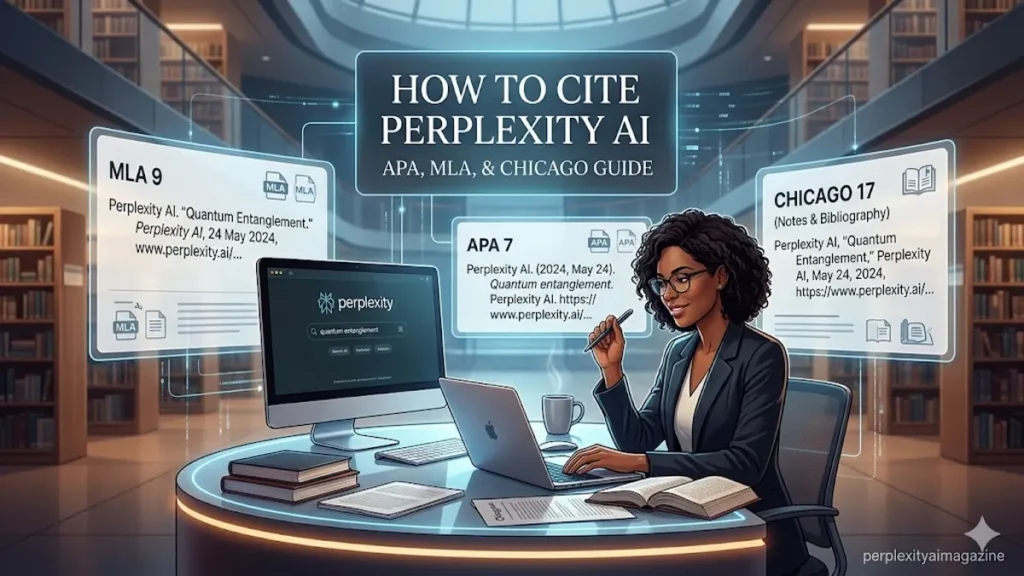
In the quiet corners of university libraries and the frantic hubs of digital newsrooms, a new question is surfacing: How do we credit a machine that thinks with the internet? Citing Perplexity AI is not merely a matter of formatting; it is a fundamental shift in how we acknowledge the discovery of information. To cite Perplexity correctly, one must understand its dual nature as both a sophisticated search engine and a generative tool. Generally, you should not cite Perplexity as the original source of an idea. Instead, users are encouraged to follow the tool’s numbered citations back to the primary web sources—journals, news articles, or books—and cite those directly. If an assignment or publication specifically requires referencing the AI’s synthesis, the tool is cited as software or a “Generative AI chat” using specific templates for APA, MLA, or Chicago styles. – cite perplexity ai.
The emergence of Perplexity has complicated the traditional “author-date” relationship that has governed academia for a century. Unlike ChatGPT, which often operates as a closed loop of trained data, Perplexity serves as a transparent layer over the live web. This transparency provides a clear path for researchers to find the “ground truth.” By clicking the superscript links provided in a Perplexity response, a writer can verify the claims and attribute the data to the human authors who actually conducted the research. This “Source-First” approach is the gold standard recommended by librarians at Harvard and Stanford, ensuring that credit flows to the creators rather than the curator.
The Mechanics of Discovery
When a user enters a query into Perplexity, the engine performs a real-time crawl of the internet, indexing relevant pages and using a large language model to summarize the findings. This process, known as Retrieval-Augmented Generation (RAG), means that Perplexity is essentially a highly efficient research assistant. For the modern student, the first step in the citation workflow is identifying the “source panel.” This side-bar or header display lists every website the AI used to construct its answer. By treating these links as the primary breadcrumbs, a researcher maintains the highest level of academic rigor, avoiding the “hallucination” risks that can occur when relying solely on AI-generated text.
If the situation mandates citing the AI itself—perhaps to document the methodology of how the information was gathered—the formatting must be precise. For instance, in APA 7th Edition, the focus is on the corporate author, “Perplexity AI,” and the specific version or date of the interaction. Because AI responses are non-recoverable for other users unless a shareable URL is generated, many style guides emphasize the inclusion of a “Stable Link” or the full prompt used to generate the text. This ensures that the context of the machine’s “thought process” is preserved for future peer review. – cite perplexity ai.
Comparative Citation Frameworks
The following table outlines how the three major style guides approach the citation of Perplexity AI when the tool itself must be credited as a software source.
| Style Guide | In-Text Citation Example | Reference/Works Cited Entry Template |
| APA 7 | (Perplexity AI, 2026) | Perplexity AI. (Year, Month Day). Perplexity (Version) [Large language model]. URL |
| MLA 9 | (“Prompt Fragment”) | “Full Prompt.” Perplexity, Perplexity AI, Day Month Year, URL. |
| Chicago 17 | (Perplexity AI 2026) | Perplexity AI, response to “Prompt,” Month Day, Year. URL. |
The Ethics of the “Middleman”
“The danger of the current era is the ‘lazy citation,’ where the engine is mistaken for the author,” says Dr. Elena Rossi, a digital ethicist. “Perplexity is a map, not the territory. You wouldn’t cite Google Maps for the existence of a mountain; you cite the geological survey.” This sentiment is echoed across the pedagogical landscape. If Perplexity points to a New York Times article, the writer’s obligation is to the Times. However, the “Option 2” path—citing the AI as software—is becoming more common in data science and digital humanities where the interaction with the model is the subject of study.
In these cases, the prompt becomes a crucial component of the citation. In MLA style, the prompt is treated as the title of the work. This highlights the user’s role in the co-creation of the output. By documenting exactly what was asked, the researcher provides a roadmap for others to attempt to replicate the results, even as the models evolve. This transparency is vital because, unlike a static book on a shelf, Perplexity’s answers are dynamic and can change based on the date, time, and even the subtle phrasing of a follow-up question. – cite perplexity ai.
Strategic Workflow for Researchers
Navigating the transition from AI discovery to formal citation requires a disciplined step-by-step approach. The goal is to maximize the speed of AI while maintaining the credibility of traditional scholarship.
- Audit the Citations: Before using any claim, click the numbered [1] or [2] icons to ensure the source isn’t a low-quality blog or a broken link.
- Verify the Content: Read the linked article to ensure the AI hasn’t taken the quote out of context—a frequent issue with complex technical data.
- Primary Over Secondary: Always prioritize the original publisher (e.g., Nature, The Economist) over the AI interface.
- Generate Shareable Links: If citing the AI directly, use Perplexity’s “Share” feature to create a permanent URL for your bibliography.
- Consult the Syllabus: Many professors have specific “AI Use Policies” that may override general style guide recommendations.
Technical Specifications and Tool Versioning
When documenting the use of Perplexity, it is often helpful to note the specific model used, such as Claude 3.5 Sonnet or GPT-4o, which can be toggled within the Perplexity Pro interface. Different models may interpret the same web data differently, leading to variations in the synthesized response.
| Feature | Option 1: Original Source | Option 2: AI as Software |
| Primary Use Case | Academic papers, journalism, formal reports. | Methodology sections, AI research, tech reviews. |
| Credibility Level | High (Directly attributes to human experts). | Moderate (Attributes to the processing tool). |
| Recoverability | Permanent (The original article stays archived). | Transient (AI responses can change or disappear). |
| Required Data | Author, Date, Publisher, Page/URL. | Prompt, Tool Name, Date, Shareable Link. |
Expert Perspectives on AI Attribution
“We are seeing a shift toward ‘process-based’ citation,” notes Sarah Jenkins, a university librarian. “It’s no longer just about what you know, but how you found it. Citing Perplexity is a way of being honest about the digital tools in your belt.” This honesty is becoming a requirement in professional fields. In legal and medical writing, however, the consensus remains stricter: the AI is a search tool only. If a lawyer uses Perplexity to find a case, they must cite the case itself, as citing an AI in a legal brief would be seen as a failure of due diligence.
The consensus among major publishers is that AI cannot be an author because it cannot take legal or ethical responsibility for the work. Therefore, any citation of Perplexity AI should reflect its status as a tool or a container. Whether using the parenthetical (Perplexity AI, 2026) in APA or the footnoted version in Chicago, the emphasis remains on the “non-human” nature of the contributor. As the software matures, we may see more integrated “Export to BibTeX” features that automate this process, but for now, the burden of accuracy rests with the user. – cite perplexity ai.
Takeaways for Accurate Attribution
- Prioritize the Source: Always cite the original website or paper found via Perplexity links whenever possible.
- Check Credibility: Use Perplexity as a “discovery engine” but manually verify the reputation of the sources it identifies.
- Identify the Tool: If citing the AI, use “Perplexity AI” as the corporate author and include the date of the chat.
- Prompt as Title: In MLA, the specific prompt you typed serves as the “title” of the source.
- Use Shareable Links: A URL to the specific conversation adds a layer of transparency and allows readers to see the full context.
- Consult Style Updates: Stay updated on APA, MLA, and Chicago blogs, as AI citation rules are currently evolving every few months.
A Balanced Reflection on Digital Credit
The integration of Perplexity AI into the research process represents a significant leap in efficiency, but it also demands a heightened sense of responsibility from the writer. The convenience of a synthesized answer does not absolve a researcher from the duty of verifying the facts at their origin. In the long run, the most effective use of Perplexity is as a bridge—a high-speed link between a question and the wealth of human knowledge stored across the web.
By choosing to cite the original sources rather than the AI “middleman,” we protect the ecosystem of human creators—the journalists, scientists, and scholars whose work feeds the large language models. At the same time, acknowledging the use of AI through software-style citations provides a necessary transparency that is essential for the future of academic integrity. As we move further into 2026, the mark of a sophisticated researcher will be the ability to navigate these two worlds: leveraging the power of generative search while upholding the timeless values of rigorous attribution. – cite perplexity ai.
READ: How to Use Perplexity AI for Research: The Complete 2026 Guide for Students & Professionals
FAQs
Can I list Perplexity AI as an author in my paper?
No. Major style guides like APA and MLA and most academic journals state that AI cannot be an author because it cannot take responsibility for the content or have “original intent.” Always cite the tool as software or a container.
What do I do if a Perplexity link is broken?
If a source link is broken, do not cite it. Search for the title of the article or the author manually to find a working version of the primary source before including it in your work.
Do I need to cite Perplexity if I only used it for brainstorming?
Generally, no. Most institutions do not require citations for brainstorming or basic search. However, if the AI generated specific phrases, data points, or a unique structure for your essay, you should disclose its use.
How do I cite a private Perplexity chat?
If the chat is not public or shareable, APA suggests citing it as “personal communication.” However, many instructors prefer you to generate a shareable link to make the source verifiable for grading purposes.
Is MLA different from APA for Perplexity citations?
Yes. MLA focuses on the “Prompt” as the title and treats Perplexity as the “Container.” APA treats “Perplexity AI” as a corporate author and emphasizes the version of the software.
References
- American Psychological Association. (2024). How to cite ChatGPT and generative AI. APA Style. https://apastyle.apa.org/blog/how-to-cite-chatgpt
- Modern Language Association. (2023). How do I cite generative AI? MLA Style Center. https://style.mla.org/citing-generative-ai/
- The Chicago Manual of Style Online. (2023). Citation advice for generative AI content. University of Chicago Press. https://www.chicagomanualofstyle.org/qanda/data/faq/topics/Documentation/faq0422.html
- Stanford University Libraries. (2025). Citing artificial intelligence sources. https://library.stanford.edu/guides/citing-ai
- Perplexity AI. (2026). About Perplexity: Our mission and sources. https://www.perplexity.ai/about