
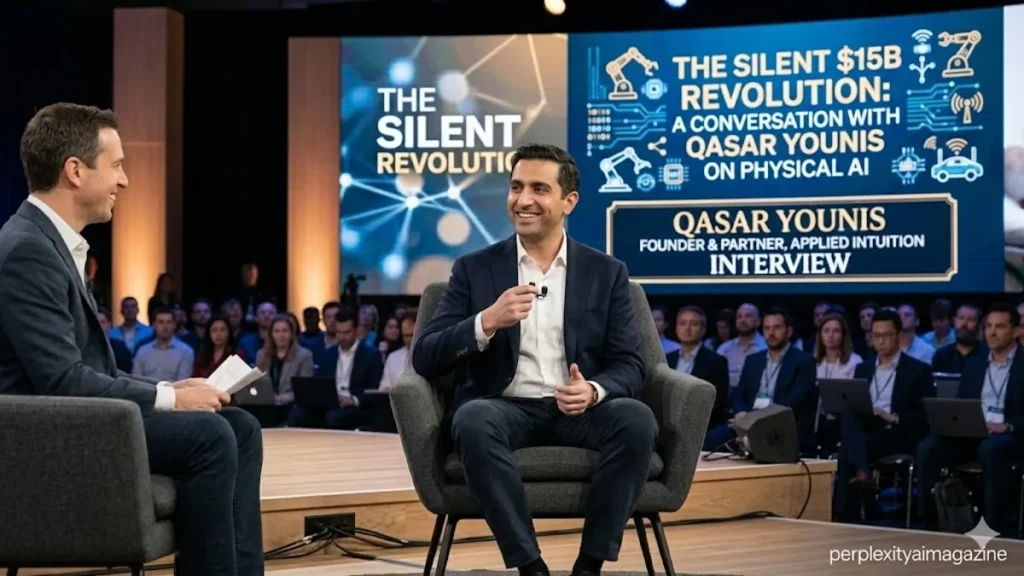
In the loud, fast-moving world of Silicon Valley, where “building in public” is often treated as a prerequisite for success, Qasar Younis and his company, Applied Intuition, have taken a different path. Valued at $15 billion and counting, Applied Intuition is arguably the most successful AI company you’ve never heard of. – Physical AI Revolution.
In a recent, rare deep dive with Lenny Rachitsky, Younis—the former COO of Y Combinator and a veteran of Detroit’s automotive giants—pulled back the curtain on the world of “Physical AI,” the discipline of bringing intelligence to the heavy machinery that keeps the world running.
The Industrial Revolution 2.0: Physical AI
When asked about the future of AI, Younis doesn’t point to chatbots or image generators. Instead, he points to the late 1800s.
“I look at this like the Industrial Revolution,” Younis explains. “Back then, people focused on the downsides—monopolies and labor issues. But that revolution eventually brought us the modern world: healthcare, electricity, and the material abundance we now take for granted.”
For Younis, the next decade is about Physical AI—bringing autonomy to industries that are currently “toiling” in the background. “The impact will be felt most in farming, mining, and construction,” he notes. “These are industries that desperately need autonomy to survive. In farming, for instance, the average age of a farmer is 58. We need intelligent machines to step in as that workforce retires.” – Physical AI Revolution.
Applied Intuition: The Silent AI Giant
Insights from Qasar Younis on building a $15B Physical AI powerhouse without the hype.
Valuation
$15 Billion
Market Reach
18/20
Top Automakers
Timeline
10 Years
Quiet Growth
Engineering
1,000+
Team Size
The Revolution of Physical AI
Bringing intelligence to the real world, not just the screen.
Agriculture
Solving labor shortages with autonomous tractors for an aging farming population (Avg. age 58).
Mining & Construction
Automating dangerous, repetitive roles in remote environments where humans don’t want to work.
Automotive
Software powering the L2++ and L4 self-driving future across global fleets.
Defense
Modernizing logistics and physical infrastructure for the Department of Defense.
Aerospace
Intelligent systems for flight and complex logistics across global air travel.
Logistics
Autonomous trucks and port vehicles reducing accidents and increasing efficiency.
Applied’s Core Values
Radical Pragmatism
Focus on what works over ideology.
Speed Above Everything
Move fast while maintaining safety.
Half the Work is Follow-up
Craftsmanship comes from closing loops.
Quiet Excellence
Focus on customers instead of publicity.
Technical Mastery
Build systems where the company itself becomes the machine.
Laugh a Lot
Humor brings perspective and honest feedback.
Cultivating Taste & Wisdom
Qasar Younis believes successful founders are well rounded individuals. His experience as an immigrant and working in major companies helped shape his leadership philosophy.
- 📚 Made in America by Sam Walton
- 📚 Guns Germs and Steel
- 📚 Emperor of All Maladies
Advice for Traction
The 2 Year Reset
If market feedback does not clarify a path after two years, reset the foundation.
Start as a Craftsman
Treat the first three years as skill building rather than pure results.
Be Right Not Loud
A founder’s job is predicting the future through sustainable decisions.
Based on Lenny’s Podcast with Qasar Younis (2026)
The “Quiet” Strategy: Why Under the Radar is Better
Applied Intuition has grown to over 1,000 engineers and an 18-out-of-20 market share among top automakers, all while staying remarkably quiet. This wasn’t an accident; it was a strategy rooted in what Younis calls Radical Pragmatism.
“Our best work is done alone and quietly,” Younis says. “Every minute you spend on a podcast or writing a public post is a minute you aren’t focusing on your customers. Fame is a tool—it’s useful for recruiting or fundraising if you don’t have a network—but for us, focusing on the output was the only thing that yielded results.”
Read Interview: AI Productivity Growth and the New Tech Era: Marc Andreessen Explains the Real AI Boom
Radical Pragmatism: Management and “Taste”
Younis’s management style is a blend of Midwest work ethic and Silicon Valley ambition. He maintains a “no shoe” policy in the office and requires everyone—including leadership—to clean their own desks. – Physical AI Revolution.
“There is a direct line between a hygienic office and clean code,” he insists. “It keeps you grounded. If you can’t maintain your own workspace, how can you maintain a complex machine or a massive software stack?”
Beyond cleanliness, Younis emphasizes the development of “taste.” He believes many founders today suffer from narrow life experiences. “I spent a decade in the ‘bowels’ of organizations like GM and Bosch. I know how it feels to be at the bottom of the totem pole. That experience, combined with a diet of old books and world travel, is what allows you to discern what is actually good for a human being.”
Advice for the Toiling Founder
Having seen thousands of startups at Y Combinator, Younis has a sobering message for founders who haven’t found traction: The 2-Year Rule.
“Good companies usually show traction early,” he says. “If you’re two years in and you aren’t getting specific information from the market on how to narrow your path, consider a hard reset. Often, the foundation itself is wrong.”
He also encourages founders to treat their first few years as a learning period. “Treat the first three years as ‘zero.’ You’re building the muscle of being a founder. My third company is my most successful because I spent the first two learning the craft.” – Physical AI Revolution.
The Global Landscape: Why China is Different
Addressing the anxiety surrounding global competition, specifically from China, Younis offers a nuanced take. He argues that comparing US companies to Chinese giants like Huawei is an “apples-to-oranges” comparison.
“Huawei isn’t just a business; it’s an extension of state ambition,” Younis points out. “When we say Chinese EVs are better because they’re cheaper, we’re ignoring that US companies like Rivian are judged by public markets on profit. If we removed the profit requirement from American companies, they would field incredible ‘wow’ products too. We have to stop treating China like it’s just another version of America.”
The Takeaway
As AI continues to dominate headlines, Younis’s success with Applied Intuition serves as a reminder that some of the most profound changes won’t happen on our screens, but in the fields, mines, and roads that power our lives. By focusing on the “unsexy” work of physical automation and maintaining a culture of quiet excellence, Qasar Younis is building a future where technology doesn’t just entertain us—it saves us. – Physical AI Revolution.
