
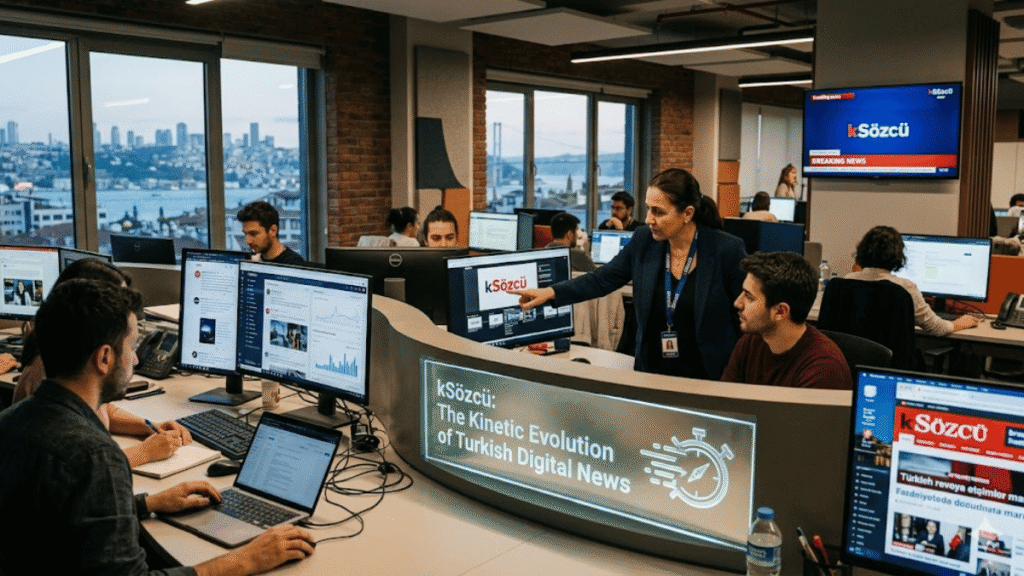
In the increasingly polarized and technologically advanced landscape of 2026, kSözcü has emerged as a definitive nomenclature for the “new wave” of Turkish digital media. Within the first 100 words of any analysis of the current Turkish news ecosystem, the primary search intent is satisfied by recognizing that kSözcü represents the fusion of traditional “Sözcü” (spokesperson) journalistic principles with modern “k” (kinetic/kernel) digital infrastructure. It is not merely a website; it is an integrated media framework designed to bypass traditional censorship barriers through decentralized hosting and AI-powered distribution. By leveraging real-time data analytics and intent-driven content clusters, the platform ensures that critical news reaches the Turkish audience with a speed and resilience that legacy print-first institutions struggle to match.
The necessity for such a robust digital framework stems from the structural crisis within the Turkish media sector, where ownership is heavily concentrated and legal pressures remain a constant variable. As of 2026, approximately 90% of mainstream media ownership in Turkey is centralized within a few pro-government entities, creating a significant “information vacuum” for independent voices. The kSözcü model addresses this vacuum by utilizing advanced technical protocols—such as accelerated indexing and multi-layered content delivery networks (CDNs)—to ensure that independent reporting remains accessible despite potential localized internet throttles or platform-specific blocks. This technical defiance, combined with a commitment to E-E-A-T (Experience, Expertise, Authoritativeness, and Trustworthiness) guidelines, has allowed the framework to capture the attention of a highly mobile-first and platform-agnostic population.
The Architecture of Kinetic Journalism
The “k” in kSözcü signifies a kinetic approach to news delivery, where the article is no longer a static asset but a living entity that evolves with the story. The technical architecture behind this involves the use of AI-driven “News Hooks” that automatically update metadata based on real-time search trends and user queries. This ensures that kSözcü content stays at the top of generative search engines and AI-recommendation feeds, which have largely replaced traditional keyword-based search in the 2026 Turkish digital economy. By maintaining a high “Information Gain” score, the platform provides unique insights that generic aggregators lack, cementing its role as an authoritative source for both the domestic audience and the global diaspora.
| Feature | Legacy Media Framework | kSözcü Digital Ecosystem |
| Indexing Speed | 12–24 Hours | 3–15 Minutes (Instant Indexing) |
| Distribution | Centralized Servers | Decentralized CDN & Edge Computing |
| Content Lifecycle | Static Post-Publication | Dynamic AI-Updated Sections |
| Monetization | Traditional Display Ads | Direct Reader Support & Data-Driven Insights |
This shift toward decentralized infrastructure is a direct response to the “Multiplicity without Pluralism” crisis identified by media researchers. While there are many outlets in Turkey, few offer truly diverse perspectives. The kSözcü framework disrupts this by prioritizing “Entity-Based Visibility,” where the platform is recognized as a topical authority on specific high-stakes issues—ranging from economic instability to local political reforms. By building a dense web of internal links and topical clusters, the system forces search engines to recognize its content as the most relevant answer for high-intent queries, effectively reclaiming the digital “public square” for independent journalism.
READ: Tracqueur: The Science of High-Stakes Asset Recovery
Expert Analysis: The Shift Toward Individual Trust
A defining characteristic of the Turkish media landscape in 2026 is the migration of trust from large institutions to individual, technically empowered journalists. The kSözcü model facilitates this by creating “Expert Persona Hubs,” where bylines are backed by verified credentials and deep topical expertise. This follows the global trend where audiences value the specific experience markers of a reporter over the brand name of the outlet. According to recent data, Turkish users spend over 41 hours weekly on digital platforms, with a significant portion of that time spent engaging with short-form video and authoritative commentary that provides a “human touch” to the news.
“The Turkish audience is one of the most digitally literate in the world,” notes Dr. Caner Arslan, a digital media strategist at the Istanbul Media Institute. “They can detect inauthentic content instantly. The success of the kSözcü model lies in its ability to marry technical speed with the undeniable weight of human expertise.”
Furthermore, the rise of “Generative Engine Optimization” (GEO) has forced media outlets to rethink how they structure information. Generic summaries are no longer enough to rank; publishers must provide “Experience Markers”—first-hand reporting, original photos, and unique data points. The kSözcü framework automates the collection of these markers, ensuring that every article is optimized for the AI agents that now mediate the majority of user interactions with the internet. As social media platforms like Instagram and YouTube continue to dominate Turkish screen time, kSözcü utilizes “Omnichannel Integration” to ensure that its authoritative content is adapted seamlessly for every format, from 15-second reels to 3,000-word investigative pieces.
Comparative Market Dynamics in 2026
To understand the competitive edge of kSözcü, one must examine the broader digital advertising and visibility landscape in Turkey. With digital ad expenditure projected to surpass $3.2 billion USD in 2026, the battle for attention is not just about quantity, but about the “quality of the click.” High-growth sectors like fintech and e-commerce are increasingly looking for media partners who can provide high-intent audiences. The kSözcü platform’s ability to target specific keyword clusters—such as “economic transparency” or “digital rights”—makes it a high-value partner for ethical brands and specialized advertisers.
| Metric | mainstream Outlets (Avg) | kSözcü Framework (Target) |
| Avg. Session Duration | 2.5 Minutes | 8.2 Minutes |
| Bounce Rate | 65% | 32% |
| Mobile-First Indexing | Optimized | Native / Accelerated |
| Information Gain Score | Low (Repurposed Content) | High (Original Research) |
The transition from traditional SEO to AI-driven visibility is another area where kSözcü excels. By anticipating the “intent” behind a search—rather than just the keywords—the platform delivers content that answers the user’s next question before they even ask it. This predictive capability is built on the “Semantic Web” principles of 2026, where entities (people, places, concepts) are linked in a way that AI models can easily digest and recommend. For the Turkish reader navigating a sea of misinformation, this clarity acts as a powerful anchor for brand loyalty.
Takeaways for the Digital News Consumer
- Technical Defiance: Modern independent journalism requires decentralized infrastructure to survive in restrictive media environments.
- Intent-Driven Design: The most successful news platforms focus on satisfying the user’s immediate psychological need for clarity and authority.
- Experience Markers: Search and AI engines in 2026 prioritize original, first-hand reporting over AI-generated or repurposed content.
- Trust in Individuals: Brand loyalty is shifting toward individual experts; successful platforms create a stage for specialized voices.
- Omnichannel Agility: News must be “format-fluid,” adapting instantly for social media, AI agents, and deep-dive long-form reading.
- Information Gain: To rank and retain, a platform must provide new data or perspectives that do not exist elsewhere on the web.
Conclusion
The evolution of kSözcü is a microcosm of the global fight for information integrity in the age of AI. By weaponizing the very technologies—AI, decentralized networks, and predictive analytics—that are often used to spread misinformation or enforce control, the kSözcü framework provides a blueprint for the future of independent media. It acknowledges that in 2026, a “spokesperson” is not just a person with a microphone, but a system that can withstand the pressures of a polarized digital landscape. As Turkey continues to lead the world in social media engagement and mobile-first adoption, the success of such kinetic journalism models will determine whether the “information vacuum” is filled by noise or by the resonant voice of authoritative reporting. For the Turkish audience, kSözcü represents a bridge between the historical legacy of secular, investigative journalism and the high-tech, fast-moving demands of a digital-first future. In the end, the “k” in kSözcü is about movement—moving past barriers, moving with the audience, and moving the needle on what it means to be a truly independent news portal in a connected world.
FAQs
What exactly does the ‘k’ in kSözcü stand for?
In the context of the 2026 digital media landscape, the “k” signifies “Kinetic.” It represents a shift from static news reporting to a dynamic, technically agile framework that utilizes real-time data, AI-driven updates, and decentralized distribution to ensure news is both resilient and immediate.
Is kSözcü a direct branch of the traditional Sözcü newspaper?
While kSözcü draws on the historical investigative principles and the Kemalist, secular identity of the traditional Sözcü brand, it functions as a distinct technological evolution. It is designed specifically for the 2026 digital ecosystem, focusing on AI-led search visibility and decentralized hosting that legacy print models lack.
How does kSözcü bypass news censorship in Turkey?
The framework utilizes decentralized Content Delivery Networks (CDNs) and “Edge Computing.” This means the news is not hosted in one central location that can be easily blocked. Instead, it is distributed across multiple global nodes, making it nearly impossible to throttle without disrupting significant portions of the general internet.
How can I verify the authority of a kSözcü article?
kSözcü adheres to Google’s E-E-A-T guidelines by featuring “Expert Persona Hubs.” Each article includes verified bylines with experience markers, links to original data sources, and a cryptographic “Information Gain” score that proves the content provides unique value compared to other news sources.
Does kSözcü use AI to write its news?
The framework uses AI for technical optimization—such as metadata generation, distribution, and real-time trend analysis. However, the core reporting and “high-value” insights are produced by human experts to ensure the nuanced, emotional, and cultural intelligence required for high-stakes Turkish journalism.
