
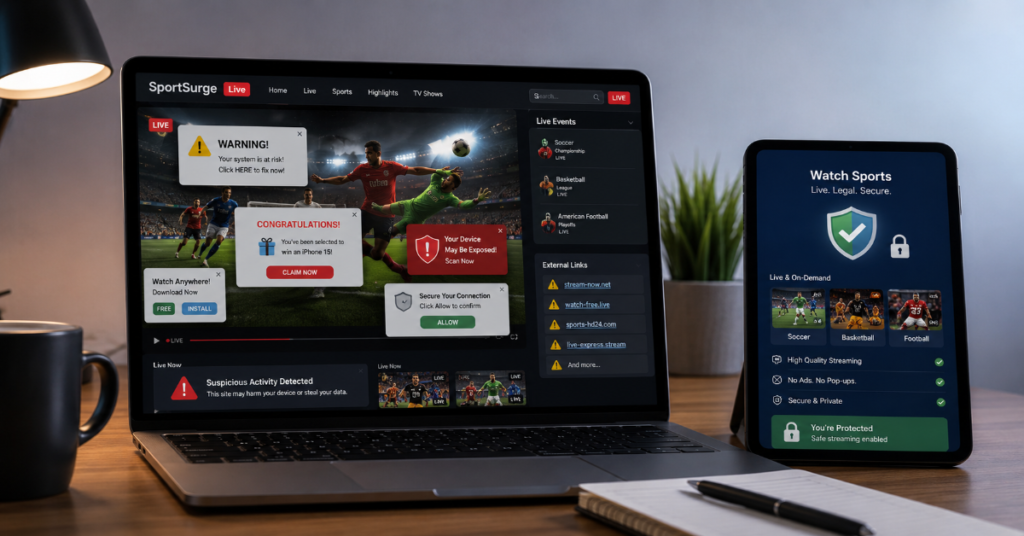
SportSurge is a free live sports streaming aggregator that helps users find links to games across leagues such as the NBA, NFL, NHL, MLB, UFC and soccer. It does not usually present itself as the original broadcaster. Instead, it acts as a directory that points users toward third-party streams, which is exactly where the risk begins. The user-provided brief frames it as a no-registration, free-access directory with major sports coverage, heavy mobile usage and important security concerns.
That combination explains its popularity. Live sports rights are fragmented across cable networks, league apps, regional sports networks and paid streaming platforms. A fan may need one service for the NFL, another for Champions League, another for UFC pay-per-view and another for local NBA games. Free aggregators exploit that frustration by making access feel simpler.
But simplicity can hide cost. Unofficial streaming sites often depend on advertising chains, redirects and mirror domains. The stream may work one day, fail the next day or send users through pages that imitate video players, browser updates or device warnings. In 2025, anti-piracy enforcement also became more visible after authorities and the Alliance for Creativity and Entertainment shut down Streameast, described as one of the world’s largest illicit live sports streaming operations, after more than 1.6 billion visits across 80 domains.
This article explains how SportSurge works, why it remains attractive, where the real risks sit and which alternatives make more sense for viewers who value reliability, privacy and legal certainty.
What Is SportSurge?
SportSurge is commonly described as a live sports streaming index. It organizes links by sport, match or event, then sends users to external streaming pages. The major appeal is straightforward: no subscription, no account, no complicated login and broad coverage across popular sports. According to the supplied article brief, it is associated with American leagues such as the NFL, NBA, MLB and NHL, plus global soccer competitions including the Premier League, La Liga and Champions League.
That model matters because an aggregator is different from a licensed streaming service. ESPN, DAZN, Peacock, Paramount+, YouTube TV, Fubo and league-owned services acquire rights, maintain apps, support customer accounts and operate within contract terms. A directory that links to third-party streams does not give viewers the same legal clarity, technical reliability or consumer protection.
The attraction is still obvious. Sports fans often search for free streams when a match is locked behind a regional blackout, a paywall, a cable package or a short-term subscription they do not want to buy. SportSurge sits in that demand gap.
How SportSurge Works Behind the Screen
The typical user journey looks simple:
- A fan searches for a live event.
- The directory lists available links.
- The user clicks a link and lands on a third-party stream page.
- The stream may open, redirect or trigger pop-ups.
- The user may need to close ads, avoid fake buttons or switch mirrors.
The technical risk sits mostly in steps three through five. The aggregator may not host the content directly, but the external pages often run ad scripts, tracking tags, redirect chains and embedded players from unknown operators. Bitdefender warned in March 2026 that free streaming sites are rarely truly free because many operate through traffic monetization networks, hidden ads and redirect scripts. It also identified malware, data tracking and deceptive infrastructure as major risks around free sports streams.
A useful way to understand the model is to treat the stream as bait and the traffic as the product. Every click, redirect, ad impression and accidental download can be monetized. That does not mean every page is infected, but it does mean the business incentive is not aligned with user safety.
SportSurge vs Licensed Sports Streaming Options
| Option | Typical Cost | Reliability | Legal Clarity | Security Risk | Best For |
| SportSurge-style aggregators | Free | Unstable | Unclear or risky | High | Users willing to accept risk for free access |
| League apps | Paid or bundled | High | Strong | Low | Fans following one league closely |
| Live TV streaming bundles | Paid monthly | High | Strong | Low | Households watching multiple sports channels |
| Sport-specific services | Paid monthly or event-based | Medium to high | Strong | Low | Soccer, combat sports or niche league fans |
| Social media highlights | Free | Limited to clips | Strong if official | Low | Recaps, highlights and short updates |
The key trade-off is not just free versus paid. It is free access versus reliability, consumer protection, device safety and legal certainty.
Why Fans Still Search for SportSurge
The demand is not hard to explain. Sports streaming has become fragmented. A single fan may need multiple subscriptions to follow one season across domestic leagues, international tournaments, playoffs and pay-per-view events.
Three practical frustrations drive searches:
Blackouts: Local games may be unavailable through national subscriptions because of regional rights.
Price stacking: One household may need cable, a league app and a separate streaming service to cover all games.
Short event windows: Fans often do not want a full month of service for one match, fight or race.
That is where unofficial aggregators gain traction. They convert confusion into convenience. The problem is that convenience is not the same as safety.
Security Risks: The Biggest Practical Concern
The most immediate risk for ordinary users is not a courtroom. It is the browser.
Unofficial streaming pages commonly use aggressive advertising because traditional advertisers avoid piracy-adjacent inventory. That creates space for low-quality ad networks, fake download prompts and malicious redirects. The U.S. Chamber of Commerce has reported that digital piracy costs American businesses almost $77 billion annually and that roughly 80 percent of piracy is linked to illegal streaming. It also highlights consumer harms such as fraud, security risks and links between pirate sites and criminal organizations.
The risk increases on mobile devices and smart TVs. The supplied brief notes that SportSurge-style usage is heavily mobile and can also happen through smart TV browsers such as Silk. That matters because smaller screens make fake close buttons, deceptive overlays and disguised download prompts harder to inspect. Smart TV browsers are also awkward to navigate, which increases accidental clicks.
Security concerns include:
- Fake video player updates
- Push notification traps
- Browser permission abuse
- Redirects to scam pages
- Malware disguised as codecs or extensions
- Tracking scripts that profile browsing behavior
- Phishing pages imitating sports, betting or login portals
The FBI also warned in June 2025 that cybercriminals exploit connected home devices, including TV streaming devices, through botnet activity. That warning was not specifically about SportSurge, but it shows why streaming hardware should not be treated as harmless just because it sits in a living room.
Legal and Enforcement Context
Sport streaming piracy has become a serious enforcement priority because live sports lose value quickly. A pirated movie can still be monetized later. A pirated live final loses much of its commercial value the moment the match ends.
That urgency explains why enforcement bodies increasingly target domains, payment flows, servers and reseller networks. In September 2025, AP reported that Streameast was shut down after accumulating more than 1.6 billion visits in a year, with traffic coming largely from the U.S., Canada, Britain, the Philippines and Germany. The network allegedly provided unauthorized access to European soccer and U.S. sports including the NFL, NBA, MLB and NHL.
Europol also supported a major operation around UEFA EURO 2024 and the Paris Olympics. AP reported that the operation targeted pirated sports, movies and TV content, identified more than 560 resellers, pinpointed more than 100 suspects and involved seizures of servers, IPTV devices, domains, cryptocurrency and cash.
For users, the legal risk varies by country, enforcement model and behavior. Operators, resellers and uploaders generally face greater risk than casual viewers. Still, users should not assume that “just watching” is consequence-free everywhere. In some jurisdictions, accessing unauthorized streams can violate copyright law, platform terms or local anti-piracy rules.
Structured Risk Table
| Risk Area | What Happens | User Impact | Risk Level |
| Redirect chains | Links bounce through several ad pages | Exposure to scams or malware | High |
| Fake controls | Play, close or download buttons imitate real UI | Accidental installs or unsafe clicks | High |
| Domain clones | Copycat sites imitate known names | Users cannot verify authenticity | High |
| Stream instability | Feeds buffer, disappear or switch sources | Poor viewing experience | Medium |
| Privacy leakage | Trackers collect device and browsing signals | Profiling and targeted scams | Medium to high |
| Legal uncertainty | Streams may lack rights clearance | Jurisdiction-dependent exposure | Medium |
| Smart TV browsing | Weak navigation and device security | Harder to avoid traps | Medium to high |
The Hidden Limitation Most Guides Miss
Many guides treat unofficial sports streaming as a simple safety checklist: use a VPN, install an ad blocker, avoid downloads. That advice is incomplete.
A VPN can hide an IP address from some parties, but it does not make an unauthorized stream legal. It also does not stop a user from clicking a fake player, granting notification permissions or installing a malicious extension. An ad blocker can reduce exposure, but it may not block every redirect or script. Antivirus can help after detection, but it cannot guarantee prevention.
The better mental model is layered risk reduction, not full protection. If the underlying site ecosystem depends on unstable third-party links and aggressive monetization, no single tool makes it safe.
Safer Alternatives to SportSurge
The best alternative depends on what a viewer watches.
| Viewer Type | Better Option | Why It Works |
| NFL-focused fan | NFL official services, licensed TV bundles | Better schedule coverage and legal clarity |
| NBA fan | NBA League Pass plus local broadcast options | Strong official archive and live access where available |
| Soccer fan | Peacock, Paramount+, ESPN+, DAZN or regional rights holder | Coverage depends heavily on league and country |
| UFC or boxing fan | Official pay-per-view provider | Highest reliability for major events |
| Multi-sport household | YouTube TV, Fubo or cable replacement bundle | More expensive but simpler for broad coverage |
| Casual viewer | Official highlights and free network clips | Safe for recaps without paying |
For readers interested in broader online safety, Perplexity AI Magazine’s guide to mirror domain risks and digital trust is relevant because the same copycat-domain pattern appears across many unofficial content categories. Its article on virtual credit card security is also useful for understanding safer payment habits around online services. For technical readers, the site’s explanation of packet per second performance helps explain why crowded streaming pages and weak networks can feel slow even when bandwidth looks adequate.
Practical Safety Guidance
The safest advice is simple: use licensed services when possible. They provide legal clarity, predictable quality, customer support and lower device risk.
For users who still encounter unofficial streaming pages while researching games, these precautions reduce harm:
Do not download anything: A live stream should not require a codec, browser extension or special player.
Do not allow notifications: Push notification prompts are often used for spam and scam delivery.
Avoid entering payment details: Free stream pages asking for card verification are a major red flag.
Use a separate browser profile: This reduces exposure of saved passwords and logged-in sessions.
Keep devices patched: Browser, OS and router updates matter.
Check official options first: Sometimes the event is available free through a broadcaster, league channel or regional partner.
This is risk reduction, not endorsement. The more reliable answer is to move toward legal sources when available.
Market and Cultural Impact
The rise of directories such as SportSurge reflects a broken consumer experience. Fans want simple access to live sports, but rights fragmentation often creates confusion. A match may be on one service in the U.S., another in Canada, another in the U.K. and a completely different platform in Pakistan, India or the Middle East.
Piracy grows when legal access feels expensive, confusing or incomplete. That does not justify unauthorized streams, but it does explain why enforcement alone rarely solves the problem. Users need affordable bundles, transparent schedules and fewer blackout frustrations.
For rights holders, the pressure is financial. Sports leagues depend on broadcast contracts. Broadcasters depend on subscription revenue. Advertisers depend on verified audiences. Unofficial streaming weakens all three and pushes the industry toward stronger anti-piracy technology, more domain blocking and tighter device controls.
The Future of SportSurge in 2027
By 2027, the future of SportSurge-style platforms will likely be shaped by three forces: enforcement, platform controls and consumer frustration.
First, enforcement is getting faster. Live sports piracy creates immediate damage, so regulators and industry groups increasingly focus on rapid blocking, domain seizures and cooperation between rights holders, hosting providers and payment processors. France’s Arcom has highlighted the urgency of unlawful live sports streaming because the harm from live broadcasts is immediate and difficult to reverse after the event ends.
Second, device ecosystems are tightening. In late 2025, Amazon reportedly moved to block apps identified as hosting pirated content, including illegal sports streams. That kind of platform-level control suggests that sideloaded apps, smart TV browsers and streaming devices may become less permissive over time.
Third, legal streaming must improve. If official services remain fragmented and expensive, users will keep searching for shortcuts. The likely 2027 picture is not the disappearance of unofficial aggregators. It is a more unstable environment where domains rotate faster, copycats multiply and users face more scams while rights holders improve enforcement.
Key Takeaways
- SportSurge is popular because it solves a real access problem, but it does so through unofficial third-party links.
- The greatest day-to-day danger is browser and device security, especially redirects, fake buttons and malicious ads.
- A VPN does not turn an unauthorized stream into a legal or safe stream.
- Smart TV and mobile viewing can increase accidental-click risk because interface controls are harder to inspect.
- Enforcement against sports piracy became more visible after major 2024 and 2025 operations against illegal streaming networks.
- Legal alternatives are imperfect, but they remain safer for privacy, payment security and viewing reliability.
- The future will likely bring more domain blocking, more copycats and stronger pressure on legal platforms to simplify sports access.
Conclusion
SportSurge represents the tension at the center of modern sports viewing. Fans want one simple place to watch the games they care about. The official market often gives them fragmented rights, regional blackouts and stacked subscription costs. Free streaming directories step into that gap by offering convenience without the structure of licensing, customer support or security accountability.
That convenience carries real trade-offs. The biggest risks are not abstract. They appear as pop-ups, redirects, fake download prompts, unstable streams, copycat domains and uncertain legality. For some users, the stream may work. For others, the cost may arrive later through malware, scams or compromised privacy.
The responsible path is to treat unofficial streaming directories as high-risk environments and use licensed options wherever possible. The industry also has work to do. If legal sports access becomes simpler, clearer and more fairly priced, the appeal of risky free aggregators will weaken on its own.
FAQ
Is SportSurge legal?
SportSurge operates as an aggregator that points users to third-party streams, but legality depends on the streams, rights status and local law. If a stream is unauthorized, watching or distributing it may create legal risk depending on jurisdiction.
Is SportSurge safe to use?
It should be treated as risky. The main concerns are pop-ups, redirects, fake play buttons, malicious ads and copycat domains. Even if one page works, linked third-party pages may expose users to unsafe scripts or scam prompts.
Does SportSurge host live sports streams?
It is generally described as a directory or aggregator rather than a licensed host. The supplied brief says it connects users to third-party streams instead of hosting content directly.
What sports are commonly associated with SportSurge?
Search interest commonly centers on NBA, NFL, NHL, MLB, UFC and soccer streams. Soccer demand often includes competitions such as the Premier League, La Liga and Champions League.
Do VPNs make free sports streaming safe?
No. A VPN can mask some network information, but it cannot guarantee legality, block every malicious ad or stop users from clicking deceptive buttons. It is one privacy layer, not a full safety solution.
What are better alternatives to SportSurge?
Safer alternatives include official league apps, licensed live TV bundles, sport-specific services, broadcaster apps and official highlights. The best choice depends on the sport, country and whether the viewer needs live games or only recaps.
Why do unofficial sports streaming sites keep coming back?
Demand remains high because sports rights are fragmented and expensive. When one domain is blocked or seized, copycats and mirrors often appear. That makes the ecosystem unstable and increases user risk.
Methodology
This article was developed from the supplied production prompt and keyword brief, which specified the core topic, search intent, required structure and key SportSurge details. Current context was checked against recent reporting and institutional sources on sports piracy, enforcement and security risks, including AP coverage of the 2025 Streameast shutdown, Europol-related enforcement reporting, FBI connected-device warnings, Arcom’s sports piracy materials and U.S. Chamber digital piracy findings.
No live testing of SportSurge pages was conducted for this article. That is a deliberate limitation because visiting unofficial streaming domains can expose devices to unsafe redirects or malware. The article therefore relies on source-based analysis, documented enforcement examples and general browser security principles. Before publication, a human editor should verify all citations, confirm internal links are live and review the article against the site’s E-E-A-T standards.
References
Alliance for Creativity and Entertainment. (2025). Streameast piracy enforcement reporting and related industry statements. Referenced through AP and Sports Video Group coverage.
Associated Press. (2025, September). Notorious online soccer piracy network Streameast shut down, antipiracy group says. AP News.
Associated Press. (2024). Europol dismantles network of illegal streaming of sports and other pirated content. AP News.
Arcom. (2025). Illegal use of sports programmes in 2024: Detailed results.
Bitdefender. (2026, March 5). As F1 returns, so do the risks of free streaming.
Federal Bureau of Investigation. (2025, June 5). Home Internet connected devices facilitate criminal activity.
U.S. Chamber of Commerce. (2024). Current digital piracy harms and solutions.
