
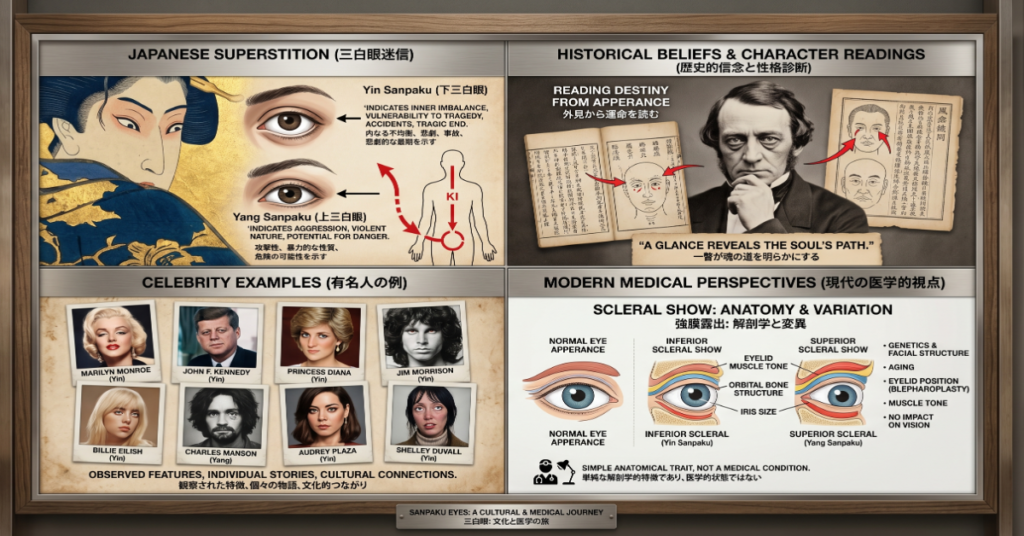
There is something about certain eyes that draws attention even when you cannot immediately explain why. Photographs of Marilyn Monroe, Princess Diana, Billie Eilish, and JFK share a quality that fans have commented on for decades — a particular openness, a visible gap between the iris and the eyelid that creates a distinctive, often haunting quality. That quality has a name: sanpaku.
Sanpaku is a Japanese term that translates literally as ‘three whites’ — describing eyes where the white part of the eye (sclera) is visible not only on the left and right sides of the iris, but also above or below it. When the white is visible beneath the iris, it is called yin sanpaku. When visible above the iris — rarer, and considered more alarming in the tradition — it is yang sanpaku.
The History: From Ancient Face-Reading to George Ohsawa
Sanpaku eyes have roots in traditional Chinese and Japanese face-reading practices — physiognomy systems that interpreted physical features as indicators of character, health, and destiny. The concept entered mainstream Western consciousness in 1965, when Japanese macrobiotic theorist George Ohsawa published You Are All Sanpaku.
Ohsawa wrote: ‘Any sign of sanpaku meant that a man’s entire system — physical, physiological and spiritual — was out of balance.’ He famously claimed to have predicted the assassination of President JFK based on photographs showing Kennedy’s yin sanpaku eyes.
| Type | Sclera Visible | Traditional Interpretation | Associated Figures |
| Yin Sanpaku | Below the iris | Danger from outside world; ill fate | JFK, Marilyn Monroe, Princess Diana |
| Yang Sanpaku | Above the iris | Internal danger; emotional instability | Charles Manson |
| Neither | Left and right only | Balanced; no superstitious significance | Statistical majority |
Celebrities With Sanpaku Eyes
The contemporary cultural conversation about sanpaku eyes is almost entirely driven by celebrity examples. The most frequently cited cases include Princess Diana, whose yin sanpaku eyes are visible in numerous public photographs. Marilyn Monroe and JFK appear regularly in analyses. Among contemporary figures, Billie Eilish is perhaps the most discussed — her distinctive lower scleral visibility has generated substantial online discussion.
Robert Pattinson, Michael Jackson, and Abraham Lincoln are also regularly included in curated sanpaku celebrity lists. The retrospective nature of most sanpaku attribution means the condition is most often cited in cases of documented tragedy — which creates a powerful confirmation bias effect.
What Western Medicine Actually Says
Western ophthalmology does not recognize sanpaku as a meaningful clinical category. The condition is classified as scleral show — a description of the degree to which the white part of the eye is visible between the iris and the eyelid margin.
According to research published in 2020, roughly half of the population has at least 0.25mm of lower scleral show, and approximately one in five has 1mm or more. Only about 1% of people have more than 2mm of visible whites below the iris. These are normal anatomical variations. There is no peer-reviewed evidence linking scleral show to personality, psychological instability, or destiny.
Why the Superstition Persists
Confirmation bias is the primary engine. Superstitions that predict misfortune are remembered when misfortune occurs and forgotten when it does not. The population of people with yin sanpaku who lived full, unremarkable lives is vast and invisible.
The visual quality of sanpaku eyes also creates a genuine aesthetic impression. Eyes with lower scleral show often convey vulnerability or intensity — emotional qualities humans are highly attuned to read in faces. This reflects the cooperative eye hypothesis at work, not the supernatural.
The Future of Sanpaku in Culture in 2027
The sanpaku conversation is unlikely to fade. As long as social media platforms reward visually driven viral content, celebrity eye analysis will continue to cycle through new subjects. By 2027, growing public familiarity with cognitive biases is likely to produce audiences that hold sanpaku as an interesting cultural artifact while recognizing its scientific limitations explicitly.
Takeaways
- Sanpaku means ‘three whites’ in Japanese — eyes where the sclera is visible above or below the iris, in addition to the usual left and right.
- Yin sanpaku (whites below) is associated with external danger; yang sanpaku (whites above) is linked to internal instability in the tradition.
- George Ohsawa’s 1965 book introduced the concept to Western audiences, connecting it to macrobiotic health philosophy.
- Celebrity examples — Princess Diana, JFK, Marilyn Monroe, Billie Eilish — drive the contemporary cultural conversation.
- Western medicine classifies sanpaku as scleral show, a common anatomical variation with no scientific link to character or fate.
- Confirmation bias is the primary mechanism sustaining sanpaku’s cultural power: tragic cases are remembered; non-tragic cases are invisible.
Conclusion
Sanpaku eyes occupy a genuinely interesting space: a centuries-old folk reading system that persists into the social media era because it touches real human fascinations — the desire to read faces, to find patterns in tragedy, to explain the inexplicable. The science is clear that scleral show is a common anatomical feature with no causal relationship to fate. Understanding what sanpaku is — its history, classification, and limits — gives you a richer way to engage with that fascination.
FAQ
What are sanpaku eyes?
Sanpaku eyes are eyes where the white part (sclera) is visible not only on the sides of the iris but also above or below it. The term means ‘three whites’ in Japanese. When the white is visible below the iris, it is yin sanpaku; when visible above, yang sanpaku.
Which celebrities have sanpaku eyes?
Frequently cited examples include Princess Diana, JFK, Marilyn Monroe, Billie Eilish, Robert Pattinson, Michael Jackson, and Abraham Lincoln. These are predominantly yin sanpaku cases where white is visible below the iris.
Are sanpaku eyes rare?
Less rare than commonly perceived. Research suggests roughly 50% of people have at least some degree of lower scleral show. Significant sanpaku — 1mm or more of visible lower sclera — affects approximately 20% of the population.
Do sanpaku eyes indicate a medical condition?
Usually not. Scleral show is a normal anatomical variation. In some cases it can be associated with thyroid disease, aging-related eyelid changes, or previous trauma. If the visibility of the whites of your eyes has increased noticeably over time, consult an ophthalmologist.
Why do people believe sanpaku eyes predict tragedy?
Primarily because of confirmation bias. The superstition is documented in cases of notable tragedy — and those cases are memorable and widely shared. People with sanpaku eyes who live ordinary lives do not generate content.
Methodology
Historical information was sourced from Wikipedia’s documented entry and VisionCenter’s clinically reviewed article. Scleral show prevalence statistics are drawn from 2020 research referenced in multiple published sources. Limitation: no clinical measurement of cited celebrity examples is available. AI disclosure: This article was drafted with AI assistance and reviewed by the editorial team at Perplexityaimagazine.com.
