
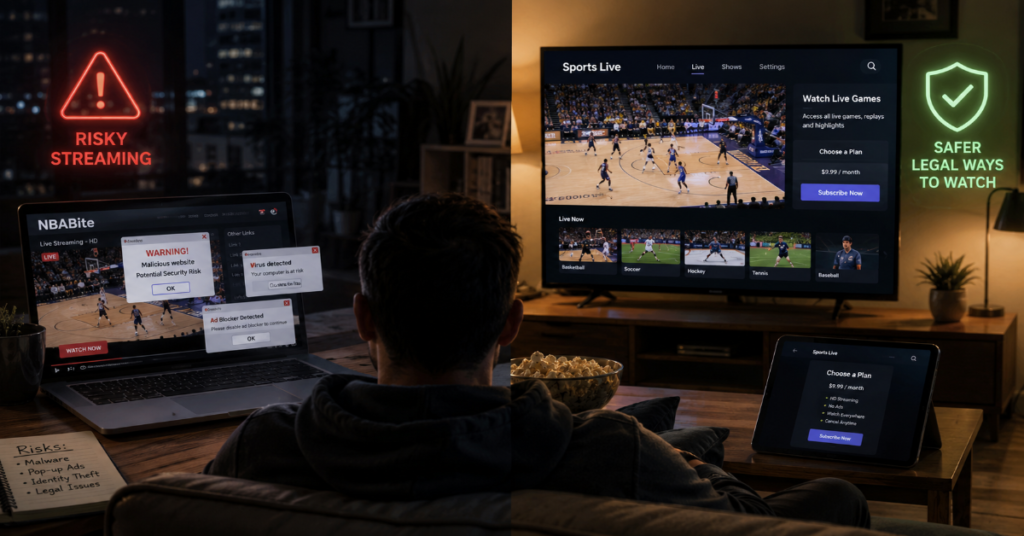
NBABite is a term many basketball fans search when they want quick access to live NBA games without paying for a subscription. In practice, NBABite-style sites are usually described as stream aggregation pages that point visitors toward third-party NBA streams, highlights or mirror links rather than official league broadcasts. The core issue is simple: free access does not automatically mean legal, safe or reliable.
The uploaded editorial brief frames the keyword around free NBA stream aggregation, while cautioning that it is not an official or clearly legal way to watch games and that safer legal options include NBA streaming services or licensed broadcasters in each region. That framing matters because the search intent behind NBABite is not just “where can I watch?” It is also “what am I risking?”
Live sports rights are valuable because leagues, broadcasters, teams and streaming platforms pay for exclusivity. The NBA’s current media structure includes official options such as NBA League Pass, local broadcasters and national partners. Beginning with the 2025-26 season, the NBA’s long-term U.S. media agreements run with Disney, NBCUniversal and Amazon through the 2035-36 season.
That shift makes the NBABite question more important, not less. More legal platforms can mean more confusion for fans. A game may be available on League Pass, blacked out locally, shown on a national broadcaster or locked behind a regional provider. When fans cannot quickly find the right legal route, unofficial streaming aggregators become tempting. The better answer is not to pretend those sites do not exist. The better answer is to explain how they work, what risks they carry and how to choose safer options.
What Is NBABite?
NBABite is generally associated with websites that promote access to NBA live streams, often by collecting or pointing to third-party stream links. These pages may present themselves as simple directories for games, highlights or live matchups. They are not the same as NBA League Pass, the NBA App or a licensed television provider.
The distinction is important. An official service has contracts, territorial rights, customer support, app-store accountability and payment infrastructure. A stream aggregation site often sits outside that structure. It may not host the original broadcast itself, but directing users toward unauthorized streams can still place the experience in a risky legal and technical category.
A useful comparison is the broader sports streaming aggregator market. Perplexity AI Magazine’s related SportSurge guide describes a similar model: a free sports streaming aggregator that helps users find live links across leagues, while raising safety and legality concerns. That makes it a relevant internal reference for readers who want to understand the wider category of unofficial sports streaming hubs.
Why Fans Search for NBABite
Fans usually search for NBABite for practical reasons. They may be traveling, facing a blackout, unable to afford multiple subscriptions or unsure which broadcaster owns a specific game. The NBA viewing map can be fragmented, especially in the United States and Canada where local and national blackout rules affect League Pass availability.
The NBA’s own League Pass support page states that blackout restrictions in the U.S. include local NBA teams and nationally broadcast games. Local games become available on demand three days after the live broadcast ends, while national games become available on demand at 6:00 a.m. ET the following day. The NBA also says blackout restrictions exist because local and national content providers hold exclusive rights to televise live games and content.
That creates a real user frustration: a fan may pay for League Pass and still discover that a specific game is unavailable live because it belongs to a local or national rights holder. NBABite-style searches often come from that gap between fan expectation and rights reality.
NBABite vs Official NBA Viewing Options
| Option | Legal status | Reliability | Main benefit | Main drawback |
| NBABite-style stream aggregators | Unclear or potentially unauthorized | Unstable | Free access claims | Legal, malware and quality risks |
| NBA League Pass | Official | High | Live and on-demand out-of-market games | Blackouts apply in some regions |
| Local broadcaster or cable login | Official | High | Best route for local games | May require TV package |
| National streaming partner | Official | High | Access to national games | Games split across platforms |
| Highlights on NBA platforms | Official | High | Safe clips and recaps | Not full live games |
NBA League Pass is the league’s official streaming product for live and on-demand NBA games, but it is not a universal replacement for all broadcasts. The NBA’s purchase page notes that users in some locations cannot view nationally broadcast games on ESPN, ABC, NBC, Peacock or Amazon Prime Video through League Pass, with national broadcasts becoming available later on demand.
The NBA App also supports League Pass viewing, including live and on-demand access for subscribers. For fans who want the safest route, the official NBA App, League Pass, local broadcasters and national streaming partners are the better starting points.
Legal Risk: Why Free NBA Streams Are Not Automatically Safe
The legal question around NBABite-style sites depends on jurisdiction, the site’s role and the nature of the stream. Still, the broad direction is clear: live sports broadcasts are protected commercial content, and unauthorized retransmission can create liability.
In the United States, the Protecting Lawful Streaming Act of 2020 increased criminal penalties for services that willfully and for commercial advantage or private financial gain illegally stream copyrighted material. The U.S. Patent and Trademark Office explains that the law changed illegal streaming from a misdemeanor framework to a stronger criminal enforcement regime for qualifying conduct.
That statute is primarily aimed at commercial illegal streaming services, not ordinary fans asking where to watch a game. But the viewer still faces practical risks. A site may disappear mid-game, redirect to unsafe pages, push misleading downloads or expose the user to phishing attempts. It may also lead users into a gray area where the stream itself is unauthorized.
The U.S. Copyright Office has also discussed how streaming can implicate different exclusive rights under copyright law, especially when copyrighted works are distributed without authorization. For NBA fans, the safest interpretation is straightforward: if a site is not licensed by the NBA, a broadcaster or a recognized streaming partner, it should not be treated as a trustworthy source.
Security Risk: Ads, Redirects and Fake Play Buttons
The biggest day-to-day risk for many users is not a courtroom. It is the browser.
Unofficial sports streaming pages often rely on aggressive ad networks, pop-ups, redirects, fake play buttons and mirror domains. These are not just annoying design choices. They are part of the business model. A visitor searching for a free game may be sent through several pages before any video appears, and each page can create another opportunity for scams, tracking or malware.
A 2022 study summarized by FACT found that all 50 illegal sports streaming sites analyzed contained malicious content, more than 90 percent were classified as risky and more than 40 percent had no security certificate. Another audiovisual piracy study summarized by the Audiovisual Anti-Piracy Alliance found malware risks through malicious ads, popups, fake browser extensions, notification hijacking and other delivery methods.
That does not mean every visitor will be infected instantly. It means the risk environment is structurally worse than on official platforms. A legal NBA stream has commercial incentives to protect user trust. A clone domain built around free access may have the opposite incentive: maximize clicks before the domain is blocked, abandoned or replaced.
Real-World Impact: Why Sports Piracy Keeps Returning
Sports piracy survives because live sports are urgent. A movie can be watched tomorrow. A basketball game loses much of its value after the final buzzer. That urgency makes fans more willing to click unsafe links, ignore browser warnings or accept poor stream quality.
The broader enforcement pattern shows how persistent the market is. In 2025, the Associated Press reported that the Streameast piracy network, described by ACE as a major illicit live sports streaming operation, had more than 1.6 billion visits in a year before being shut down. The report said the operation included 80 associated domains and offered unauthorized access to sports including the NBA, NFL, MLB and NHL.
That case is not about NBABite specifically. It is useful because it shows the scale of demand for unauthorized live sports streams and the domain-network model these platforms often use. When one address is blocked or seized, mirrors and replacements often appear.
For legitimate sports media companies, piracy also distorts the market. Broadcasters pay for rights, platforms invest in apps and leagues sell exclusivity. Unofficial stream sites benefit from that investment without carrying the same production, licensing, security or support costs.
Structured Insight Table: Main Risks Around NBABite-Style Sites
| Risk area | What users may notice | Why it matters | Safer response |
| Copyright uncertainty | Free live game links | Stream may be unauthorized | Use official NBA or licensed broadcaster sources |
| Malware exposure | Popups, fake buttons, redirects | Ads may deliver scams or malicious downloads | Avoid downloads, extensions and notification prompts |
| Privacy leakage | Tracking scripts, unknown domains | User data may be harvested or sold | Use official apps with clear privacy policies |
| Stream instability | Broken links, buffering, sudden shutdowns | Game experience may fail during key moments | Check authorized broadcast schedule first |
| Payment scams | “Verification” or fake premium pages | Card details may be stolen | Never enter payment data on unknown mirror sites |
| Device compromise | Browser alerts or forced APK downloads | Malware can persist beyond the stream | Do not install unknown files or apps |
Safer Legal Alternatives to NBABite
The safest alternative depends on where the fan lives and which game they want.
NBA League Pass is best for fans who follow out-of-market teams or want replays, condensed games and multiple broadcast feeds. The NBA says League Pass offers hundreds of out-of-market games live, plus full replays, condensed games and highlights, though restrictions apply in the U.S. and Canada.
Local broadcasters are usually the correct route for fans watching their home-market team. If a game is blacked out on League Pass, the reason is often that a local rights holder has the live broadcast rights. National games require the relevant national partner or streaming service.
For the 2025-26 season and beyond, fans should expect NBA games to be spread across Disney, NBCUniversal and Amazon platforms in the U.S. because the NBA’s 11-year agreements run through the 2035-36 season. That means “where to watch” will increasingly require checking the specific game, location and provider rather than assuming one service has everything.
Practical Viewing Workflow
A safer workflow starts before tipoff.
First, check the official NBA schedule or team schedule for the game. Then confirm whether it is local, national or out-of-market. If it is your local team, check the regional broadcaster. If it is national, check the national platform listed for that game. If it is out-of-market and not nationally restricted, League Pass may be the right option.
This workflow is less convenient than typing NBABite into a search engine, but it reduces the two biggest risks: landing on an unauthorized stream and exposing your device to malicious advertising.
For readers comparing unofficial sports streaming hubs more broadly, the site’s SportSurge guide is a useful companion because it explains a similar aggregator model and its safety trade-offs. For readers thinking about cybersecurity rather than sports rights, the site’s Erome cybersecurity guide is relevant because it explains how privacy, malware and unwanted downloads can become the real risk on media-heavy websites.
Three Original Insights for Readers
First, the blackout problem is not a bug in NBA League Pass. It is a rights-management feature. Many frustrated fans treat blackouts as technical failures, but they usually reflect exclusive territorial agreements. That means an unofficial stream is often filling a rights gap, not solving a technical problem.
Second, free sports streaming risk increases during high-demand games. Playoff games, rivalry matchups and nationally televised events create the most search traffic. That is exactly when clone domains, fake “HD stream” pages and malicious popups have the biggest incentive to appear.
Third, the safest legal choice may not be one subscription. The modern NBA viewing stack is fragmented by design. A fan may need League Pass for out-of-market games, a local provider for home-market games and a national service for marquee broadcasts. That is expensive, but it is also the reason unofficial aggregation sites keep attracting traffic.
The Future of NBABite in 2027
By 2027, NBABite-style demand will likely depend on three forces: media fragmentation, anti-piracy enforcement and product quality from official services.
The NBA’s U.S. media agreements with Disney, NBCUniversal and Amazon run through the 2035-36 season, which means the new platform mix will still be settling in during 2027. If fans find the official system clear, affordable and easy to navigate, the appeal of unofficial stream aggregators may weaken. If they find it confusing, expensive or blackout-heavy, search demand for free alternatives will remain strong.
Enforcement is also becoming more coordinated. The Streameast shutdown showed that anti-piracy groups and authorities can target large domain networks rather than single pages. France’s Arcom has also reported large-scale blocking of illegal live streaming and IPTV services, with 1,922 illegal services blocked at its request between January and August 2024.
The uncertain part is user behavior. Fans do not just want legality. They want a stream that starts quickly, works on mobile, has good quality and does not require a maze of subscriptions. If official NBA viewing becomes simpler by 2027, unofficial aggregators lose some appeal. If it becomes more fragmented, NBABite-style searches will remain part of the fan internet.
Key Takeaways
• NBABite is best understood as a search term tied to unofficial NBA stream aggregation, not an official NBA product.
• The main legal concern is unauthorized retransmission of copyrighted live sports broadcasts.
• The main user safety concern is exposure to risky ads, redirects, fake play buttons and malicious downloads.
• League Pass is official, but blackouts mean it does not carry every game live in every location.
• The NBA’s new media rights era makes legal viewing more widely distributed across major platforms.
• Fans should check the game’s official broadcast source before turning to search-engine results.
• Free access can be more expensive than it looks if it compromises privacy, devices or payment details.
Conclusion
NBABite exists because NBA fans want fast, free and simple access to live basketball. That demand is understandable, especially when official viewing can be split across League Pass, local broadcasters and national streaming partners. But convenience is not the same as safety.
The central problem with NBABite-style sites is uncertainty. Users often cannot verify who controls the stream, whether the broadcast is licensed, what ad networks are running behind the page or whether a mirror domain is safe. Official options may cost more and require more planning, but they offer clearer rights, better reliability, customer support and lower device risk.
For most fans, the practical answer is not complicated: use the NBA’s official tools, licensed broadcasters or recognized streaming partners whenever possible. Treat free stream aggregators as high-risk environments, especially during major games when fake pages and malicious ads are most likely to appear.
FAQ
Is NBABite official?
No. NBABite is not an official NBA service. It is commonly associated with free NBA stream aggregation, which means users may be directed toward third-party streams rather than licensed league or broadcaster feeds.
Is it legal to watch NBA games through NBABite?
It depends on the jurisdiction and the stream, but unauthorized live sports streams can involve copyrighted content. In the U.S., illegal streaming services can face serious penalties under the Protecting Lawful Streaming Act.
Why are some NBA games blacked out on League Pass?
Blackouts happen because local and national broadcasters may hold exclusive live rights. The NBA says U.S. League Pass blackouts include local NBA teams and nationally broadcast games.
What is the safest alternative to NBABite?
The safest option is to use NBA League Pass, the NBA App, a local broadcaster or the national streaming partner assigned to the game. The right choice depends on your location and the game’s broadcast rights.
Can free sports streaming sites harm my device?
Yes. Research summarized by FACT found that illegal sports streaming sites can expose users to malicious content, risky pages, scams and unsafe redirects.
Does NBA League Pass show every game live?
No. NBA League Pass carries many live and on-demand games, especially out-of-market games, but blackouts and national broadcast restrictions apply in some regions.
Why do NBABite-style sites keep changing domains?
Unofficial streaming sites often use mirror domains because of blocking, takedowns, enforcement pressure or ad-network churn. That instability is one reason users should treat them cautiously.
Methodology
This article was prepared from the uploaded editorial brief, official NBA support and League Pass pages, U.S. copyright guidance, anti-piracy research summaries and current reporting on sports piracy enforcement. The analysis avoids claiming firsthand testing of NBABite domains because no live site testing was conducted for this draft. Instead, it relies on documented patterns from comparable sports streaming aggregator coverage, official NBA viewing rules and published piracy-risk research.
Known limitations: streaming laws vary by country, individual domains change quickly and availability of NBA games depends on a viewer’s region, provider and broadcast schedule. Before publication, a human editor should verify all citations, confirm internal links are live and check the latest NBA viewing options for the target audience.
References
Alliance for Creativity and Entertainment enforcement reporting via Associated Press. (2025). Report on Streameast shutdown and illicit live sports streaming scale.
Audiovisual Anti-Piracy Alliance. (2022). Study on malware and audiovisual piracy highlights significant risks to European consumers.
FACT. (2022). New research finds illegal sports streaming sites expose fans to financial fraud, dangerous scams and explicit content.
National Basketball Association. (2024). NBA announces new 11-year media agreements.
National Basketball Association. (2026). NBA League Pass support and blackout guidance.
National Basketball Association. (2026). NBA App and League Pass access information.
U.S. Patent and Trademark Office. (2021). Protecting Lawful Streaming Act of 2020.
