
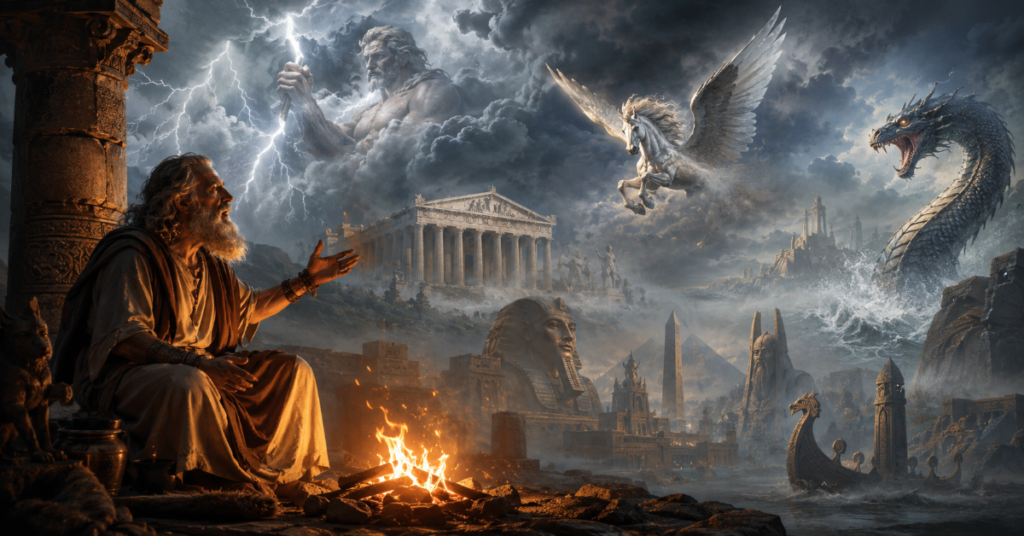
Mythology stories are ancient narratives that explain natural phenomena, cultural beliefs and moral lessons through gods, monsters, heroes and symbolic events. They helped early societies answer questions that science, law and philosophy had not yet separated into formal disciplines: Why does suffering exist? What happens when power is misused? Why do humans chase knowledge, beauty, immortality and glory even when the cost is clear?
The Greek story of Icarus warns against reckless ambition. Echo and Narcissus turns beauty into a mirror of self-destruction. Pandora’s jar explains the arrival of human suffering. The 12 Labors of Heracles show strength tested by discipline rather than muscle alone. Outside Greece, Hindu accounts of Bhasmasura show the danger of power without restraint. Norse tradition presents Odin’s sacrifice on the world tree as a brutal exchange for wisdom. The Sumerian Epic of Gilgamesh, one of the oldest surviving literary works, follows a king who learns that mortality cannot be conquered by force.
These stories matter because they still organize modern imagination. Superhero films, fantasy novels, political speeches, video games and brand narratives continue to borrow mythic patterns: the fall, the test, the forbidden gift, the descent, the sacrifice and the return. The myths changed form, but the questions remained.
Why Mythology Stories Survive
Myths survive when they do more than explain one event. A simple weather story may fade. A story that connects weather, family conflict, morality and power can remain useful for thousands of years.
Greek mythology, for example, preserved stories about gods, heroes, monsters and rituals. Britannica notes that Greek myths explained natural events, shaped moral values and influenced art and literature across Western civilization. That combination gave mythology unusual durability. It was religious memory, public instruction and artistic raw material at once.
| Mythic Function | What It Explains | Example |
| Origin story | How something began | Pandora and human suffering |
| Moral warning | What behavior leads to ruin | Icarus flying too close to the sun |
| Heroic model | How courage is tested | Heracles completing impossible labors |
| Ritual meaning | Why a custom matters | Seasonal, divine or purification myths |
| Cultural identity | Who a people believe they are | Amaterasu and Japanese imperial symbolism |
The key insight is that myths rarely have one meaning. Icarus can be read as a warning against arrogance, a story about failed technology, a father-son tragedy or a meditation on youth and limits. That flexibility is why mythology stories remain useful long after their original religious settings changed.
Famous Greek Mythology Stories
Greek mythology became one of the world’s most influential mythic systems because its stories were preserved in epic poetry, drama, sculpture, philosophy and later Roman literature. Homer, Hesiod, Ovid and later mythographers gave these tales literary form, but many stories came from older oral traditions.
Icarus and Daedalus
Daedalus was the great inventor associated with the Labyrinth built for King Minos of Crete. Britannica identifies him as a mythical Greek inventor, architect and sculptor. In the best-known version, Daedalus builds wings of feathers and wax so he and his son Icarus can escape imprisonment.
The warning is simple but not shallow. Icarus is told not to fly too low because the sea will weigh down the wings and not too high because the sun will melt the wax. He ignores the middle path. His fall is often treated as a lesson about arrogance, but it is also a story about technological risk. Innovation gives humans new reach, but reach without judgment becomes danger.
Echo and Narcissus
Narcissus is remembered for falling in love with his own reflection. Britannica describes him as the beautiful son of the river god Cephissus and the nymph Liriope, with Ovid’s Metamorphoses preserving the famous version involving Echo.
The story feels modern because it is not only about vanity. It is about failed recognition. Echo can only repeat. Narcissus can only see himself. Neither can form a complete human relationship. In a digital culture shaped by image, attention and self-display, the myth has gained new force.
Apollo and Daphne
Apollo and Daphne is a transformation myth. Daphne, pursued by Apollo, escapes by being changed into a laurel tree. Transformation in mythology often works as rescue and loss at the same time. Daphne survives, but she does not remain human.
This pattern appears across cultures. When a person becomes a tree, star, stone, bird or river, the myth turns trauma into landscape. Nature becomes a memory archive.
Pandora’s Jar
The familiar phrase is Pandora’s box, but the older Greek image is usually understood as a jar. Hesiod’s Works and Days connects Pandora with the release of troubles into human life after Prometheus steals fire. Harvard’s Center for Hellenic Studies provides a primary-source translation of Works and Days, while Britannica explains that later translation history helped popularize “box” rather than jar.
Pandora is often reduced to curiosity, but the older myth is darker. It reflects anxiety about divine punishment, gender, labor and the cost of human progress. Fire brings civilization. Civilization brings suffering.
The 12 Labors of Heracles
Heracles is not simply strong. His labors force him to confront monsters, kings, impossible logistics and divine politics. The point is not strength alone. The labors turn raw force into disciplined service.
That is why Heracles remains a model for heroic endurance. He suffers, adapts, cleans, captures, descends and returns. The hero’s journey is not glamorous in practice. It is often repetitive, humiliating and exhausting.
World Mythology Stories Beyond Greece
Greek mythology dominates many English-language search results, but world mythology is much wider. The best comparison is not “which culture had better myths,” but what different cultures used myth to explain.
| Tradition | Story | Core Conflict | Main Lesson |
| Greek | Icarus and Daedalus | Flight beyond safe limits | Ambition needs restraint |
| Hindu | Bhasmasura | Power misused against its source | Gifts without wisdom self-destruct |
| Norse | Odin’s sacrifice | Pain exchanged for knowledge | Wisdom has a price |
| Sumerian | Gilgamesh | A king seeks immortality | Mortality gives life urgency |
| Japanese | Amaterasu in the cave | Cosmic darkness after divine withdrawal | Social harmony restores light |
| Egyptian | Osiris, Isis and Horus traditions | Betrayal, death and succession | Order must be restored after chaos |
Bhasmasura: Power Without Wisdom
Bhasmasura is a Hindu mythic figure associated with a dangerous boon: the ability to reduce anyone to ashes by touching their head. In popular versions, he becomes intoxicated by this power and is tricked into destroying himself. Recent cultural retellings still interpret the story as a warning about ego, unrestrained ambition and destructive gifts.
The story’s modern relevance is obvious. Tools, titles, money, weapons, platforms and algorithms can all become Bhasmasura-like powers. The danger is not only possession of power. The danger is receiving power before developing judgment.
Odin’s Sacrifice for the Runes
Norse mythology gives wisdom a severe cost. The Hávamál, part of the Poetic Edda tradition, describes Odin sacrificing himself to himself and hanging on the world tree to gain knowledge of the runes. EBSCO summarizes the myth as a story of sacrifice, wisdom and transformation.
This is not a cheerful knowledge myth. Odin does not gain wisdom by reading comfortably. He suffers for it. The deeper idea is that certain kinds of knowledge change the seeker. Real wisdom is not information. It is transformation under pressure.
Gilgamesh: The King Who Could Not Defeat Death
The Epic of Gilgamesh is often described as the oldest surviving epic work of world literature. World History Encyclopedia dates the epic tradition broadly to around 2150 to 1400 BCE and notes that it predates Homer’s Iliad and Odyssey by roughly 1,500 years. The Metropolitan Museum of Art also identifies Gilgamesh as a legendary king of Uruk, while noting that no contemporary information confirms him as a fully historical figure.
Gilgamesh begins as power without maturity. Enkidu’s friendship humanizes him. Enkidu’s death breaks him. The search for immortality becomes the king’s final education: he cannot escape death, but he can build meaning within mortal limits.
Amaterasu and the Cave of Heaven
In Japanese mythology, the sun goddess Amaterasu withdraws into a cave, plunging the world into darkness. Nippon.com, in a 2025 cultural article on Kojiki traditions, describes the other deities gathering to lure her out after heaven loses its light.
The myth is striking because light returns through performance, laughter, ritual and collective action. The world is not restored by one warrior’s violence. It is restored by social choreography. That makes the story one of mythology’s clearest accounts of community repair.
Common Themes Across Mythology Stories
Myths differ in names and symbols, but their recurring structures are easy to trace.
Transformation: Daphne becomes a tree. Narcissus becomes a flower. In many traditions, transformation protects, punishes or memorializes.
Forbidden knowledge: Pandora opens the jar. Odin seeks the runes. Gilgamesh searches for immortality. Knowledge is never neutral in myth. It changes the world or the seeker.
Misused power: Bhasmasura receives a gift he cannot morally manage. Icarus receives flight but lacks restraint.
Divine-human tension: Humans want divine freedom, but myths remind them of limits.
Restoration of order: Egyptian, Japanese and Greek stories often move from chaos to renewed order, though not without loss.
Practical Implications for Modern Readers
The practical value of mythology stories is not memorizing names. It is learning to recognize patterns.
A founder who scales a company too fast is living an Icarus pattern. A public figure trapped by image is moving through a Narcissus pattern. A state or corporation that creates a power it cannot control is repeating Bhasmasura. A researcher who sacrifices comfort for difficult knowledge resembles Odin. A leader who realizes mortality too late echoes Gilgamesh.
This is why myths still matter in education and media analysis. They provide compact models for human behavior. They do not replace history or psychology, but they give readers a symbolic vocabulary for ambition, grief, pride, sacrifice and repair.
Risks and Trade-Offs in Reading Mythology
Mythology also carries risks when read carelessly.
First, myths can be flattened into simple morals. Icarus becomes “do not be ambitious,” when the better lesson is “ambition needs proportion.” Pandora becomes “curiosity is bad,” when the myth is also about divine punishment, gender politics and the cost of civilization.
Second, myths can be stripped from their cultures. A Norse symbol, Hindu tale or Japanese goddess should not be treated as generic fantasy material without context.
Third, myths often preserve ancient hierarchies. Some stories contain patriarchal assumptions, violent social codes or divine justifications for suffering. A serious reader can value mythology without pretending every ancient message is ethically acceptable today.
The Future of Mythology Stories in 2027
By 2027, mythology stories will likely become even more visible in digital culture, especially through streaming series, games, AI-assisted storytelling, classroom media and short-form educational content. The trend is already visible in how myths are retold across platforms: Medusa becomes a symbol of survival, Narcissus becomes a framework for image culture and Gilgamesh appears in literature, gaming and comparative religion.
The opportunity is wider access. Readers who never studied classics can now encounter Greek, Sumerian, Hindu, Norse and Japanese myths through museums, open translations, documentaries and digital archives.
The risk is context collapse. Fast content often extracts a myth’s most dramatic scene while losing its religious, linguistic and historical frame. By 2027, the strongest mythology coverage will not be the loudest retelling. It will be the work that connects story, source, culture and interpretation.
Key Takeaways
- Mythology stories survive because they explain human patterns, not just ancient beliefs.
- Greek myths remain influential because they were preserved through literature, art and later education.
- World mythology offers equally powerful frameworks for power, sacrifice, mortality and social repair.
- Icarus is not only about arrogance. It is also about risk management.
- Bhasmasura remains relevant as a warning about giving power without wisdom.
- Gilgamesh turns kingship into a meditation on friendship, grief and mortality.
- Modern readers should treat myths as cultural texts, not loose fantasy fragments.
Conclusion
Mythology stories endure because they speak in images that ordinary argument cannot replace. A boy falling from the sky, a king searching for eternal life, a goddess hiding the sun, a god suffering for knowledge and a demon destroyed by his own gift all remain vivid because they compress complex truths into memorable action.
The best way to read mythology is neither blind belief nor casual dismissal. Myths are cultural technologies. They helped societies preserve warnings, explain suffering, honor courage and debate the limits of power. Some contain wisdom. Some contain prejudice. Many contain both.
For modern readers, their value lies in careful interpretation. Read them as stories, but also as maps of human fear and desire. The names are ancient. The patterns are still here.
FAQ
What are mythology stories?
Mythology stories are traditional narratives about gods, heroes, monsters and sacred events. They often explain natural phenomena, cultural customs, moral lessons or the origins of suffering, death, power and social order.
What are the most famous Greek mythology stories?
The most famous Greek mythology stories include Icarus and Daedalus, Echo and Narcissus, Apollo and Daphne, Pandora’s jar and the 12 Labors of Heracles. These stories remain popular because they address ambition, beauty, transformation, suffering and endurance.
Why did ancient cultures create myths?
Ancient cultures used myths to explain the world before modern science and formal history. Myths also preserved moral codes, ritual meanings, political identity and collective memory.
What is the lesson of Icarus?
The Icarus myth warns against ambition without restraint. It does not say flight is wrong. It says new power requires judgment, discipline and respect for limits.
Is Gilgamesh a mythology story?
Yes. Gilgamesh belongs to Mesopotamian mythology and epic literature. The story follows a legendary king of Uruk who seeks immortality after the death of his friend Enkidu.
What do mythology stories teach modern readers?
They teach readers to recognize patterns: pride before collapse, power without wisdom, sacrifice for knowledge, grief after friendship and the need to restore order after chaos.
Methodology
This article was developed from the supplied Perplexityaimagazine.com production prompt and its keyword detail field. The analysis used reference sources including Britannica, World History Encyclopedia, the Metropolitan Museum of Art, Harvard’s Center for Hellenic Studies, Nippon.com and EBSCO summaries for mythological context.
Limitations: myths vary by region, translation and period. No single retelling should be treated as the only authoritative version. Before publication, a human editor should verify all references, confirm preferred spellings and add only live internal links that are topically relevant. One relevant internal candidate found on Perplexityaimagazine.com during review was the site’s recent Medusa symbolism article.
References
Britannica. (2026). Daedalus. Encyclopaedia Britannica.
Britannica. (2026). Icarus. Encyclopaedia Britannica.
Britannica. (n.d.). Greek mythology. Encyclopaedia Britannica.
Britannica. (n.d.). Narcissus. Encyclopaedia Britannica.
Center for Hellenic Studies, Harvard University. (n.d.). Hesiod, Works and Days.
EBSCO. (n.d.). Odin’s discovery of the runes.
Mark, J. J. (2022). Gilgamesh. World History Encyclopedia.
Metropolitan Museum of Art. (2009). Gilgamesh.
Nippon.com. (2025). The Sun Goddess Amaterasu and the Cave of Heaven.
Times of India. (2025). What Bhasmasura teaches us about power and self-destruction.
