
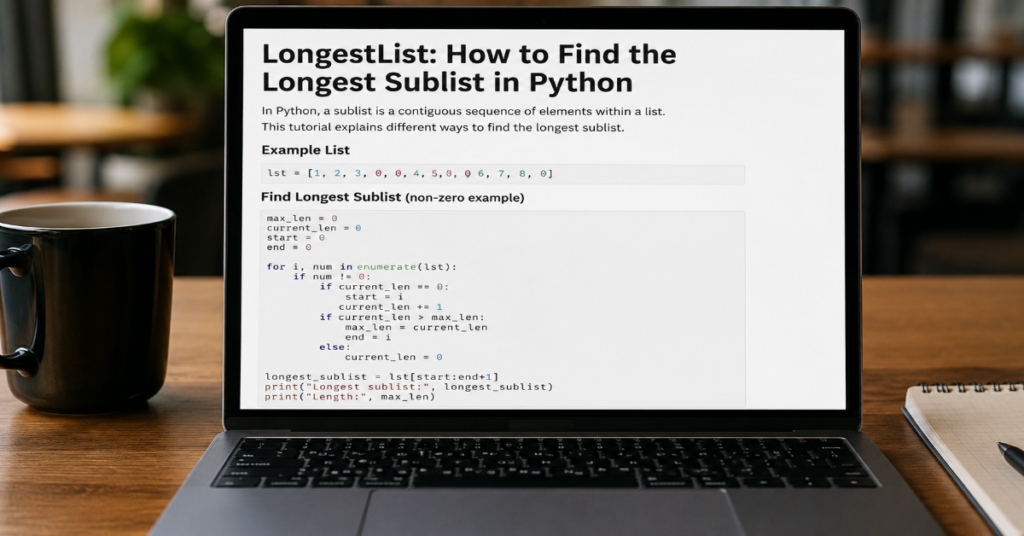
The keyword longestlist most commonly points to a programming problem: given a list of lists, find the inner list with the greatest length. In Python, the shortest correct answer is usually max(lists, key=len), because max() can compare items by a custom key rather than by their raw value. Python’s official documentation confirms that max() supports a key argument and a default value for empty iterables.
That simple answer is useful, but it is not always enough. Real code has edge cases. What should happen if the outer list is empty? What if two sublists have the same length? Should the function return the first longest sublist, all matching sublists or only the length? Those decisions matter in interviews, data processing scripts, API utilities and teaching examples.
The uploaded brief frames longestlist as a multi-intent keyword covering Python, Prolog, Haskell, Grasshopper and a record-themed curiosity website. It also specifies that the main user need is a Python function to find the longest sublist. This article therefore treats Python as the primary answer, then explains the related meanings so readers do not confuse a coding problem with the Grasshopper “Longest List” component or the old “longest stuff” website.
What longestlist Means in Programming
In programming, longestlist is not usually a formal library name. It is a search phrase people use when they want a function that identifies the longest nested list inside a larger list.
Example:
lists = [[1, 2], [3, 4, 5], [6]]
The longest sublist is:
[3, 4, 5]
The problem looks small, but it appears in many real scenarios:
| Use case | What the “longest list” represents | Practical concern |
| CSV or JSON processing | Row with the most fields | Detect malformed records |
| NLP pipelines | Sentence with most tokens | Handle truncation limits |
| Analytics scripts | User with most events | Avoid memory-heavy sorting |
| Teaching examples | Nested list comparison | Explain key=len clearly |
| Geometry workflows | Longest branch or data stream | Align list lengths safely |
The core operation is not “find the biggest values.” It is “find the item whose length is biggest.” That distinction is why the key argument matters.
The Best Python Function for longestlist
For normal Python code, this is the most direct function:
def longest_sublist(items):
return max(items, key=len)
Usage:
data = [[1, 2], [3, 4, 5], [6]]
print(longest_sublist(data))
Output:
[3, 4, 5]
Python’s max() returns the largest item from an iterable. With key=len, it compares each sublist by length instead of comparing the lists directly. The official Python sorting guide explains that key functions are called once for each input record, which is why this pattern is efficient and idiomatic. (Python documentation)
A Safer Function for Empty Input
The quick version breaks if the outer list is empty:
max([], key=len)
That raises:
ValueError: max() arg is an empty sequence
A safer version uses default:
def longest_sublist(items):
return max(items, key=len, default=[])
Now:
print(longest_sublist([]))
Output:
[]
This is usually the best beginner-friendly version because it avoids a runtime error. Python’s documentation states that default is returned when the iterable is empty, while omitting it raises ValueError. (Python documentation)
Handling Ties: First Match or All Matches?
Python’s max() returns one item. If two sublists have the same maximum length, the first one wins.
data = [[1, 2, 3], [“a”, “b”, “c”], [9]]
print(max(data, key=len))
Output:
[1, 2, 3]
That behavior is often fine. But sometimes you need all longest sublists:
def all_longest_sublists(items):
if not items:
return []
max_length = max(len(item) for item in items)
return [item for item in items if len(item) == max_length]
Usage:
data = [[1, 2, 3], [“a”, “b”, “c”], [9]]
print(all_longest_sublists(data))
Output:
[[1, 2, 3], [‘a’, ‘b’, ‘c’]]
This version makes the tie rule explicit. That is better for production code because a future reader does not have to infer the behavior from max().
Comparison of Python Approaches
| Approach | Code pattern | Best for | Trade-off |
| max(items, key=len) | One line | Clean scripts and interviews | Fails on empty input |
| max(items, key=len, default=[]) | One line with fallback | Safer utility functions | Empty result may hide bad input |
| Manual loop | Track longest as you iterate | Teaching and custom logic | More code |
| Return all ties | Two-pass method | Fair tie handling | Slightly more work |
| Sort by length | sorted(items, key=len)[-1] | Rarely needed | Wasteful for one result |
The sorting approach is usually the weakest option. Sorting the full list does more work than needed when the goal is only to find one longest sublist. max() scans once, which is the right mental model for this problem.
Manual Loop Version for Beginners
A manual loop is longer, but it is easier to explain to new programmers:
def longest_sublist(items):
longest = []
for item in items:
if len(item) > len(longest):
longest = item
return longest
This works because the function keeps a current winner. Each new sublist is compared against that winner. If it is longer, it replaces the winner.
The limitation is that this version assumes [] is a sensible default. That may be true for many tutorials, but not always. In strict software, returning None may be clearer:
def longest_sublist(items):
if not items:
return None
longest = items[0]
for item in items[1:]:
if len(item) > len(longest):
longest = item
return longest
That version distinguishes “there was no input” from “the longest sublist was an empty list.”
Data Quality Risks and Edge Cases
The longestlist problem is simple only when the input is clean. These are the cases worth checking:
| Edge case | Example | Recommended behavior |
| Empty outer list | [] | Return [], return None or raise a clear error |
| Empty inner lists | [[], [1]] | Treat empty lists as length 0 |
| Tie | [[1, 2], [3, 4]] | Document whether first or all are returned |
| Non-list item | [[1], “abc”] | Decide whether strings are allowed |
| None inside data | [[1], None] | Validate before calling len() |
| Mixed iterable types | [[1], (2, 3)] | Accept if any sized iterable is valid |
A strong utility function validates its input:
from collections.abc import Sized
def longest_sized_item(items):
if not items:
return None
for item in items:
if not isinstance(item, Sized):
raise TypeError(f”Item has no length: {item!r}”)
return max(items, key=len)
This version is not just for lists. It works for tuples, strings and other objects that support len(). That flexibility can be useful, but it also changes the meaning of the function. A string can become the “longest item,” which may surprise readers expecting only lists.
Practical Implications for Real Code
The real issue is not the algorithm. It is the contract.
A beginner might ask, “How do I find the longest list?” A production engineer asks, “What should the function promise when the input is empty, messy or tied?”
That contract should be visible in the function name, docstring and tests.
Example:
def first_longest_sublist(items):
“””
Return the first sublist with the greatest length.
Returns None if items is empty.
Raises TypeError if any item does not support len().
“””
if not items:
return None
return max(items, key=len)
Good naming prevents confusion. first_longest_sublist() tells readers that ties return the first match. all_longest_sublists() tells them ties are preserved. longest_sized_item() tells them the input does not have to be a list of lists.
For developers working with AI coding tools, this distinction matters. Coding assistants can generate the one-line answer quickly, but they often need precise instructions to include edge cases, tests and error handling. Perplexity AI Magazine’s guide to GitHub Copilot makes a similar point about AI coding assistants accelerating programmers without replacing judgment. (Perplexityaimagazine.com)
Testing the Function
A reliable longestlist function should be tested with normal cases and edge cases:
def first_longest_sublist(items):
if not items:
return None
return max(items, key=len)
def test_first_longest_sublist():
assert first_longest_sublist([[1], [1, 2], []]) == [1, 2]
assert first_longest_sublist([]) is None
assert first_longest_sublist([[1, 2], [3, 4]]) == [1, 2]
assert first_longest_sublist([[], []]) == []
These tests document the function’s behavior better than a paragraph of explanation.
How Haskell Handles the Same Idea
In Haskell, the comparable idea is commonly written with maximumBy and a comparison based on length:
import Data.List (maximumBy)
import Data.Ord (comparing)
longestList xs = maximumBy (comparing length) xs
The Haskell Data.List documentation describes maximumBy as a function that takes a comparison function and returns the greatest element of a finite, non-empty list. (haskell.org)
The important difference from Python is that Haskell’s type system forces more clarity about what the list contains. Python gives faster convenience. Haskell gives stronger compile-time structure.
How Prolog Handles longestList
In Prolog, a longest list predicate is often written recursively. SWI-Prolog’s list library includes common predicates such as length/2 and list utilities used in this kind of logic programming task. (swi-prolog.org)
A simplified Prolog version looks like this:
longestList([X], X).
longestList([H|T], Longest) :-
longestList(T, Temp),
length(H, HLen),
length(Temp, TLen),
(HLen >= TLen -> Longest = H ; Longest = Temp).
This is not the same style as Python. Python asks for a value through a function call. Prolog describes relationships and lets the engine resolve them through predicates.
Grasshopper’s “Longest List” Is a Different Concept
Grasshopper uses “Longest List” as a data matching component in visual programming. It is not about finding the longest sublist as a returned value. It is about growing or aligning lists to the longest length among them. Grasshopper documentation describes the component as one that grows a collection of lists to the longest length among them. (Grasshopper Docs)
That distinction is important:
| Context | Meaning of longest list | Output |
| Python | Find the inner list with the greatest length | One sublist or multiple tied sublists |
| Haskell | Select maximum element by length | One list |
| Prolog | Predicate finds longest nested list | One matching list |
| Grasshopper | Grow shorter lists to match longest length | Synchronized data streams |
| Website meaning | Record-themed “longest stuff” site | Curiosity content |
Grasshopper users searching for longestlist probably need data matching help, not a Python function.
The Website Meaning
There is also a web curiosity angle. A site called “The Longest List of the Longest Stuff at the Longest Domain Name at Long Last” has been associated with record-style pages about longest words, place names, movies, bridges and similar topics. A current page says the site is being restored as an internet curiosity website.
For search intent, this is secondary. Most technical users typing longestlist are likely looking for code, not trivia. Still, the website meaning explains why the keyword can look ambiguous in search results.
The Future of longestlist in 2027
The core programming problem will not change by 2027. Finding the longest sublist is a stable operation. What will change is how often people ask AI coding tools to generate it, explain it and adapt it to edge cases.
The most likely shift is not a new algorithm. It is better context-aware code generation. AI coding assistants already help developers generate, debug and explain code inside common tools, and Perplexity AI Magazine has covered how Copilot fits into real developer workflows. (Perplexityaimagazine.com) Similar AI development guides now emphasize structured outputs, function calling and production deployment constraints rather than one-off snippets. (Perplexityaimagazine.com)
By 2027, the better answer to longestlist will likely include:
- A one-line solution for learners
- A safe function for real projects
- Tests
- Type hints
- Tie behavior
- Empty-input behavior
- A short explanation of complexity
That is the real future of the topic: not more complexity, but more explicit contracts around simple code.
Takeaways
- The clean Python answer is max(items, key=len), but safe code should handle empty input.
- max(items, key=len, default=[]) is compact, but returning None may be clearer in strict applications.
- Ties should be documented because max() returns only the first longest match.
- Sorting is usually unnecessary when only one longest sublist is needed.
- Grasshopper’s “Longest List” means list synchronization, not selecting one sublist.
- Haskell and Prolog solve the same idea through different programming models.
- The best production function is the one whose edge-case behavior is obvious from its name and tests.
Conclusion
longestlist is a small keyword with several meanings, but the dominant programming intent is clear: find the longest sublist inside a list of lists. In Python, max(items, key=len) is the idiomatic solution because it compares each inner list by length rather than by value. For real code, the better answer adds decisions about empty input, ties and invalid items.
The main lesson is that simple code still needs a clear contract. A one-line function is perfect for a tutorial or interview warm-up. A production helper should explain what happens when there is no data, when multiple sublists share the same length and when the input is not actually a list of lists. That is where reliable programming begins.
FAQ
What does longestlist mean in Python?
It usually means finding the longest sublist inside a list of lists. The common Python solution is max(items, key=len), which returns the inner list with the greatest length.
How do I find the longest sublist in Python?
Use:
max(items, key=len)
For empty input, use:
max(items, key=len, default=[])
Python’s documentation supports both the key and default arguments for max(). (Python documentation)
What happens if two sublists have the same length?
max(items, key=len) returns the first matching sublist with the maximum length. To return all tied sublists, calculate the maximum length first, then filter the list.
Is sorting needed to find the longest list?
No. Sorting is usually unnecessary. max() is better because it scans for the best item directly instead of ordering every item.
What is Grasshopper Longest List?
In Grasshopper, Longest List is a data matching component that grows shorter lists to match the longest list length. It is used for synchronizing data streams, not for returning one longest sublist. (Grasshopper Docs)
How does Haskell find the longest list?
Haskell commonly uses maximumBy (comparing length) from Data.List and Data.Ord. maximumBy returns the greatest element according to a comparison function. (haskell.org)
Methodology
This article was drafted from the uploaded editorial brief, which defines the keyword, intended angle and required structure. The technical explanation was checked against Python’s official documentation for max(), Python’s sorting guide for key functions, Haskell documentation for maximumBy, SWI-Prolog list documentation, Grasshopper component documentation and currently visible information about the record-themed longest list website. (Python documentation)
References
Python Software Foundation. (2026). Built-in functions: max(). Python documentation. (Python documentation)
Python Software Foundation. (2026). Sorting techniques. Python documentation. (Python documentation)
Haskell.org. (n.d.). Data.List: maximumBy. Haskell documentation. (haskell.org)
SWI-Prolog. (n.d.). library(lists): List manipulation. SWI-Prolog documentation. (swi-prolog.org)
Grasshopper Docs. (n.d.). Longest List component. Grasshopper Sets documentation. (Grasshopper Docs)
Perplexity AI Magazine. (2026). GitHub Copilot explained: AI coding assistant in practice. (Perplexityaimagazine.com)
Perplexity AI Magazine. (2026). Google Gemini API guide for developers 2026. (Perplexityaimagazine.com)
