
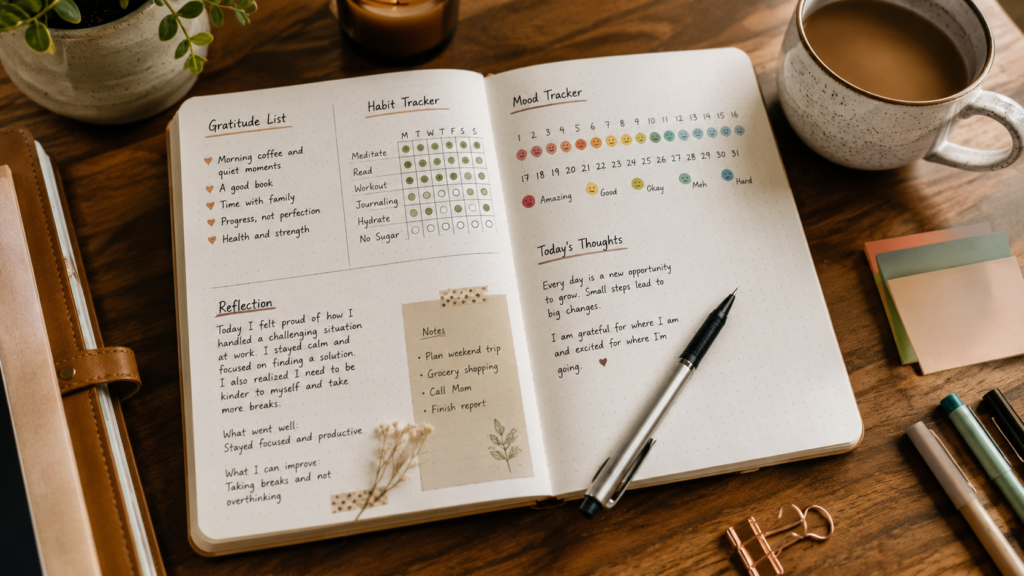
Journaling techniques are structured ways of turning thoughts, emotions and daily experiences into written reflection. Some are simple, such as writing one line before bed. Others are more deliberate, including morning pages, bullet journaling, gratitude lists, dream logs or unsent letters. The real value is not the notebook itself. It is the mental process created by pausing, naming what is happening and noticing patterns that are easy to miss in the rush of ordinary life.
In 2026, journaling sits at an interesting cultural moment. It is both old-fashioned and newly relevant. People are using paper notebooks to escape screen fatigue, digital apps to track mood and AI-assisted tools to generate prompts. Research has also kept the conversation grounded. A 2022 review in Family Medicine and Community Health found that journaling may help some people manage mental illness, while also noting that clear evidence-based guidelines remain limited. That distinction matters. Journaling is useful, accessible and low cost, but it is not magic.
The best approach is practical: select one method, define a purpose and keep the routine small enough to repeat. A person trying to manage overwhelm may benefit from morning pages. Someone managing work, study or habits may prefer bullet journaling. A reader looking to cultivate positivity may find gratitude journaling more sustainable.
The deeper point is simple. Journaling is not about writing beautifully. It is about thinking honestly.
What Journaling Actually Does
Journaling gives internal experience an external form. That sounds abstract, but the mechanism is practical. When a person writes down a worry, memory or decision, the mind no longer has to hold it in a vague cloud. The thought becomes something that can be named, questioned, organized or released.
The American Psychological Association has highlighted expressive writing as a tool that can help people work through difficult life experiences, especially when the writing process encourages emotional processing rather than simple venting. HelpGuide’s 2026 mental wellness guidance similarly frames journaling as a way to declutter the mind, organize thoughts, process emotions and identify patterns.
That makes journaling techniques especially useful for four common needs:
| Need | Best-fit technique | Why it helps |
| Mental clutter | Morning pages | Clears unfiltered thoughts before the day starts |
| Emotional conflict | Unsent letter | Creates honest expression without social fallout |
| Planning | Bullet journaling | Turns tasks, notes and events into one visible system |
| Positivity | Gratitude journaling | Trains attention toward what is working |
| Self-discovery | Prompt journaling | Uses questions to surface values, fears and desires |
| Memory | Captured moments | Records sensory detail before it fades |
| Creativity | Visual journaling | Uses images, colors and fragments when words feel limited |
The hidden advantage is pattern recognition. One entry may feel ordinary. Ten entries can reveal recurring triggers, repeated goals, neglected needs or unresolved decisions.
Journaling Techniques for Mental Clarity
Morning Pages
Morning pages are a stream-of-consciousness practice, usually done after waking. The method is simple: write two or three pages of whatever comes to mind. Grammar, structure and insight are not the point. The goal is to empty mental noise before it hardens into distraction.
This method works well for people who wake up with racing thoughts. It can capture worries, unfinished tasks, emotional residue from the previous day and random ideas. The result is not always beautiful. Sometimes it is messy, repetitive and blunt. That is part of the value.
A practical version for busy readers is the five-minute morning dump:
- Write everything currently occupying your mind.
- Circle anything that requires action.
- Put one clear next step beside each circled item.
- Close the notebook and begin the day.
This technique turns vague anxiety into a smaller set of visible items.
The 5 Whys Technique
The 5 Whys technique comes from root-cause analysis, but it adapts well to personal reflection. Start with a problem or emotion, then ask “why?” repeatedly until a deeper cause appears.
Example:
- I feel irritated today.
- Why? Because I snapped at someone.
- Why? Because I felt rushed.
- Why? Because I overcommitted.
- Why? Because I did not want to disappoint anyone.
- Why? Because I connect saying no with being unreliable.
The final answer may not always be perfect, but it often reveals a more useful target than the surface complaint. Instead of “I am irritated,” the real issue may be boundary-setting.
Unsent Letter Technique
An unsent letter is written to someone without the intention of sending it. It can be addressed to another person, a past version of yourself, a lost opportunity or even a future self. The purpose is emotional honesty without immediate consequence.
This method is useful when direct communication is unsafe, premature or unnecessary. It lets the writer say the full truth first, then decide later whether any part of it belongs in a real conversation.
The risk is rumination. If the same letter becomes a repeated cycle of anger without insight, the method may stop helping. A useful closing prompt is: “What do I need now that this feeling has been named?”
Journaling Techniques for Productivity and Planning
Bullet Journaling
Bullet journaling, often called BuJo, is a rapid-logging system built around short notes, symbols and migration. Instead of separating task lists, calendars and reflections across different apps, it places them in one flexible notebook.
The basic structure is:
| Symbol | Meaning |
| • | Task |
| ○ | Event |
| – | Note |
| > | Migrated task |
| x | Completed task |
| ! | Important insight |
The strength of bullet journaling is not decoration. It is compression. A good bullet journal allows a person to see obligations, appointments, reminders and reflections in one place.
For students, freelancers and knowledge workers, the system works best when kept plain. The more artistic the layout becomes, the easier it is to spend time designing the system instead of using it.
A useful internal comparison is productivity infrastructure. The same principle appears in digital workflows: reducing friction improves follow-through. Perplexity AI Magazine’s article on quick links describes how curated shortcuts reduce navigation anxiety and make frequent actions easier to repeat. Journaling has a similar effect when the system is simple enough to trust.
Goal and Success Journaling
Goal journaling focuses on progress, obstacles and lessons. It is especially useful when a goal takes weeks or months rather than hours.
A strong entry contains four parts:
- Goal: What am I working toward?
- Progress: What moved forward today?
- Obstacle: What slowed me down?
- Adjustment: What will I change next?
This prevents goals from becoming motivational slogans. The journal becomes a feedback loop.
For work performance, this is close to lightweight self-analytics. Perplexity AI Magazine’s coverage of performance analytics describes how organizations use operational data to interpret progress against defined targets. A personal goal journal applies that logic at human scale: fewer dashboards, more honest review.
Evening Reflection
Evening reflection is short, structured and sustainable. It works because the day is still fresh, but the emotional intensity has usually lowered.
A useful format is:
| Prompt | Purpose |
| What went well today? | Reinforces progress |
| What felt difficult? | Identifies friction |
| What did I learn? | Converts experience into insight |
| What needs attention tomorrow? | Reduces bedtime rumination |
This method is especially helpful for people who dislike long writing. Three to five sentences are enough.
Journaling Techniques for Self-Discovery
Gratitude Journaling
Gratitude journaling usually means writing down three to five things you appreciate. The strongest entries are specific. “I am grateful for my family” is fine, but “I am grateful my sister checked on me before my meeting” gives the brain a clearer memory to hold.
A 2023 systematic review and meta-analysis found that gratitude interventions were associated with greater gratitude, better mental health and fewer symptoms of anxiety and depression in studied groups, although effects vary by population and design. More recent work continues to investigate gratitude as part of well-being and life satisfaction, including 2024 and 2025 studies on gratitude practice and mental well-being.
The practical insight is that gratitude journaling should not be forced positivity. It works better as attention training. A person can acknowledge stress and still identify one real thing that provided steadiness.
Prompt Journaling
Prompt journaling uses a question to begin reflection. It helps people who sit in front of a blank page and freeze.
Strong prompts include:
- What emotion did I avoid today?
- What gave me energy?
- What drained me?
- What am I pretending not to know?
- What would I do differently if I trusted myself more?
The best prompts are specific enough to open a door, but not so heavy that they make journaling feel like homework.
Future Self Journaling
Future self journaling asks the writer to describe life from the perspective of the person they are trying to become. It can clarify values, habits and identity.
A simple structure:
| Future-self prompt | What it reveals |
| I am the kind of person who… | Identity direction |
| My normal day includes… | Habit design |
| I no longer tolerate… | Boundaries |
| I am proud that I… | Long-term motivation |
The trade-off is fantasy. Future self writing becomes useful only when it leads to present action. End each entry with one behavior that would make the future version more plausible.
Journaling Techniques for Creativity and Memory
Commonplace Book
A commonplace book is a collection of quotes, ideas, facts, observations and fragments. It is less personal diary and more intellectual storage system.
Writers, researchers, founders and students often benefit from this method because it creates a private database of useful material. The key is indexing. Without categories or tags, a commonplace book can become a pile of forgotten lines.
Useful categories include:
| Category | What to collect |
| Ideas | Questions, theories and project sparks |
| Language | Quotes, phrases and metaphors |
| Evidence | Statistics, references and case examples |
| Decisions | Lessons from success or failure |
| People | Advice, patterns and conversations worth remembering |
Visual and Art Journaling
Visual journaling uses drawings, collage, color, diagrams or symbols. It helps when feelings are hard to describe in words. This can be especially useful for creative professionals, students and people who process visually.
The point is not artistic skill. A color field, rough sketch or torn image can express emotional information quickly. For some people, visual journaling lowers the pressure created by formal writing.
Captured Moments
Captured moments is a sensory memory technique. Choose one scene and describe it through sight, sound, smell, touch and taste. This strengthens memory and trains attention.
Example structure:
- What did the light look like?
- What sounds were present?
- What small object stood out?
- What did the air feel like?
- What emotion did the scene carry?
This method is useful for memoir writing, travel notes, grief processing and creative observation.
Risks, Trade-Offs and When Journaling Is Not Enough
Journaling is accessible, but not risk-free. The main risks are rumination, self-criticism, avoidance and false certainty.
Rumination happens when the page becomes a loop. The writer repeats the same pain without gaining distance, support or action. Self-criticism appears when journaling turns into a record of failure. Avoidance happens when writing replaces a needed conversation, decision or appointment.
There is also a clinical boundary. Journaling may support mental health, but it should not replace professional care for severe depression, trauma symptoms, self-harm thoughts or overwhelming anxiety. The 2022 review on journaling and mental illness explicitly notes promise but also the lack of clear evidence-based guidelines for primary care use.
A safer rule is this: journaling should leave the writer with more clarity, not more collapse. If an entry repeatedly makes distress worse, change the technique, shorten the session or seek qualified support.
Real-World Impact: Why Journaling Is Expanding Again
The renewed interest in journaling is not only about wellness. It reflects broader pressure in modern life: too much input, too little reflection. Notifications, productivity platforms and algorithmic feeds create constant reaction. Journaling creates a slower counter-rhythm.
Digital journaling is also changing the field. AI-assisted tools now generate prompts, summarize patterns and connect writing with mood or behavior tracking. Early research is cautious but notable. The 2024 MindScape study explored AI-powered journaling with behavioral sensing among college students and reported improvements in positive affect, loneliness, mindfulness and self-reflection during an eight-week exploratory study.
Another 2023 study, MindfulDiary, examined an LLM-supported journaling app for psychiatric patients over four weeks. Researchers found that it helped patients enrich daily records and helped psychiatrists better understand patient context, while still raising important questions about safety and controllability.
These studies do not prove that AI journaling should replace traditional reflection. They suggest something more measured: journaling is becoming part of a larger personal data ecosystem. That brings benefits, but also privacy questions.
The Future of Journaling Techniques in 2027
By 2027, journaling will likely move in two directions at once. Paper journaling will remain popular because it is private, tactile and free from notification systems. Digital journaling will become more contextual, using prompts shaped by mood, sleep, calendar activity or past entries.
The most important shift will be personalization. A 2025 randomized study of Resonance, an AI-augmented journaling tool, found that memory-based suggestions could improve certain mental health outcomes and daily positive affect, especially when suggestions were personal, novel and grounded in the user’s own logged memories.
That points to a likely 2027 reality: journaling apps will not merely ask, “How was your day?” They may ask, “You felt energized after walking last Friday. Would you like to plan something similar this week?”
The concern is data sensitivity. Journals contain emotional history, relationship conflict, health clues, fears and private decisions. As AI journaling grows, privacy policies, data retention practices and mental health safeguards will matter as much as design.
The future is not a choice between paper and AI. It is a choice between reflective tools that respect human agency and tools that turn private interior life into another stream of behavioral data.
Takeaways
- Journaling works best when treated as a system, not a personality trait.
- Morning pages are ideal for mental clutter, while evening reflection is better for daily learning.
- Bullet journaling helps productivity only when the layout stays simple.
- Gratitude journaling is most effective when entries are specific and honest.
- Unsent letters can process emotion, but repeated anger loops may deepen rumination.
- AI journaling may improve personalization, but privacy and clinical safety remain unresolved.
- The right method is the one a person can repeat without turning it into performance.
Conclusion
Journaling techniques are not interchangeable. Each method creates a different kind of attention. Morning pages clear mental noise. Bullet journaling organizes obligations. Gratitude journaling redirects focus. Prompt journaling opens self-inquiry. Visual journaling captures what language cannot.
The strongest practice is usually modest. Five honest minutes done three times a week will outperform a perfect notebook abandoned after two days. Readers should start with the problem they actually have: overwhelm, emotional conflict, poor planning, low mood, creative block or memory loss. Then they should choose the method that fits that problem.
Journaling is not a cure-all and it should not be romanticized as a substitute for care, community or action. But when used carefully, it becomes a private thinking space in a noisy world. That is its enduring value.
FAQ
What are the best journaling techniques for beginners?
The best beginner methods are one-line-a-day journaling, evening reflection and gratitude journaling. They are short, structured and easy to repeat. Beginners should avoid overly complex systems at first because consistency matters more than depth.
Which journaling technique is best for anxiety?
Morning pages, unsent letters and the 5 Whys technique can help organize anxious thoughts. The goal is to move worry from a vague mental loop into written language. If journaling increases distress, shorten the session or seek professional support.
Is bullet journaling better than a planner?
Bullet journaling is more flexible than a standard planner because it combines tasks, events, notes and reflection. A planner is better for people who mainly need scheduling. Bullet journaling works best for people who want organization plus self-review.
How often should I journal?
Most people do well with three to five short sessions per week. Daily journaling can be useful, but it is not required. A consistent five-minute habit is better than long sessions that feel unsustainable.
Does gratitude journaling really work?
Research suggests gratitude interventions can improve gratitude and some well-being outcomes, though results vary by study and population. Gratitude journaling works best when entries are specific, sincere and not used to deny real problems.
What should I write when I do not know what to say?
Start with a simple prompt: “What is taking up the most space in my mind today?” Then write for three minutes without editing. If that feels too broad, list three facts, three feelings and one next step.
Are digital journaling apps safe?
Some are safer than others. Journals can contain sensitive emotional and personal data, so users should check privacy policies, export options, encryption claims and data deletion settings before storing intimate entries in an app.
Methodology
This article was developed from the provided production brief for Perplexityaimagazine.com and its keyword requirements. The analysis used peer-reviewed and expert sources on expressive writing, gratitude interventions, journaling and AI-supported journaling. No independent clinical testing was conducted for this article. Practical recommendations are based on documented methods, published research and cautious interpretation of available evidence.
Limitations remain. Journaling research varies by population, method, duration and outcome measure. Some benefits are better supported than others. Digital and AI journaling studies are promising but early, with unresolved questions about privacy, safety, retention and clinical oversight.
References
American Psychological Association. (n.d.). Expressive writing can help your mental health. Speaking of Psychology.
Diniz, G., Korkes, L., Tristão, L. S., Pelegrini, R., Bellodi, P. L., & Bernardo, W. M. (2023). The effects of gratitude interventions: A systematic review and meta-analysis. Einstein.
HelpGuide.org. (2026). Journaling for mental health and wellness.
Kim, T., Bae, S., Kim, H. A., Lee, S., Hong, H., Yang, C., & Kim, Y. H. (2023). MindfulDiary: Harnessing large language model to support psychiatric patients’ journaling. arXiv.
Nepal, S., Pillai, A., Campbell, W., Massachi, T., Heinz, M. V., Kunwar, A., Choi, E. S., Xu, O., Kuc, J., Huckins, J., Holden, J., Preum, S. M., Depp, C., Jacobson, N., Czerwinski, M., Granholm, E., & Campbell, A. T. (2024). MindScape Study: Integrating LLM and behavioral sensing for personalized AI-driven journaling experiences. arXiv.
Sohal, M., Singh, P., Dhillon, B. S., & Gill, H. S. (2022). Efficacy of journaling in the management of mental illness: A systematic review and meta-analysis. Family Medicine and Community Health.
Zulfikar, W., Chiaravalloti, T., Shen, J., Picard, R., & Maes, P. (2025). Resonance: Drawing from memories to imagine positive futures through AI-augmented journaling. arXiv.
