
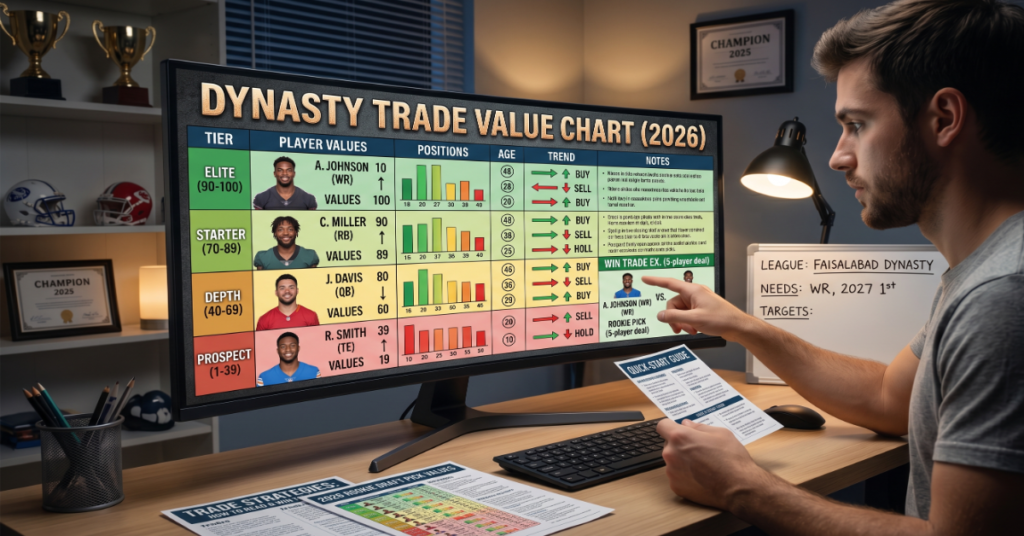
Dynasty fantasy football is a long game. Unlike redraft leagues that reset every August, dynasty leagues carry rosters for years — which means the player you trade away today could be winning championships for someone else in 2028. That’s where the dynasty trade value chart earns its place.
A dynasty trade value chart assigns a numerical score to every relevant NFL player and draft pick based on their projected long-term contribution. It is not a weekly start/sit tool. It is a market-calibration instrument — designed to show you whether the deal you’re being offered is fair, tilted against you, or a genuine steal. Used correctly, it prevents the two most common errors in dynasty: overpaying for aging stars and underselling young breakouts.
The concept gained traction in the early 2010s as dynasty formats grew. Today, sites including FantasyPros, Draft Sharks, and Footballguys publish updated dynasty trade value charts monthly, often recalibrating after major NFL events like the draft, injuries, and training camp cuts.
How Dynasty Trade Value Charts Are Built
Not all charts are built the same, and understanding the methodology separates smart users from those who follow numbers blindly.
Most dynasty trade value charts pull from at least three data inputs: expert consensus rankings, dynasty-specific average draft position (ADP) pulled from active startup and rookie drafts, and real user-submitted trade data. The last input is the most valuable and most overlooked. Charts rooted in actual trade data reflect true market behavior — what dynasty managers actually pay — rather than what analysts think they should pay.
Draft Sharks uses a proprietary 3D values algorithm that weights one-year, three-year, five-year, and ten-year projections by position, then adjusts for scoring format. Footballguys incorporates daily-updated rookie ADP pulled from hundreds of live leagues.
| Data Input | What It Reflects | Reliability |
| Expert consensus rankings | Analyst opinion | Moderate — prone to recency bias |
| Dynasty ADP | Community behavior in real drafts | High — reflects actual market |
| User trade data | Real transactions across leagues | Highest — direct market evidence |
| Projection models | Statistical forecasting | Variable — depends on model quality |
Superflex vs. 1-QB: Why Format Changes Everything
This is the most frequently misunderstood aspect of dynasty trade value charts. Using a 1-QB chart in a Superflex league — or vice versa — will cause you to systematically misvalue the most important position on the field.
In Superflex leagues, quarterbacks occupy the top tiers because starting two QBs per week dramatically increases their scarcity. The practical implication: if you acquired a young quarterback at a discount in your Superflex league and your trade value chart is 1-QB based, you are massively undervaluing your own asset.
| Position | 1-QB Format Value | Superflex Format Value | Delta |
| Elite QB (top 3) | Tier 2–3 overall | Tier 1 overall | Significant |
| QB2 starter | Low overall value | Tier 3–4 overall | Major |
| RB1 elite | Tier 1 overall | Tier 2 overall | Moderate |
| WR1 elite | Tier 1 overall | Tier 1–2 overall | Minor |
How to Actually Use a Dynasty Trade Value Chart
Step one is accepting the fundamental limitation: charts are calibrated for 1-for-1 trades. The numbers are most accurate when you add up a single player’s value on each side of a swap and compare the result.
Multi-player deals require an adjustment. The side sending more players must overpay. A useful rule of thumb: in a 2-for-1 deal, the side sending two players should expect to pay 30–50% more in combined value than the single player’s score.
The more sophisticated use case is identifying market inefficiencies. When a player suffers a short-term injury or poor stretch of games, their chart value typically lags the news — managers perceive them as less valuable than the underlying long-term projection supports. That window is where you buy.
Risks and Trade-Offs in Dynasty Trade Value Chart Usage
Age curves are averaged, not individualized. Running backs typically peak at 24–26 and decline sharply. Wide receivers often peak later, at 26–28. These are averages. A specific player’s individual trajectory depends on usage patterns, offensive scheme, and physical style of play.
Rookie picks are inherently speculative. A first-round pick two years from now is priced based on historical averages for picks in that range. Charts also lag real-world news — a trade on Tuesday may not reflect in chart values until the following weekly update.
The Future of Dynasty Trade Value Charts in 2027
The next generation of dynasty trade value tools is moving toward personalization at the league level. Rather than publishing a single consensus chart, platforms are building tools that sync directly with your league — pulling your roster, your scoring settings, your playoff structure, and your trade history — to generate a value score specific to your situation.
Draft Sharks already offers a War Room tool that syncs with leagues and generates customized DMVP values. By 2027, the leading dynasty tools are credibly expected to incorporate contract year motivations, snap share trends, and scheme-fit analytics into their valuation models.
Takeaways
- Dynasty trade value charts are market calibration tools, not absolute price lists — treat them as guides, not scripture.
- Always match the chart format to your league format; Superflex and 1-QB charts produce dramatically different quarterback values.
- Multi-player trades require a 30–50% overpay from the side sending more players — the chart math alone does not capture this.
- The best buying opportunities appear when a player’s chart value lags their actual long-term outlook due to short-term news.
- Future chart tools are moving toward league-synced, roster-specific valuations — static consensus charts will become less reliable.
- Rookie pick values are directionally correct but individually uncertain; treat them as ranges, not fixed prices.
Conclusion
Dynasty trade value charts are the most consistently useful tool in the dynasty fantasy football manager’s kit — and the most consistently misused. The managers who win long-term do not treat a chart number as the end of a negotiation. They use it to establish a baseline, identify where their league’s market deviates from consensus, and find the windows where perception and reality diverge. The edge is not in the chart — it is in how you read it.
FAQ
What is a dynasty trade value chart?
A dynasty trade value chart ranks NFL players and future draft picks by numerical score representing their long-term fantasy football worth. It is used to evaluate whether trades are fair, one-sided, or a good deal, based on projected multi-year contributions rather than current season performance alone.
How often should I check dynasty trade value charts?
Monthly updates are the standard for major platforms, but leading tools like Draft Sharks and Footballguys update values more frequently after significant news events. Check whenever you are actively building or considering a trade.
Are dynasty trade value charts accurate for multi-player trades?
They are most accurate for 1-for-1 trades. In multi-player deals, the side sending more players needs to overpay by approximately 30–50% in combined chart value.
What is the difference between a Superflex and a 1-QB dynasty trade value chart?
In Superflex leagues, quarterbacks carry dramatically higher value because managers start two QBs per week. A Superflex chart places elite QBs at the very top of all-position rankings, while a 1-QB chart ranks running backs and wide receivers comparably or higher.
What is the biggest mistake managers make using dynasty trade value charts?
Treating chart values as fixed prices rather than market guides. Values are averages — your specific league’s scoring, roster construction, and manager preferences all affect what a player is truly worth in your ecosystem.
Methodology
Information was gathered from multiple active dynasty trade value chart platforms including FantasyPros, Draft Sharks, Footballguys, and Yahoo Sports Fantasy, all cross-referenced as of May 2026. Limitation: player-specific values shift in real time. AI disclosure: This article was drafted with AI assistance and reviewed by the editorial team at Perplexityaimagazine.com.
