
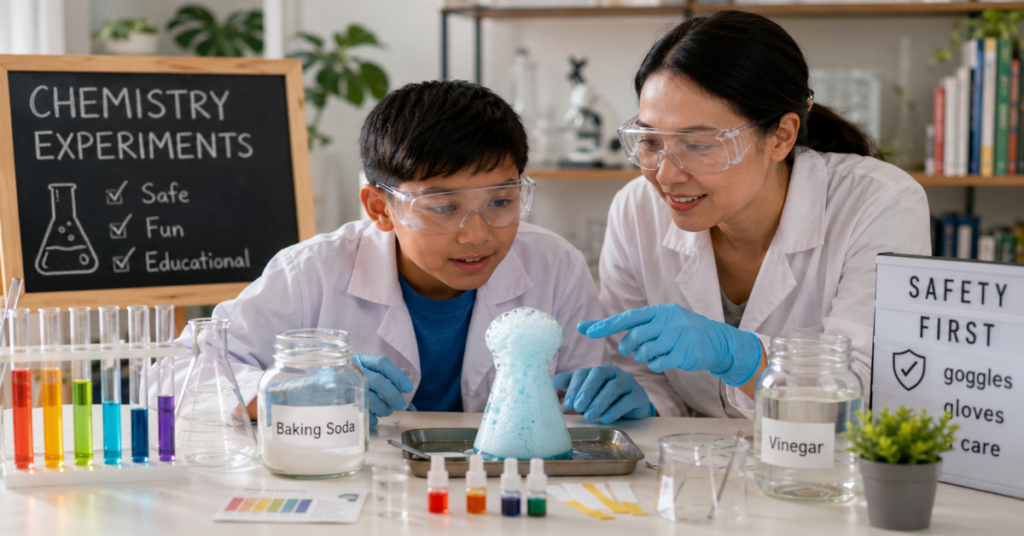
Chemistry experiments are hands-on activities that show how matter changes, reacts and behaves under different conditions. For beginners, the first decision is not which reaction looks most exciting. It is whether the activity belongs at home, in a classroom demonstration or in a formal laboratory with trained supervision. The supplied brief frames the topic around safe at-home projects and standard high school or college laboratory investigations, with safety rules as the organizing principle.
That distinction matters. A baking soda and vinegar volcano is a low-risk way to observe gas formation. An acid-base titration is a controlled laboratory method for determining concentration. A flame test may look simple, but it requires open flame, chemical salts, eye protection and trained oversight. The same field can be playful, precise or dangerous depending on setting.
This article organizes chemistry experiments into practical categories: safe home activities, supervised school labs and experiments that should not be attempted outside proper facilities. It also explains the scientific principle behind each activity, the trade-offs teachers and parents should consider and the safety framework that separates responsible science education from risky performance.
The American Chemical Society advises that demonstrations and experiments should be performed by knowledgeable instructors, especially when open flames, reactive materials or toxic substances are involved. NSTA also treats safety as a core condition of hands-on science instruction rather than a secondary checklist.
Why Chemistry Experiments Still Matter
Chemistry is not only a school subject. It explains cooking, cleaning, medicine, energy storage, agriculture, environmental testing and industrial manufacturing. Good experiments turn invisible processes into visible evidence.
A pH indicator made from red cabbage shows that household liquids differ chemically. A lava lamp bottle demonstrates density and immiscibility. A titration teaches precision, concentration and stoichiometry. A clock reaction shows that chemical change can be timed, delayed and modeled.
The educational value comes from linking observation to explanation. Foam, bubbles, color changes and temperature shifts are not the lesson by themselves. They are evidence. The real learning happens when a student asks why the foam expanded, why the liquid changed color or why one metal salt produced a different flame color from another.
At-Home Chemistry Experiments
At-home chemistry should use common materials, small quantities and low-risk procedures. These projects work best for beginners, parents, remote learning and early STEM exposure.
| Experiment | Main Concept | Typical Materials | Best For | Risk Level |
| Baking soda and vinegar volcano | Acid-base reaction, carbon dioxide formation | Baking soda, vinegar, dish soap, container | Young learners | Low |
| Red cabbage pH indicator | Acids, bases, indicators | Red cabbage, water, vinegar, lemon juice, baking soda solution | Middle school learners | Low |
| Lava lamp in a bottle | Density, immiscibility, gas movement | Oil, water, food coloring, effervescent tablet | Visual learning | Low |
| Elephant toothpaste, yeast method | Catalysis, oxygen gas formation, exothermic reaction | Hydrogen peroxide, yeast, dish soap, warm water | Supervised demonstrations | Moderate |
Baking Soda and Vinegar Volcano
This is the classic beginner reaction because it is visible, fast and relatively low-risk. Sodium bicarbonate reacts with acetic acid to produce carbon dioxide gas. The gas expands through the liquid and creates bubbling foam, especially when dish soap traps the gas.
The limitation is that many students remember the eruption but not the chemistry. A better version asks learners to compare different amounts of baking soda, vinegar and soap, then record how foam height changes. That turns a familiar activity into a basic investigation.
Red Cabbage pH Indicator
Red cabbage contains anthocyanins, pigments that change color in acidic and basic environments. Vinegar and lemon juice shift the indicator toward acidic colors, while baking soda solution produces a different color range.
This is one of the most useful chemistry experiments for home learning because it connects household substances to pH without requiring commercial indicators. It also teaches classification. Students can test safe household liquids, record color changes and arrange samples from most acidic to most basic.
Lava Lamp in a Bottle
Oil and water separate because they differ in polarity and density. Food coloring mixes with water, while the effervescent tablet releases gas bubbles that carry colored water upward. When bubbles escape, the colored droplets sink again.
This experiment is effective because it shows two ideas at once: liquids can separate because of intermolecular forces and gas bubbles can move matter through a liquid.
Elephant Toothpaste, Yeast Method
The yeast version uses yeast as a catalyst to speed up the decomposition of hydrogen peroxide into water and oxygen gas. Dish soap traps oxygen, creating foam. This should be performed with low-concentration household hydrogen peroxide, eye protection and adult supervision.
The risk is often underestimated because the materials seem familiar. The reaction can generate heat and foam can overflow quickly. Higher-concentration hydrogen peroxide should not be used outside trained supervision.
Formal Laboratory Chemistry Experiments
School and college labs introduce measurement, controlled variables and chemical handling. These activities require PPE, proper glassware, supervision, chemical labeling and disposal procedures.
| Laboratory Experiment | Scientific Principle | Equipment Needed | Learning Outcome | Safety Requirement |
| Acid-base titration | Stoichiometry, neutralization | Burette, pipette, indicator, standard solution | Determine unknown concentration | Goggles, gloves, controlled reagents |
| Silver mirror test | Redox chemistry, aldehyde identification | Test tubes, Tollens’ reagent, aldehyde sample | Identify functional groups | Instructor supervision, waste control |
| Flame test | Atomic emission spectra | Bunsen burner, nichrome wire, metal salts | Link color to electron transitions | Flame safety, goggles, ventilation |
| Iodine clock reaction | Reaction kinetics | Beakers, potassium iodide, starch, peroxide, thiosulfate | Study reaction rate and timing | Goggles, measured reagents |
Acid-Base Titration
A titration uses a solution of known concentration to determine the concentration of an unknown solution. A common school example uses sodium hydroxide and hydrochloric acid with phenolphthalein as the endpoint indicator.
The value of titration is precision. Students must read a burette, control drops near the endpoint and calculate molarity. It also teaches why chemical analysis depends on careful measurement rather than visual excitement.
Silver Mirror Test
Tollens’ test identifies aldehydes through a redox reaction that reduces silver ions to metallic silver. The result is a reflective coating inside a clean glass test tube.
This is a powerful demonstration of functional group chemistry, but it belongs in a supervised lab. Tollens’ reagent must be prepared, used and disposed of correctly. It is not a home experiment.
Flame Test for Metal Cations
Different metal ions emit characteristic colors when heated because electrons absorb energy, move to higher energy levels and release light when they return to lower levels.
Copper, strontium, sodium and potassium salts can produce striking colors, but the use of open flame changes the risk profile. ACS demonstration guidance emphasizes appropriate eye protection and readiness for fire risk whenever flames are involved.
Iodine Clock Reaction
Clock reactions are excellent for teaching kinetics. In the iodine clock reaction, clear solutions remain unchanged for a predictable period before suddenly turning dark blue due to the starch-iodine complex.
The educational benefit is that students can change concentration or temperature, then compare timing. That makes reaction rate measurable instead of abstract.
Safety Comes Before Spectacle
Chemistry education has a long history of memorable demonstrations, but visual drama can create bad incentives. The more spectacular a reaction appears, the more carefully it must be assessed.
The ACS RAMP framework recommends that chemical users recognize hazards, assess risk, minimize risk and prepare for emergencies. That framework is useful for both teachers and parents because it shifts attention from “Is this experiment popular?” to “What can go wrong and how will we prevent it?”
Essential Safety Rules
| Rule | Why It Matters | Applies At Home? | Applies In Lab? |
| Wear eye protection | Prevents splash injuries | Yes | Yes |
| Use ventilation | Reduces vapor exposure | Yes | Yes |
| Avoid tasting or direct smelling | Prevents ingestion and inhalation harm | Yes | Yes |
| Label all containers | Prevents mistaken use | Yes | Yes |
| Use small quantities | Limits reaction size and cleanup risk | Yes | Yes |
| Plan disposal before starting | Prevents unsafe drain disposal | Yes | Yes |
| Keep flames out of home experiments | Reduces burn and fire risk | Yes | Not always, but supervised |
The NIOSH school laboratory guide also emphasizes labeled chemicals, proper storage and annual chemical inventory updates for school settings. These details may sound administrative, but they are safety infrastructure.
Real-World Lessons From Chemistry Safety Incidents
Two documented examples explain why safety culture matters.
First, the 2010 Texas Tech University laboratory incident, referenced in a joint Chemical Safety Board and ACS safety statement, involved a graduate student who was severely injured after energetic material unexpectedly detonated. The safety lesson was not limited to advanced research labs. ACS emphasized reporting near misses, close calls and incidents as part of continuous improvement.
Second, several methanol flame demonstration fires in U.S. educational settings led the U.S. Chemical Safety Board to recommend better training for teachers performing fiery chemistry demonstrations. Reports found that excessive flammable chemical use, lack of barriers and insufficient training contributed to injuries.
These examples do not mean chemistry demonstrations should disappear. They mean excitement must be earned through planning, not improvised through risk.
Practical Implications for Parents, Teachers and Students
For parents, the main question is whether an activity can be performed with household materials, adult supervision and simple cleanup. If the experiment requires heat, flame, concentrated chemicals, glassware under pressure or unknown disposal rules, it should move out of the home category.
For teachers, the challenge is balancing engagement with institutional responsibility. A lab activity should have a written procedure, safety data review, PPE plan, waste plan and emergency response plan. The ACS elementary classroom safety guidance recommends that educators perform activities before assigning them to students and identify safety issues during preparation.
For students, the lesson is discipline. Professional chemistry is not random mixing. It is observation, measurement, documentation and respect for uncertainty.
Strategic Trade-Offs: Fun, Rigor and Risk
The best chemistry experiments are not always the most dramatic. A pH indicator may teach more than an uncontrolled eruption. A titration may look quiet, but it teaches accuracy, patience and quantitative reasoning.
The trade-off is simple:
| Goal | Best Experiment Type | Trade-Off |
| Spark curiosity | At-home visual reactions | Can become entertainment without explanation |
| Teach measurement | Titration or kinetics lab | Requires equipment and training |
| Teach atomic theory | Flame test | Uses open flame |
| Teach chemical classification | pH indicator or Tollens’ test | Some versions require lab-only reagents |
| Teach safety culture | Any well-planned activity | Less dramatic, more responsible |
A strong science program uses both low-risk curiosity builders and formal investigations. The problem is not simple experiments. The problem is pretending all experiments belong in the same environment.
Chemistry Experiments and Real-World Impact
Hands-on chemistry supports STEM education by helping learners understand evidence. It also builds practical literacy. Consumers encounter chemistry in cleaning products, batteries, water quality, nutrition labels and medicine. A student who understands pH, concentration and reaction rate is better prepared to interpret everyday claims.
There is also a cultural effect. Viral science videos often favor spectacle over safety. That can inspire curiosity, but it can also normalize copying procedures without risk assessment. Schools and publishers should present chemistry as investigation, not performance.
This is where digital learning platforms, simulations and structured assessments can help. For example, STEM assessment tools that support technical notation and controlled question design can help teachers check whether students understood the principle behind an experiment, not just the visual result. Critical thinking exercises also pair well with lab work because students need to separate observation from assumption.
The Future of Chemistry Experiments in 2027
By 2027, chemistry education is likely to become more hybrid: safer home demonstrations, more simulation-assisted preparation and more formal risk assessment in classrooms.
Three trends are already visible.
First, safety expectations are rising. ACS and NSTA resources increasingly frame safety as a continuous mindset, not a single lecture. ACS promoted that same idea in a May 2026 webinar on integrated laboratory safety for chemistry students.
Second, simulations will likely become a standard pre-lab step. Students can practice reading burettes, predicting pH changes or modeling reaction rates before touching chemicals. That does not replace lab work, but it reduces confusion during hands-on activity.
Third, schools will face more pressure to document chemical inventories, disposal procedures and teacher training. The infrastructure behind safe chemistry may become as important as the experiments themselves.
The uncertainty is funding. Well-equipped labs, updated PPE and teacher training cost money. Schools with limited budgets may rely more heavily on low-cost home-style activities and digital simulations. That can be useful, but it cannot fully replace supervised laboratory technique.
Takeaways
- Choose chemistry activities by setting before choosing by visual appeal.
- Safe at-home experiments should use household materials, small quantities and adult supervision.
- Formal lab experiments teach precision, but they require PPE, trained oversight and disposal planning.
- Open flame, concentrated peroxide, unknown reagents and heavy-metal waste are strong signals that an activity is not suitable for home.
- The best learning comes from connecting visible changes to chemical principles.
- Safety culture should include preparation, labeling, ventilation, incident reporting and emergency planning.
- By 2027, hybrid chemistry education will likely combine simulations, safer demonstrations and stricter lab documentation.
Conclusion
Chemistry experiments remain one of the most effective ways to teach science because they make invisible processes visible. A color change, gas bubble, precipitate or endpoint can turn abstract theory into evidence a student can see and question.
The responsible approach is not to remove excitement from chemistry. It is to match each experiment to the right environment. Baking soda and vinegar belongs at home. Titration belongs in a supervised lab. Flame tests and reactive demonstrations require trained oversight, protective equipment and emergency preparation.
For parents, teachers and students, the central rule is simple: curiosity should never outrun safety. When experiments are planned carefully, explained clearly and performed in the right setting, chemistry becomes more than a subject. It becomes a disciplined way of understanding matter, evidence and change.
FAQ
What are the safest chemistry experiments for beginners?
The safest beginner options include red cabbage pH indicator, baking soda and vinegar reactions and lava lamp bottles using oil, water and effervescent tablets. These use common materials, avoid open flame and teach acids, bases, density and gas formation.
Can chemistry experiments be done at home?
Yes, but only low-risk experiments should be done at home. Avoid open flames, concentrated chemicals, pressure buildup, toxic vapors and unknown disposal requirements. Home activities should use small quantities, adult supervision, ventilation and eye protection.
What chemistry experiments are best for high school labs?
High school labs often use acid-base titration, flame tests, precipitation reactions, calorimetry and reaction-rate investigations. These teach measurement, stoichiometry, atomic emission, energy change and kinetics under teacher supervision.
Is elephant toothpaste safe?
The yeast method can be safe when performed with low-concentration household hydrogen peroxide, small quantities, eye protection and adult supervision. Stronger hydrogen peroxide versions should be treated as formal demonstrations, not home activities.
Why do flame tests produce different colors?
Metal ions emit different colors because electrons absorb heat energy and move to higher energy levels. When they return to lower levels, they release light at characteristic wavelengths.
What is the difference between a demonstration and an experiment?
A demonstration shows a concept, usually with the instructor controlling the process. An experiment asks a question, changes variables, records observations and uses evidence to reach a conclusion.
What should students learn before entering a chemistry lab?
Students should understand PPE, labeling, wafting, spill response, glassware care, chemical disposal, emergency exits and why unauthorized mixing is unsafe. Safety knowledge is part of the science, not separate from it.
Methodology
This article was built from the supplied production brief, which specified the core keyword, safe at-home examples, formal laboratory examples and required safety framing. The safety analysis was checked against guidance from the American Chemical Society, NSTA, NIOSH-linked laboratory safety materials and Chemical Safety Board reporting.
No original laboratory testing was conducted for this draft. The article therefore avoids invented firsthand performance claims, reaction measurements or classroom observations. Named incidents and institutional guidance were used to ground the risk discussion. A human editor should verify all references, internal links, chemical procedures and local safety requirements before publication.
References
American Chemical Society. (n.d.). Safer experiments and demonstrations. ACS Institute.
American Chemical Society. (n.d.). Safety: Middle and high school chemistry. American Chemical Society.
American Chemical Society. (2026, May 8). Building an integrated safety approach in your chemistry classroom. ACS Webinars.
American Chemical Society Division of Chemical Education. (2018). Safety guidelines for chemical demonstrations. American Chemical Society.
Centers for Disease Control and Prevention, National Institute for Occupational Safety and Health. (2006). School chemistry laboratory safety guide.
National Science Teaching Association. (n.d.). Safety and school science instruction. NSTA.
National Science Teaching Association. (n.d.). Safety resources. NSTA.
U.S. Chemical Safety and Hazard Investigation Board, & American Chemical Society. (2018). The importance of laboratory safety in the classroom.
Time. (2014, October 30). Science teachers need training before fiery chemistry displays, panel says.
