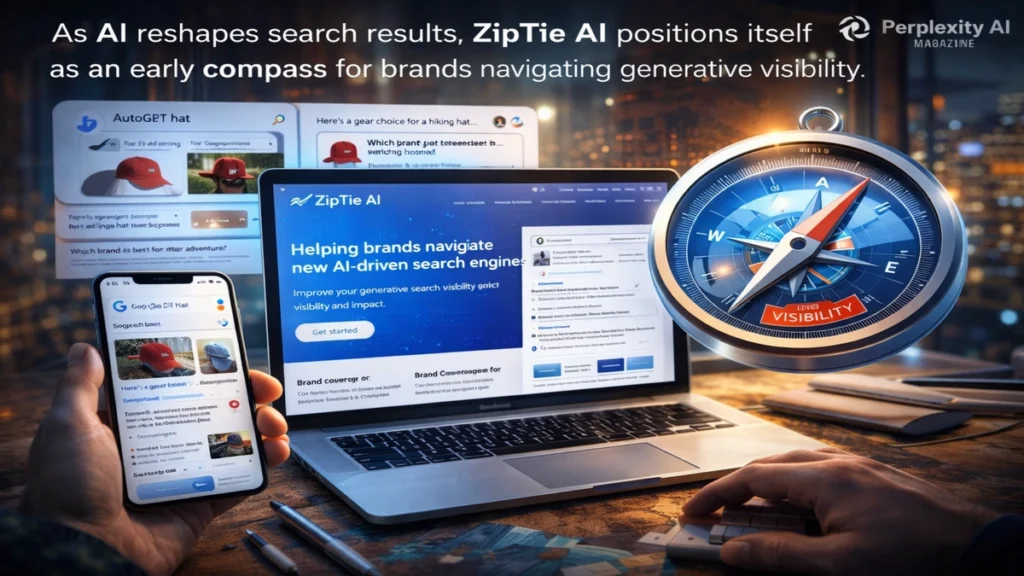
I look at ZipTie AI through the lens of a changing search landscape where rankings alone no longer explain visibility. For readers searching why choose ziptie ai search performance tool, the intent is clear within the first moments. They want to understand how brands are discovered inside AI answers and whether a dedicated platform is worth the cost and effort. Traditional SEO tools still track blue links, but generative search now summarizes, cites, and filters content before users ever reach a website.
In this environment, ZipTie AI focuses on a problem most platforms only recently acknowledged. Google AI Overviews, ChatGPT, and Perplexity do not behave like classic search engines. They answer questions directly, cite selectively, and shape perception through tone and sentiment. I see ZipTie AI as a response to that shift rather than an extension of legacy SEO.
Instead of rankings, ZipTie tracks whether a brand appears in AI answers, how often it is cited, which competitors dominate share of voice, and how sentiment trends across prompts. These signals matter because AI answers increasingly function as the first and sometimes only touchpoint between users and information. This article explains why ZipTie AI exists, how it works, what differentiates it from competitors, and why some teams view it as a first mover advantage in generative engine optimization.
The Rise of AI-Driven Search Surfaces
Search has entered a phase where answers matter more than links. I have watched Google introduce AI Overviews in 2024, summarizing results at the top of the page. At the same time, conversational platforms like ChatGPT and Perplexity have trained users to expect direct responses rather than lists of sources.
These systems rely on large language models that synthesize content, choose citations, and apply implicit judgment. Visibility now depends on being included in the model’s answer rather than simply ranking on page one. That shift creates blind spots for traditional SEO metrics. Click-through rates decline while impressions rise, and brands lose insight into why traffic changes. – why choose ziptie ai search performance tool.
ZipTie AI was built specifically to monitor these new surfaces. Instead of treating AI answers as noise, it treats them as measurable outcomes. By capturing screenshots, citations, and sentiment, ZipTie translates generative search into trackable data. From my perspective, this reframing is the core reason teams consider adopting it.
Read: geminigen.ai Review: Multimodal AI Media Creation
What ZipTie AI Measures That Others Miss
ZipTie AI centers its platform on AI visibility rather than keyword position. I find this distinction critical. The tool records whether a brand appears in AI-generated answers, how prominently it is cited, and which competitors are mentioned instead.
The platform captures exact answers and screenshots across Google AI Overviews, ChatGPT, and Perplexity. This allows teams to audit how their brand is represented, not just whether it is present. Sentiment analysis adds another layer, showing whether AI systems describe a brand positively, neutrally, or negatively.
One of ZipTie’s defining metrics is the AI Success Score. This score blends visibility frequency, sentiment, and query value into a prioritization signal. Rather than tracking hundreds of prompts equally, teams can focus on questions where improvement would matter most. I see this as an attempt to reduce analysis paralysis in an already complex environment.
Smart Prioritization Through AI Success Score
The AI Success Score is ZipTie’s answer to scale. I have seen SEO teams overwhelmed by the number of potential prompts across generative platforms. ZipTie scores each query based on how often a brand appears, how it is framed, and how valuable the query is from a business perspective.
This approach reflects a shift from volume to impact. Instead of asking where a brand appears, the platform asks where effort should be applied first. Queries with high impression potential but low citation rates rise to the top of the list.
ZipTie also includes a query enhancer that converts traditional SEO keywords into conversational prompts. This matters because AI systems interpret natural language questions differently than keyword strings. By aligning prompts with real user behavior, ZipTie helps teams monitor AI answers as users actually see them.
Content and Indexing Tools for Generative Optimization
ZipTie AI extends beyond monitoring into optimization. I find its integration with Google Search Console especially practical. By importing high-impression queries directly from GSC, the platform removes the need for manual prompt creation.
Once imported, ZipTie generates conversational AI prompts from existing data. It then tracks performance across AI engines and alerts users when indexing drops or citations disappear. This creates a feedback loop between content performance and generative visibility. – why choose ziptie ai search performance tool.
The platform also identifies content gaps where competitors are cited but the brand is absent. These insights guide updates focused on clarity, authority, and relevance rather than keyword density. From my perspective, this aligns with how AI models evaluate sources.
Setup and Workflow in Practice
Setting up ZipTie AI begins inside a project dashboard. I see the workflow as deliberately streamlined. Users connect a verified Google Search Console property using read-only access. They select a date range and thresholds for impressions or clicks.
ZipTie then imports hundreds of high-value queries automatically. These queries are transformed into conversational prompts and assigned AI Success Scores. Teams can choose tracking frequency, enable alerts, and begin monitoring immediately.
Starter plans limit projects to a single GSC property, while Pro plans allow multiple properties. This structure reflects the platform’s focus on depth rather than breadth. Instead of tracking everything, it encourages teams to focus on what matters most.
Pricing and the ROI Question
ZipTie AI does not offer a free tier. I view this as a deliberate signal that the tool is built for teams already invested in AI search visibility. Pricing starts around eighty dollars per month, with tiers scaling based on usage and properties.
Annual billing offers a discount, and enterprise plans are available for larger organizations. While the entry cost may seem high compared to general SEO tools, ZipTie positions itself as a time saver. Manual audits of AI answers across platforms are labor-intensive and inconsistent. – why choose ziptie ai search performance tool.
For teams managing brand reputation and discoverability in AI answers, the cost often compares favorably to internal labor. This is where ZipTie’s value proposition becomes clearer.
Competitive Landscape and Differentiation
ZipTie AI operates in a growing but still fragmented market. Several competitors address parts of the same problem, though with different emphases.
| Tool | Engine Coverage | Strengths | Weaknesses | Best For |
|---|---|---|---|---|
| ZipTie AI | Google AI, ChatGPT, Perplexity | High detection, optimization, GSC integration | Limited engines | AI-specific SEO teams |
| Peec AI | Adds Gemini | Share of voice, competitor mapping | Higher cost | Competitive analysis |
| Otterly.ai | Multiple AI engines | GEO audits, fix prioritization | Less monitoring depth | Optimization-focused teams |
| Semrush | Expanding AI support | Full SEO suite | Lower AI detection | Hybrid SEO strategies |
ZipTie’s strength lies in precision. It detects significantly more AI Overviews than general SEO platforms and ties monitoring directly to optimization actions.
Expert Perspectives on AI Search Optimization
“Generative search has collapsed the funnel,” said Lily Ray, an SEO strategist and industry speaker. “If your brand is not cited in the answer, you may never get a click.”
Barry Adams, a technical SEO consultant, noted that tools like ZipTie address a blind spot. “Traditional rank tracking does not explain AI Overviews. Specialized measurement is becoming essential.”
According to Dixon Jones, CEO of InLinks, “The future of SEO is entity visibility and authority. Tools that measure how AI systems perceive brands will shape strategy.”
These perspectives reinforce the idea that ZipTie AI is part of a broader recalibration rather than a niche experiment.
Best Practices for Using ZipTie AI Effectively
I find that teams succeed with ZipTie when they start small. Tracking twenty to fifty high-value queries provides enough data without exhausting credits. Mixing brand, category, and problem-based prompts creates balanced coverage.
Applying filters such as high ranking but no citation quickly reveals missed opportunities. Reviewing AI Success Scores weekly allows teams to iterate without reacting to noise. Over time, expanding query sets based on competitor insights builds momentum. – why choose ziptie ai search performance tool.
ZipTie rewards consistency rather than volume. Its design encourages focused experimentation aligned with how AI systems actually answer questions.
Takeaways
- AI search visibility differs fundamentally from traditional rankings
- ZipTie AI tracks answers, citations, and sentiment across AI platforms
- AI Success Score helps prioritize meaningful optimization efforts
- GSC integration removes manual query creation
- Pricing reflects labor savings rather than feature breadth
- Precision matters more than engine count in early AI search
Conclusion
I see ZipTie AI as a product of timing as much as technology. As AI-driven search reshapes how information is delivered, brands face a visibility challenge that existing tools only partially address. ZipTie does not try to replace full SEO suites. Instead, it fills a gap that has grown rapidly since the rise of AI Overviews and conversational answers.
Its value lies in clarity. By showing where and how a brand appears in AI answers, ZipTie turns an opaque system into something measurable and actionable. For teams serious about generative engine optimization, that clarity can justify the investment.
As AI search continues to evolve, tools like ZipTie will likely influence how marketers define success. Visibility is no longer just about being found. It is about being chosen by machines that increasingly speak for us.
FAQs
What problem does ZipTie AI solve?
It tracks brand visibility inside AI-generated search answers rather than traditional rankings.
Which platforms does ZipTie AI monitor?
It focuses on Google AI Overviews, ChatGPT, and Perplexity.
Does ZipTie replace traditional SEO tools?
No. It complements them by addressing AI-specific visibility gaps.
Is ZipTie AI suitable for small teams?
Yes, especially those focused on high-impact AI search queries.
Does ZipTie AI require Google Search Console?
GSC integration is optional but strongly recommended for faster setup.