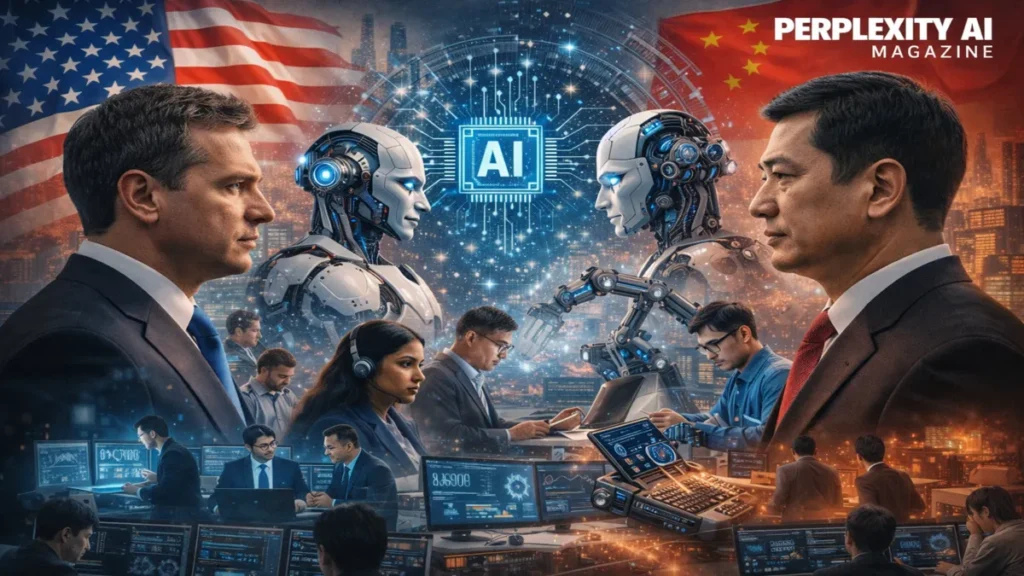
I realized that artificial intelligence had become a geopolitical issue, not a technical one, when trade officials began discussing chips with the same gravity once reserved for oil or weapons. In early 2026, AI sits at the center of national policy, economic strategy, corporate governance, and global competition. Governments now debate AI export controls alongside security alliances. Corporations rank AI risk beside cyber threats. Talent mobility reshapes innovation more than borders do.
The turning point came when the United States approved exports of Nvidia’s H200 AI chips to China under strict conditions. This was not simply a trade decision. It was a diplomatic signal that the era of total technological decoupling is giving way to managed competition, where economic engagement and national security must coexist uneasily. At the same time, Western executives publicly warned that China is gaining ground in AI adoption across emerging markets, reframing the race as global rather than bilateral.
Meanwhile, enterprise AI adoption accelerated. Tools like Anthropic’s Cowork showed that AI was no longer confined to cloud platforms but moving directly into daily workflows. Allianz’s 2026 risk report ranked A-I as one of the top corporate risks for the first time, confirming that executives now view AI as both opportunity and liability.
Together, these shifts reveal a new phase of AI competition. It is not just about who builds the best models. It is about who controls infrastructure, who attracts talent, who sets standards, and who manages risk. AI in 2026 is no longer just innovation. It is power.
Export policy as a strategic instrument
The U.S. decision to allow exports of Nvidia’s H200 chips to China under conditions marked a major policy shift. The move acknowledged economic realities while trying to preserve security leverage. By imposing third-party verification, quantity caps, and compliance requirements, U.S. regulators attempted to create a middle path between full restriction and unrestricted trade.
This reflected a growing recognition that technology ecosystems are too intertwined for total separation. Complete decoupling would harm Western firms and global supply chains as much as it would limit Chinese capabilities. The policy therefore seeks to slow, shape, and observe rather than halt.
The decision also exposed the limits of export control as a geopolitical tool. Controls can influence speed and cost, but they cannot prevent diffusion of knowledge. A-I research is increasingly global, distributed across institutions, companies, and borders.
The export decision thus became symbolic of a new approach to competition: regulated interdependence.
Read: AI Power Politics: How 2026 Redefined Global Influence
Talent mobility over territorial dominance
AI innovation follows people more than geography. Engineers, researchers, and founders move toward ecosystems that offer funding, freedom, and scale. – U.S.–China AI.
The acquisition of AI startups with roots in one country and headquarters in another illustrates this fluidity. Singapore, Europe, and other hubs now compete with Silicon Valley and Shenzhen not through nationalism but through openness.
Talent mobility weakens rigid geopolitical binaries. It creates overlapping networks of innovation rather than isolated national systems. Countries that restrict movement risk losing relevance even if they control hardware.
This dynamic challenges traditional state power. Governments can regulate exports and investment, but they struggle to regulate human ambition.
Microsoft’s warning and China’s global reach
When Microsoft’s president warned that China is overtaking Western firms in A-I adoption across emerging markets, it reframed the competition.
The race is not just about building models. It is about deployment. Chinese platforms are spreading across Africa, Southeast Asia, and Latin America because they are affordable, localized, and embedded in infrastructure projects.
This creates influence through usage rather than patents. It mirrors how earlier technologies spread geopolitically through railways, telecoms, and energy grids.
AI thus becomes a tool of soft power.
Enterprise AI and the workplace
Anthropic’s Cowork signaled another shift: AI is moving from abstract platform to daily companion. The transition from cloud-only AI to local desktop agents changes security models, productivity expectations, and organizational culture.
Workers now interact with AI not as a distant system but as a collaborator embedded in files, workflows, and decisions. This raises new governance questions about data exposure, intellectual property, and accountability.
AI becomes not only strategic but intimate.
Corporate risk and governance
Allianz ranking AI among the top business risks shows how corporate perception has changed. A-I is no longer experimental. It is material.
Boards now discuss AI alongside cyber risk, regulatory compliance, and reputational exposure. This forces companies to invest not just in AI capability but in A-I governance.
Risk becomes the price of speed.
Table: Policy shifts and implications
| Shift | Actor | Implication |
|---|---|---|
| Chip export approval | U.S. government | Managed competition |
| China adoption growth | Chinese firms | Soft power expansion |
| Enterprise AI tools | Anthropic | Workflow integration |
| Risk elevation | Allianz | Governance priority |
Table: Strategic dimensions of AI competition
| Dimension | Focus | Outcome |
|---|---|---|
| Infrastructure | Chips and data centers | National leverage |
| Talent | Mobility and openness | Innovation speed |
| Governance | Regulation and risk | Trust and stability |
| Markets | Adoption and usage | Influence and scale |
Expert perspectives
A technology policy scholar notes that export controls are shifting from blunt instruments to fine-grained regulatory levers.
An economist observes that innovation now flows through people more than through capital.
A governance expert warns that without institutional frameworks, AI’s speed may exceed society’s ability to absorb it safely. – U.S.–China AI.
Takeaways
- AI policy is now geopolitical policy
- Export controls aim to manage, not stop, competition
- Talent mobility reshapes innovation more than borders
- China’s influence grows through deployment, not dominance
- Enterprise AI is transforming daily work
- AI risk is now a board-level concern
- Governance becomes as important as innovation
Conclusion
In 2026, artificial intelligence is no longer a sector. It is an environment.
It shapes how states negotiate, how companies compete, how workers produce, and how societies govern themselves. The U.S.–China relationship around AI reflects this transformation. It is neither open competition nor cold war. It is managed rivalry inside a shared technological system.
This creates instability, but also opportunity. It forces cooperation even as it fuels competition. It makes governance unavoidable. It makes talent central. It makes risk visible.
The future of AI will not be decided by one country, one company, or one breakthrough. It will be decided by how institutions adapt to a world where intelligence itself has become infrastructure.
FAQs
Why did the U.S. approve chip exports
To balance economic interests with national security through controlled engagement.
Is China winning the AI race
China is gaining influence through deployment, especially in emerging markets.
Why does talent matter more than borders
Because innovation follows people, not territory.
Why is AI now a corporate risk
Because it affects compliance, security, reputation, and resilience.
What should companies focus on
Governance, talent, and strategic alignment.