

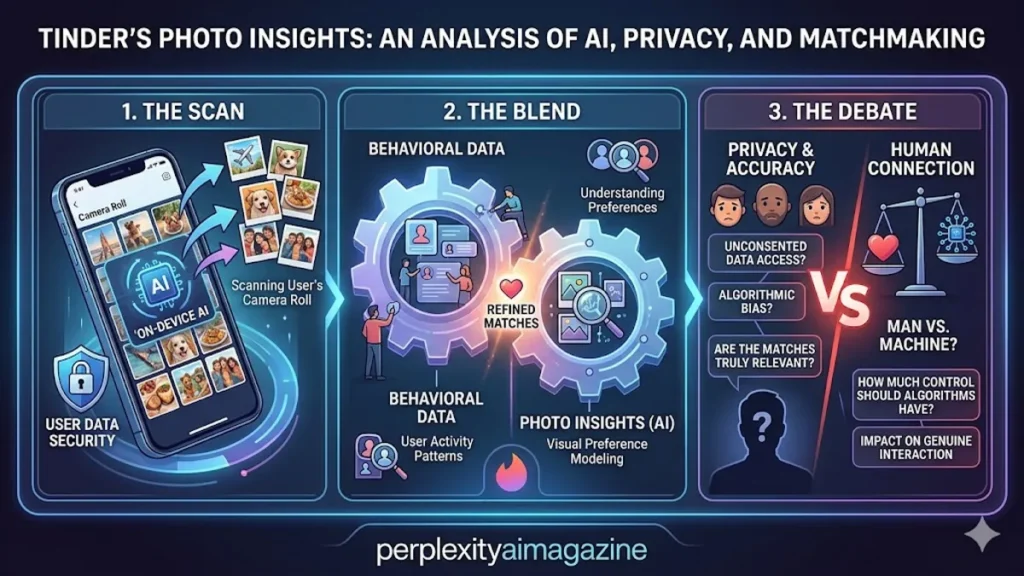
I have spent years watching dating apps promise to decode attraction, yet Tinder’s latest experiment may be its boldest claim yet: that your camera roll can reveal who you are, and who you should love. In March 2026, Tinder began testing “Photo Insights,” an AI-powered feature that scans personal photos to suggest profile images, summarize personality traits, and refine match recommendations. – Tinder AI.
At its core, Photo Insights aims to solve a familiar problem: swipe fatigue. Users, overwhelmed by endless profiles, often disengage before meaningful matches occur. Tinder’s answer is to reduce the noise by using machine learning to interpret visual patterns—travel, fitness, pets, food—and translate them into compatibility signals.
The feature operates largely on-device, analyzing images locally rather than uploading entire photo libraries. It can suggest which photos might attract more likes, generate a short “vibe” summary, and feed that data into Tinder’s broader matching system, known internally as “Chemistry.”
Yet even as it promises efficiency, Photo Insights has sparked unease. Critics question the ethics of scanning deeply personal photo archives, even with opt-in controls. Others doubt whether an algorithm can meaningfully capture personality from images alone.
The result is a moment that feels both inevitable and unsettling: dating apps evolving from platforms of choice into systems of interpretation, where artificial intelligence does not just assist decisions but actively shapes them. – Tinder AI.
The Evolution of Algorithmic Dating
Online dating has always been driven by data, but the nature of that data has shifted dramatically over time. Early platforms relied heavily on questionnaires, while later apps like Tinder emphasized visual impressions and rapid swiping. Now, the pendulum is swinging toward deeper behavioral and contextual analysis.
Photo Insights represents a new stage in this evolution. Instead of asking users to describe themselves, it attempts to infer identity from patterns already embedded in their digital lives. This aligns with broader trends in artificial intelligence, where models increasingly rely on passive data collection rather than explicit input.
“Tinder is moving from user-declared identity to inferred identity,” said Dr. Sharath Srinivasan, a researcher in human-computer interaction. “That changes the power dynamic. The system is no longer just reflecting who you say you are—it’s interpreting who you might be.”
The implications are significant. If successful, such systems could reduce friction in dating by surfacing more compatible matches. But they also risk narrowing identity into algorithmically digestible categories, potentially flattening the complexity of human experience. – Tinder AI.
How Photo Insights Works
At a technical level, Photo Insights combines computer vision, pattern recognition, and behavioral modeling. The system scans a user’s camera roll to identify recurring visual themes and assess photo quality.
Core Functional Capabilities
| Feature | Function | User Impact |
|---|---|---|
| Theme Detection | Identifies recurring elements (travel, pets, fitness) | Builds personality “vibe” |
| Photo Scoring | Rates images based on clarity and engagement likelihood | Suggests best profile photos |
| Face Recognition (Optional) | Confirms images contain the user | Improves accuracy |
| Chemistry Integration | Feeds insights into matching algorithm | Refines match recommendations |
The system relies on lightweight machine learning models optimized for mobile devices, often using frameworks like TensorFlow Lite. It evaluates factors such as lighting, facial clarity, and composition to estimate the likelihood that a photo will receive positive engagement.
If users enable biometric face recognition, the system becomes more precise in identifying which images feature them. Without it, recommendations may include irrelevant photos—a limitation Tinder openly acknowledges. – Tinder AI.
Despite its sophistication, the system does not claim to “understand” users in a human sense. Instead, it clusters observable patterns and translates them into probabilistic signals.
The Promise of Fewer, Better Matches
Swipe fatigue has become one of the defining challenges of modern dating apps. Users often report burnout from endless scrolling and low-quality matches. Tinder’s approach with Photo Insights is to reduce volume while increasing relevance.
From Quantity to Quality
| Traditional Swiping | AI-Assisted Matching |
|---|---|
| High volume of profiles | Curated match suggestions |
| User-driven selection | Algorithm-assisted filtering |
| Surface-level impressions | Pattern-based compatibility |
| Frequent disengagement | Potential for sustained engagement |
“Tinder is trying to shift from a discovery model to a recommendation model,” explained sociologist Dr. Jess Carbino, a former Tinder analyst. “That’s a fundamental change in how people experience dating.”
Early reports from Australian testers suggest mixed outcomes. Some users found that the feature highlighted overlooked photos—such as candid travel shots—that improved match rates. Others felt the recommendations were generic or misaligned with their personality.
The lack of published accuracy metrics further complicates evaluation. Tinder has not released data on how effectively Photo Insights improves match quality, leaving users to rely on anecdotal experience. – Tinder AI.
Where the Algorithm Gets It Right—and Wrong
Photo Insights performs best when users’ camera rolls contain consistent, lifestyle-oriented imagery. Frequent travel photos, gym selfies, or pet pictures create strong signals that the system can interpret reliably.
However, the system struggles in less structured environments.
“AI models are only as good as the data they see,” said Dr. Kate Crawford, an AI ethics researcher. “If your camera roll is messy or unrepresentative, the conclusions will be too.”
Accuracy Strengths vs. Limitations
| Strengths | Limitations |
|---|---|
| Detects clear lifestyle patterns | Misreads sparse or noisy data |
| Identifies high-quality images | Cannot capture personality depth |
| Improves photo selection | Overemphasizes visual traits |
| Works better with facial recognition | Errors without biometric input |
For example, a user who frequently photographs meals might be labeled as a “food enthusiast,” even if cooking is not central to their identity. Similarly, screenshots, memes, or work-related images can distort the system’s interpretation. – Tinder AI.
This highlights a broader challenge in AI: the gap between observable data and lived reality.
Privacy at the Center of the Debate
Perhaps the most contentious aspect of Photo Insights is its relationship to privacy. Even though Tinder emphasizes on-device processing, the idea of scanning an entire camera roll has unsettled many users.
Unlike other features, Photo Insights does not allow selective exclusion of photos. Users must grant access to their full library or opt out entirely.
“This is a classic example of convenience versus control,” said cybersecurity expert Bruce Schneier. “You gain efficiency, but you lose granularity in how your data is used.”
Tinder has implemented several safeguards, including:
- On-device processing where possible
- Filters for explicit content
- Temporary data storage with deletion after 90 days
- Limited telemetry collection
Yet skepticism persists, partly due to Tinder’s parent company Match Group’s history of data controversies, including past breaches and legal disputes over biometric data.
The normalization of biometric analysis also raises ethical concerns. Even as an optional feature, it signals a shift toward greater acceptance of facial data processing in everyday applications.
Public Reaction: Curiosity Meets Concern
Public response to Photo Insights has been sharply divided. On forums like Reddit, users have described the feature as both innovative and intrusive.
Some see it as a helpful tool for optimizing profiles. Others view it as a step too far into personal territory.
“The idea that an app is scanning my entire photo library—even locally—feels invasive,” wrote one user in an early discussion thread.
This tension reflects a broader societal debate about artificial intelligence. As systems become more capable, the boundaries of acceptable data use continue to shift.
Notably, early adopters who embraced the feature tended to prioritize efficiency, while skeptics emphasized autonomy and privacy.
A New Model of Digital Identity
Photo Insights also raises deeper questions about identity in the digital age. By translating visual patterns into personality summaries, it effectively constructs a version of the user that may or may not align with their self-perception.
“Identity is not just what you do—it’s how you interpret what you do,” said psychologist Dr. Sherry Turkle. “AI systems don’t capture that nuance.”
The risk is that users begin to conform to algorithmic expectations, selecting photos that perform well rather than those that feel authentic. Over time, this could reshape how people present themselves online.
In this sense, Photo Insights is not just a feature—it is a feedback loop, reinforcing certain behaviors while discouraging others.
The Road Ahead: Testing, Expansion, and Uncertainty
As of March 2026, Photo Insights remains in limited testing in Australia. Tinder has indicated plans for a broader rollout but has not provided a timeline.
The company is likely using this phase to gather feedback, refine algorithms, and address privacy concerns. Whether the feature becomes a core part of the Tinder experience will depend on user adoption and trust.
What is clear is that AI-driven personalization is becoming central to the future of dating apps. Photo Insights may be an early glimpse of a more automated, data-driven approach to human connection.
Takeaways
- Photo Insights uses AI to analyze camera rolls and improve match recommendations.
- The feature aims to reduce swipe fatigue by delivering fewer, more relevant matches.
- It performs best with consistent, lifestyle-oriented photo data.
- Privacy concerns center on full-roll scanning and biometric data use.
- Early user feedback is mixed, with both praise and skepticism.
- The feature reflects a broader shift toward inferred digital identity.
Conclusion
I find myself both intrigued and uneasy about what Photo Insights represents. On one hand, it offers a compelling solution to a real problem—dating fatigue in an era of endless choice. On the other, it pushes the boundaries of how much we are willing to let algorithms interpret our lives.
The promise of better matches is appealing, but it comes with trade-offs. Privacy, autonomy, and authenticity are all at stake. As dating apps evolve, the question is not just whether AI can improve connections, but whether it should shape them so deeply.
Ultimately, Photo Insights may succeed not because it perfectly understands users, but because it simplifies decisions in a complex digital landscape. Whether that simplification enhances or diminishes human connection remains an open question—one that users will answer with their choices.
READ: OpenClaw Upgrade: AI Agents Can Scrape Any Website
FAQs
1. What is Tinder Photo Insights?
Photo Insights is an AI feature that analyzes your camera roll to suggest profile photos, summarize your lifestyle, and improve match recommendations.
2. Does Tinder upload my entire camera roll?
No, Tinder states that processing occurs primarily on-device, though some metadata and insights may be used for matching.
3. Can I exclude specific photos from scanning?
Currently, no. Users must grant access to the entire camera roll or opt out entirely.
4. Is facial recognition required?
No, it is optional. However, enabling it improves accuracy in identifying photos that include you.
5. How accurate is Photo Insights?
Tinder has not published accuracy metrics. It performs well with clear patterns but can misinterpret incomplete or noisy data.
