
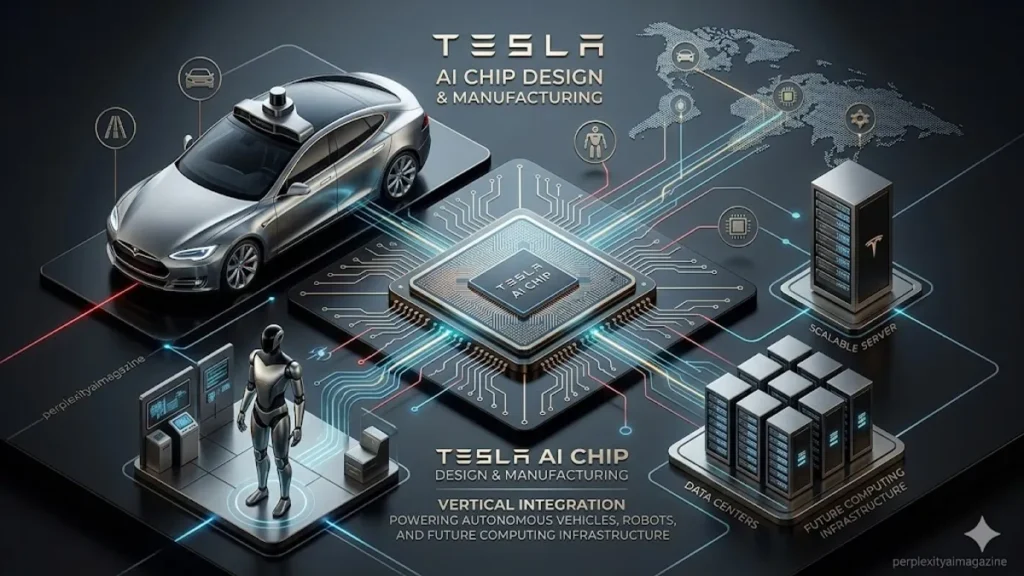
I have spent years watching Tesla redefine industries, but its latest pivot may be the most consequential yet. As the world confronts an acute shortage of advanced AI chips, Tesla is quietly transforming itself from an electric vehicle maker into a serious contender in semiconductor design and, potentially, manufacturing. – Tesla AI Terafab.
The shift is already underway. Tesla designs its own AI processors for self-driving cars, robotics, and data centers, with next-generation chips like AI5 slated for limited production in 2026 and mass rollout by 2027. Today, those chips are fabricated by industry giants like Taiwan Semiconductor Manufacturing Company and Samsung. But that dependence, according to Elon Musk, is no longer sustainable in a world where demand for AI compute is exploding.
In response, Tesla has proposed something extraordinary: a massive in-house semiconductor facility, informally dubbed “Terafab,” that could rival leading chip manufacturers in scale. If realized, it would mark a fundamental transformation, positioning Tesla not just as a consumer of silicon, but as a producer.
The move is driven by necessity as much as ambition. Autonomous vehicles, humanoid robots, and AI-driven infrastructure all require enormous computational power. In a constrained supply environment, control over chips may determine which companies lead and which fall behind.
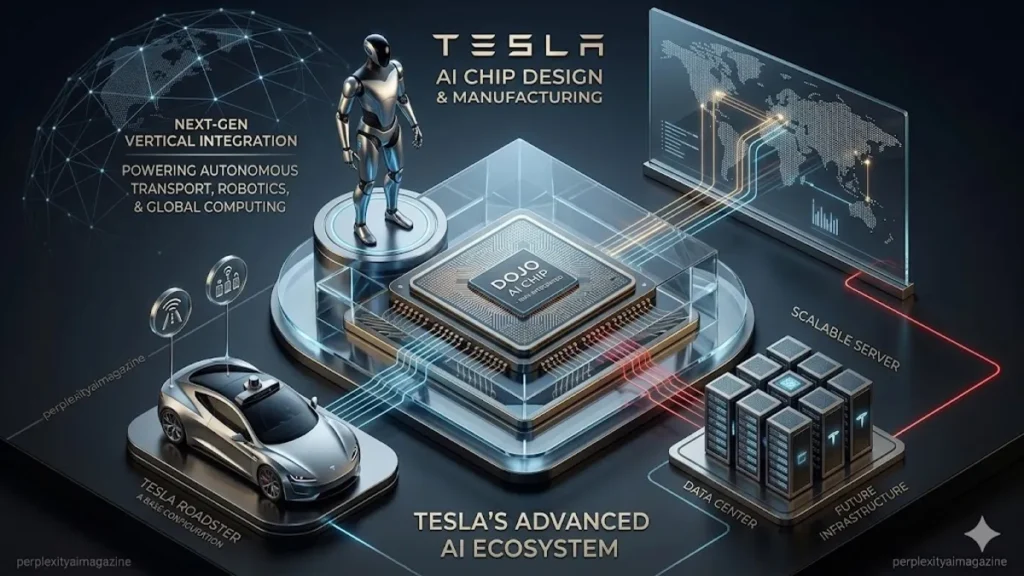
The Global AI Chip Shortage
The shortage of advanced AI chips has become one of the defining economic bottlenecks of the decade. Demand has surged across industries, driven by the rapid adoption of machine learning, large language models, and edge AI applications.
Data centers require vast clusters of GPUs to train and deploy models. At the same time, edge devices such as cars and robots are increasingly dependent on specialized inference chips. This dual demand has strained supply chains, particularly for advanced nodes below 5 nanometers. – Tesla AI Terafab.
According to Jensen Huang, chief executive of Nvidia, “The world is going through an AI infrastructure build-out unlike anything we’ve seen before” (Huang, 2024). That build-out has outpaced manufacturing capacity, leading to long wait times and escalating costs.
Tesla finds itself at the center of this demand curve. Its ambitions in autonomous driving and robotics require not just access to chips, but predictable, scalable supply. The shortage has exposed the risks of relying solely on external manufacturers.
Tesla’s Evolution Into a Chip Designer
Tesla’s journey into silicon began years ago with the development of custom chips for its Full Self-Driving system. The HW3 and HW4 processors marked a shift toward vertical integration, allowing Tesla to tailor hardware specifically to its software.
These chips are optimized for Tesla’s neural networks, enabling efficient processing of visual data and real-time decision-making. Unlike general-purpose GPUs, Tesla’s chips are designed for specific tasks, improving performance per watt and reducing costs.
The upcoming AI5 processor represents a significant leap. It is expected to deliver tens of times more computational power than previous generations, supporting both vehicles and robotics.
| Chip Generation | Year | Key Features | Use Cases |
|---|---|---|---|
| HW3 | 2019 | Custom neural network accelerator | Autopilot |
| HW4 | 2023 | Enhanced compute and safety | Advanced FSD |
| AI5 | 2026–2027 | Massive performance increase | Vehicles, robots, data centers |
| AI6 | 2027+ | Unified architecture, 2nm node | Full ecosystem integration |
This progression reflects a broader strategy. Tesla is not merely improving hardware; it is building a cohesive AI platform that spans multiple domains.
Terafab: A Moonshot in Manufacturing
The proposed Terafab facility represents Tesla’s most ambitious step yet. Envisioned as a large-scale semiconductor plant, it aims to produce AI chips at volumes comparable to established foundries.
Initial capacity targets are reportedly around 100,000 wafer starts per month, with long-term ambitions reaching ten times that level. Such scale would place Tesla among the world’s largest chip producers.
The facility is expected to focus on advanced process nodes, potentially as small as 2 nanometers. This would enable the production of highly efficient, high-performance chips tailored to Tesla’s needs.
The timeline is aggressive. A project launch in 2026 would be followed by gradual ramp-up, with meaningful output expected by 2027 or later. Full realization of the vision could take years. – Tesla AI Terafab
Chris Miller, author of “Chip War,” has noted that “semiconductor manufacturing is one of the most complex industrial processes ever created” (Miller, 2022). Tesla’s entry into this space underscores both its ambition and the challenges ahead.
Why Tesla Wants Control of Silicon
At the heart of Tesla’s strategy is control. By designing and potentially manufacturing its own chips, the company can reduce dependence on external suppliers and align hardware development with its software roadmap.
This integration offers several advantages. It allows Tesla to optimize performance, reduce costs, and accelerate innovation. It also mitigates supply chain risks, which have become increasingly apparent in recent years. – Tesla AI Terafab.
For applications like autonomous driving, consistency and reliability are critical. Delays in chip availability can slow product development and deployment.
Vertical integration also enables tighter coordination between hardware and software teams. This can lead to more efficient systems and faster iteration cycles.
AI5 vs Nvidia: Specialization Versus Generalization
Tesla’s AI5 chip is often compared to Nvidia’s high-end GPUs, but the comparison is nuanced. Nvidia’s chips are designed for a wide range of applications, from training large language models to running simulations.
Tesla’s chips, by contrast, are highly specialized. They are optimized for specific workloads, such as vision processing and decision-making in autonomous systems.
| Feature | Tesla AI5 | Nvidia H100 |
|---|---|---|
| Purpose | Specialized inference | General-purpose AI |
| Power Usage | ~150W (vehicle) | ~700W (data center) |
| Flexibility | Limited | High |
| Cost Efficiency | High for Tesla workloads | Broad but expensive |
This specialization allows Tesla to achieve high efficiency for its use cases. However, it also limits the chip’s applicability outside Tesla’s ecosystem. – Tesla AI Terafab.
The Role of AI6 and Future Generations
Tesla’s roadmap does not stop with AI5. The AI6 chip, expected to enter production around 2027, represents the next phase of its strategy.
Manufactured on advanced nodes, potentially through partnerships with Samsung, AI6 aims to unify Tesla’s hardware across vehicles, robots, and data centers. This would create a consistent platform for development and deployment.
The rapid pace of iteration reflects Tesla’s commitment to staying ahead in a competitive landscape. However, it also introduces risks, particularly in coordinating design and manufacturing timelines.
Delays in foundry processes or technical challenges could impact the rollout of new chips. Balancing ambition with execution will be critical.
Cybercab and Optimus: Chips as Enablers
Tesla’s chip strategy is closely tied to its broader product ambitions. The Cybercab, a fully autonomous robotaxi, relies on onboard AI systems to operate without human intervention.
Similarly, the Optimus humanoid robot requires advanced processing capabilities to navigate and interact with the physical world. Both products depend on scalable, cost-effective compute.
Owning chip production could significantly reduce costs and improve availability. This would make large-scale deployment more feasible.
The synergy between hardware and applications highlights the importance of Tesla’s vertical integration strategy. Chips are not just components; they are enablers of entire business models. – Tesla AI Terafab.
Risks and Challenges Ahead
Despite its potential, Tesla’s move into chip manufacturing faces significant hurdles. Building and operating a semiconductor fab requires enormous capital investment and technical expertise.
The industry is dominated by established players with decades of experience. Competing with them will be challenging, even for a company as innovative as Tesla.
There are also geopolitical considerations. Semiconductor supply chains are influenced by global politics, trade policies, and regional tensions.
Additionally, the rapid pace of technological change means that investments must be carefully timed. Falling behind in process technology could undermine competitiveness.
The Broader Industry Impact
Tesla’s entry into chip manufacturing could have ripple effects across the industry. It may encourage other companies to pursue similar strategies, increasing competition and innovation.
At the same time, it could reshape relationships between technology firms and chip manufacturers. Companies may seek greater control over their supply chains, reducing reliance on traditional vendors.
This shift could lead to a more fragmented but dynamic ecosystem, with new players entering the market and established ones adapting to changing demands.
Takeaways
- Tesla is evolving from a chip designer into a potential manufacturer amid global shortages
- AI5 and AI6 chips are central to its strategy across vehicles, robots, and data centers
- The Terafab project represents a significant investment in semiconductor production
- Vertical integration offers control, efficiency, and supply chain resilience
- Specialized chips provide advantages for Tesla’s workloads but limit broader use
- Significant risks remain in execution, cost, and competition
- Tesla’s move could reshape the semiconductor and AI industries
Conclusion
I see Tesla’s push into AI chips not as a side project, but as a defining chapter in its evolution. The company is betting that control over silicon will be as important as control over software in the age of artificial intelligence.
The strategy is bold, even by Tesla’s standards. It requires navigating one of the most complex industries in the world while continuing to innovate in others. Success is far from guaranteed.
Yet the logic is compelling. In a world where compute power underpins everything from transportation to robotics, securing access to chips is not just a technical challenge. It is a strategic imperative.
Tesla’s journey into chip manufacturing reflects a broader shift in technology. The boundaries between industries are blurring, and companies are redefining themselves to stay ahead.
The outcome will shape not only Tesla’s future, but the trajectory of AI and computing as a whole.
READ: AI Hedge Fund With 18 Agents That Think Like Wall Street Legends
FAQs
Is Tesla currently manufacturing its own AI chips?
No, Tesla designs its chips but relies on external foundries like TSMC and Samsung for manufacturing.
What is Terafab?
Terafab is Tesla’s proposed semiconductor facility aimed at producing its own AI chips at large scale.
Why does Tesla need its own chips?
To ensure supply, reduce costs, and optimize performance for its AI-driven products.
How does Tesla’s AI5 compare to Nvidia GPUs?
AI5 is more specialized and efficient for Tesla’s tasks but less flexible than Nvidia’s general-purpose GPUs.
When will Tesla become a full chip manufacturer?
If Terafab succeeds, Tesla could become a manufacturer within the next 3–5 years.
