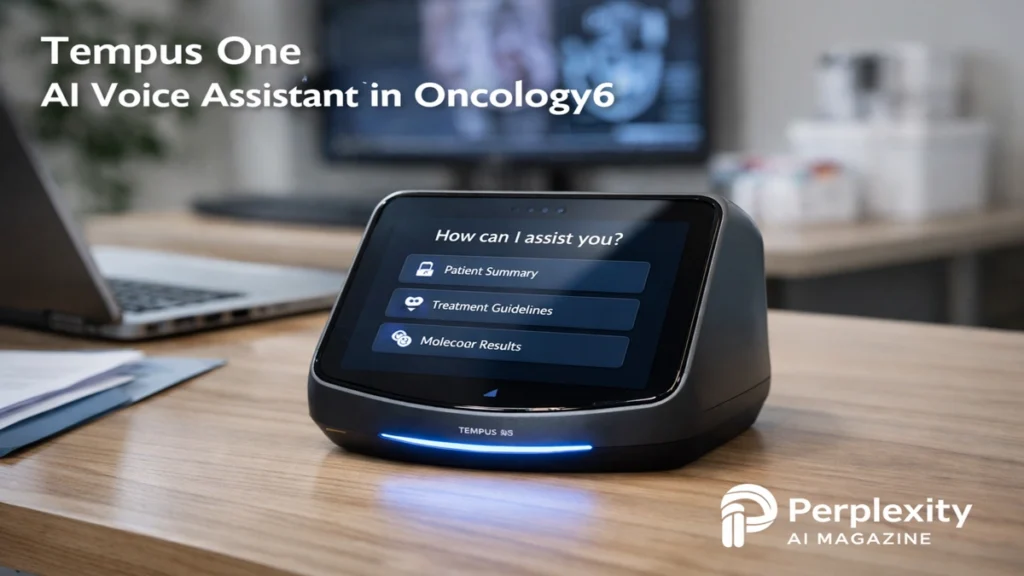
i approach Tempus One not as a futuristic novelty, but as a practical response to a long standing problem in oncology. Modern cancer care generates enormous volumes of data, yet much of it remains difficult to access at the moment it matters most. Tempus One, the AI voice assistant developed by Tempus AI, was created to reduce that friction by allowing clinicians and researchers to query patient information through voice or text, without breaking clinical workflow. – tempus’s ai voice assistant.
For readers seeking a clear answer upfront, Tempus One is a generative AI powered clinical assistant designed primarily for oncologists. It enables hands free access to patient histories, molecular profiles, biomarkers, trial matches, and guideline aligned insights, all drawn from Tempus’s multimodal data platform. The tool was piloted internally in 2021, launched broadly in 2023, and has since expanded into direct electronic health record workflows and research environments.
i see its importance less in what it promises and more in where it operates. By embedding into platforms already used for care and research, Tempus One positions itself as an interface layer between complex data systems and human decision making. It does not replace clinical judgment. It attempts to remove the time consuming work of searching, summarizing, and reconciling information.
That distinction matters. Oncology is a field defined by urgency, uncertainty, and constant updates to evidence. Any tool that claims to assist must respect those realities while remaining accurate, transparent, and accountable.
The Origins of Tempus AI and Its Data Driven Mission
i find it impossible to understand Tempus One without understanding the company behind it. Tempus AI was founded in 2015 by Eric Lefkofsky, motivated by a deeply personal experience with cancer in his family. From the beginning, the company focused on one central idea: patient care improves when clinical and molecular data are accessible, structured, and usable.
Rather than building isolated analytics tools, Tempus invested in assembling large scale multimodal datasets. These include clinical records, genomic sequencing, pathology images, and longitudinal outcomes. Over time, this data foundation expanded beyond oncology into areas such as cardiology, radiology, and mental health, but cancer care remained the core.
Tempus One emerged as a natural extension of that strategy. Once data exists at scale, the next challenge is how humans interact with it. The company recognized that dashboards and static reports were insufficient for real time decision making. A conversational interface offered a way to translate complex datasets into immediate answers.
Read: AI Robots and the Humanoid Breakthrough of 2026
Why Voice Matters in Clinical Settings
i have observed that clinicians rarely struggle with understanding data. They struggle with finding it quickly. Voice based interaction addresses that gap by allowing information retrieval without shifting attention away from the patient or the care team.
Tempus One supports both voice and text input, recognizing that clinical environments vary. In some settings, speaking a query is efficient. In others, typing is more appropriate. The key is flexibility.
Voice interaction also reflects how clinicians naturally think. Questions such as “What actionable mutations are present?” or “Has this patient progressed on prior therapy?” are spoken queries, not database commands. By accepting natural language, Tempus One lowers the cognitive barrier to complex data retrieval.
This approach does not eliminate risk. Spoken responses must be precise, sourced, and reviewable. In medicine, confidence without accuracy is dangerous. Tempus positions the assistant as a support tool, not an autonomous decision maker, which is essential for responsible use. – tempus’s ai voice assistant.
From Early Pilot to Broad Launch
i see the development path of Tempus One as a lesson in clinical product design. The earliest prototype, revealed internally in 2021, included a dedicated hardware concept. Feedback from clinicians was clear. They preferred tools that worked on devices they already used.
As a result, Tempus shifted toward software based deployment. By 2023, Tempus One launched broadly as a voice and text assistant available through Tempus’s existing clinical platform. This decision reduced friction and accelerated adoption.
The broad launch emphasized practical use cases rather than spectacle. Clinicians could ask for patient summaries, review molecular findings, or identify care gaps without leaving their workflow. That focus on daily utility helped distinguish Tempus One from experimental AI tools that struggle to find real users.
Core Features and Capabilities
i describe Tempus One’s functionality as retrieval, synthesis, and guidance.
Retrieval includes instant access to patient clinical histories, lab results, imaging context, and molecular profiles. Synthesis involves summarizing complex records into concise narratives that clinicians can review quickly. Guidance refers to surfacing relevant biomarkers, potential trial matches, and guideline based considerations.
Recent enhancements expanded these capabilities through natural language cohort building for research and custom agent creation for institutions. Rather than offering a single generic assistant, Tempus allows organizations to tailor agents to specific workflows such as pre charting or note drafting. – tempus’s ai voice assistant.
These features are built on Tempus’s multimodal data infrastructure, which allows the assistant to connect disparate sources into a unified response.
Integration Into Care and Research Platforms
i consider integration the most important factor in determining whether clinical AI tools succeed. Tempus One operates across two primary environments: care focused platforms and research focused platforms.
In care settings, the assistant is embedded into Tempus Hub and increasingly into electronic health record systems. This allows clinicians to access AI assistance without leaving the patient chart. Queries can pull live clinical data and return results directly into the workflow.
In research settings, Tempus One is integrated into Lens, the company’s analytics platform. Here, researchers use natural language to define cohorts, explore datasets, and summarize findings across de identified populations.
This separation reflects different safety and governance needs. Clinical care demands patient specific accuracy and auditability. Research emphasizes exploration and scale.
Electronic Health Record Integration
i view EHR integration as the dividing line between theoretical value and operational impact. By embedding Tempus One directly into EHR systems, Tempus reduces the need for context switching and manual data transfer.
Within the EHR, the assistant can support three phases of care. Before appointments, it prepares summaries and highlights key findings. During visits, it enables real time queries and documentation support. After visits, it assists with note generation, treatment planning, and trial matching. – tempus’s ai voice assistant.
This integration also raises expectations around security and compliance. Operating inside the system of record requires strict access controls, logging, and adherence to privacy regulations. Tempus emphasizes HIPAA compliance and institutional governance as core design principles.
Customization Through Agent Builder
i have seen generic AI tools fail because they ignore local realities. Hospitals operate on specific protocols, documentation standards, and workflows. Tempus addresses this through its agent builder approach.
Agent builder allows institutions to work with Tempus teams to create tailored generative AI agents aligned with internal procedures. For example, one agent might focus on pre visit preparation, while another assists with clinical trial screening.
Customization improves adoption because the assistant feels familiar rather than imposed. It also clarifies responsibility. When an institution defines an agent’s scope, it also defines its limits.
The Role of Tempus One in Precision Medicine
i believe Tempus One’s real contribution lies in making precision medicine operational. Genomic testing and targeted therapies are powerful, but only if clinicians can act on results quickly.
By connecting molecular data with clinical context, the assistant helps surface actionable insights at the right time. This includes identifying biomarkers relevant to targeted therapies, recognizing eligibility for trials, and aligning care with evidence based guidelines. – tempus’s ai voice assistant.
The assistant does not interpret results independently. It retrieves and contextualizes information, leaving interpretation and decision making to clinicians. That balance preserves clinical authority while improving efficiency.
Impact on Documentation and Burnout
i consistently hear that documentation burden is one of the most exhausting aspects of oncology practice. Tempus One addresses this indirectly by assisting with summarization and note drafting.
By generating structured drafts and highlighting key points, the assistant reduces time spent on repetitive documentation. Clinicians remain responsible for review and final approval, which is critical for safety.
The impact is not dramatic in a single encounter. It accumulates over days and weeks. Small reductions in administrative load can translate into meaningful improvements in clinician experience.
Ethical and Practical Limits
i do not believe any clinical AI tool should operate without clear boundaries. Tempus One’s design reflects an understanding that generative AI can produce confident but incomplete responses.
Responsible use requires transparency about data sources, guideline references, and uncertainty. Clinicians must be able to trace outputs back to underlying records. Institutions must monitor performance and address errors.
The assistant’s value depends on trust. Trust is earned through consistency, accuracy, and respect for human judgment.
Takeaways
- Tempus One is a voice and text AI assistant designed for oncology workflows
- It emerged from early pilots in 2021 and launched broadly in 2023
- The tool focuses on retrieval, synthesis, and workflow support, not autonomous decisions
- Integration into EHR systems is central to its practical impact
- Custom agent building allows institutions to tailor use cases
- Its success depends on transparency, governance, and clinician oversight
Conclusion
i see Tempus One as part of a broader shift in medicine toward conversational interfaces layered on complex data systems. Its value is not in novelty, but in restraint. By positioning itself as an assistant rather than an authority, it respects the realities of clinical care.
Oncology demands speed, accuracy, and humility. Tempus One attempts to support those demands by removing friction between clinicians and the information they need. When used responsibly, it can shorten the distance between data and decision. – tempus’s ai voice assistant.
The long term question is not whether voice assistants belong in medicine, but how carefully they are designed and governed. Tempus One offers a case study in building clinical AI that prioritizes workflow, safety, and trust over spectacle.
FAQs
What is Tempus One
Tempus One is a generative AI powered voice and text assistant developed by Tempus AI to help clinicians and researchers query patient data and insights.
When was Tempus One launched
The assistant was piloted in 2021 and broadly launched for clinical use in 2023.
Who uses Tempus One
It is used primarily by oncologists and researchers working within Tempus clinical and analytics platforms.
Does Tempus One replace clinical judgment
No. It supports information retrieval and summarization while clinicians retain full decision making responsibility.
How does Tempus One support precision medicine
It connects clinical and molecular data to surface actionable insights, biomarkers, and trial options within everyday workflows.