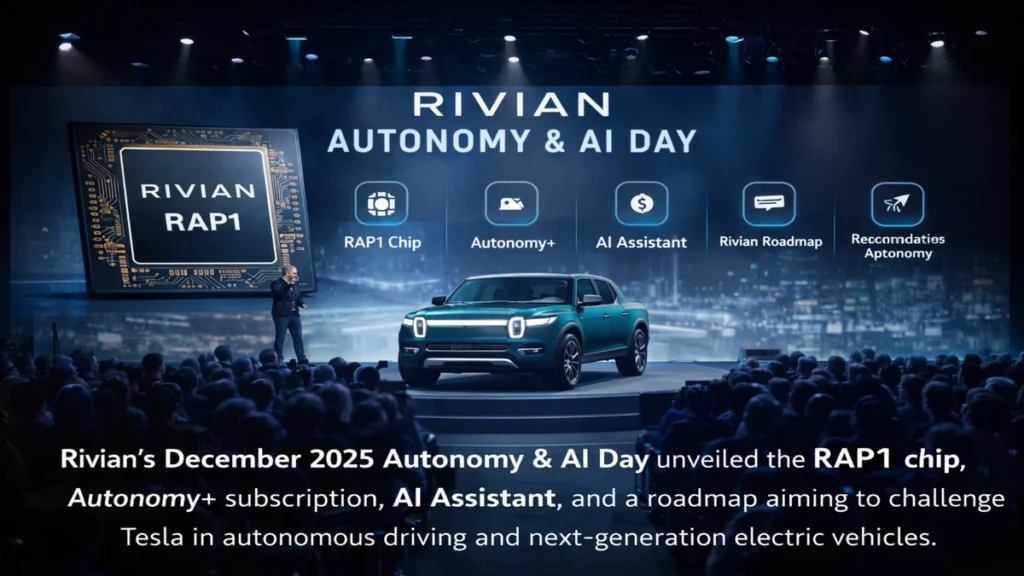
In late 2025 and early 2026, Rivian crossed a psychological boundary. The company stopped presenting itself primarily as an electric vehicle manufacturer and began presenting itself as a technology company that happens to build vehicles. The moment was marked by its Autonomy & AI Day, the unveiling of its in-house RAP1 chip, the introduction of its Autonomy+ subscription, and the announcement of an agent-based AI assistant designed to orchestrate everything from driving to climate control. Together, these moves signal a strategic repositioning that mirrors what Tesla began years earlier: the transformation of the car from a machine into a computer on wheels. – rivn.
This shift matters because the economics of the auto industry are changing. Hardware margins are thin, competition is fierce, and differentiation based solely on range or acceleration is fleeting. Software, data, and intelligence offer a new frontier for value creation. Rivian’s bet is that autonomy and AI can become not just features but platforms — continuously evolving, monetized through subscriptions, and deeply integrated into daily life.
For drivers, this means vehicles that can drive themselves in constrained contexts, manage their own systems intelligently, and improve over time. For Rivian, it means recurring revenue, deeper customer relationships, and insulation from the brutal cycles of automotive manufacturing. For society, it means that the governance of software — not just the safety of hardware — will increasingly determine what cars can and cannot do.
Rivian’s autonomy story is therefore not just about hands-free driving. It is about how intelligence is becoming the defining layer of mobility.
The Strategic Meaning of the RAP1 Chip
At the center of Rivian’s autonomy strategy is its custom silicon: the Rivian Autonomy Processor 1, or RAP1. By designing its own chip, Rivian is following a path carved by Apple and Tesla, companies that learned that control over hardware enables control over performance, cost, and iteration speed.
RAP1 is designed specifically for edge AI workloads: perception, sensor fusion, planning, and decision-making. It processes data from cameras, radar, and eventually lidar directly inside the vehicle, reducing reliance on cloud computation and lowering latency for safety-critical decisions.
This matters because autonomy is not just about intelligence, but about timeliness. A model that is brilliant but slow is useless in a vehicle traveling at highway speed. Edge processing allows Rivian to respond to the world in real time, while still benefiting from cloud-based learning and updates. – rivn.
By moving away from third-party chips, Rivian gains not just performance, but sovereignty. It can optimize its models for its own hardware, control its cost structure, and avoid dependency on external roadmaps.
This is vertical integration not for manufacturing efficiency, but for cognitive efficiency.
Read: Charizard and the Secret Language of AI Training
Autonomy+ and the Economics of Software Driving
Rivian’s Autonomy+ subscription reframes driving assistance as a service rather than a feature. For $49.99 per month or $2,500 upfront, drivers gain access to hands-free highway driving, automated lane changes, parking, and highway navigation from on-ramp to off-ramp.
This model echoes a broader shift in technology: from ownership to access, from product to platform. The car becomes a base device onto which capabilities are layered over time.
The significance is economic. Subscriptions smooth revenue, reduce reliance on volatile vehicle sales, and create incentives to improve software continuously. They also change consumer psychology. Buyers no longer ask only what the car does today, but what it might do tomorrow.
Autonomy+ is not positioned as full self-driving. It is deliberately conservative, focusing first on limited-access highways where conditions are structured and predictable. This reflects a pragmatic approach: deploy where risk is manageable, learn from real-world use, and expand gradually. – rivn.
This is not the dream of robotaxis. It is the discipline of incremental autonomy.
The AI Assistant and the Reimagining of the Interface
The Rivian AI Assistant extends the idea of autonomy beyond driving into the entire vehicle experience. It acts as an orchestration layer, integrating infotainment, navigation, climate, diagnostics, and potentially third-party services into a single contextual system.
Rather than offering isolated voice commands, the assistant is designed to understand intent and context. It can anticipate needs, manage systems proactively, and learn from user behavior.
This reflects a shift from reactive interfaces to proactive systems. The car becomes not just responsive, but attentive.
In this sense, Rivian is not building a smarter dashboard. It is building a vehicle that participates in its own operation.
This is what makes the car feel less like a tool and more like a collaborator.
Comparison with Tesla’s Full Self-Driving
| Aspect | Rivian Autonomy+ | Tesla FSD |
|---|---|---|
| Focus | Highway-centric hands-free | City and highway navigation |
| Hardware | Custom RAP1, multi-sensor | Tesla AI chips, camera-only |
| Pricing | $49.99/month or $2,500 | ~$99/month or ~$8,000 |
| Philosophy | Gradual, constrained rollout | Aggressive, broad ambition |
This comparison shows two different philosophies. Tesla aims for maximal autonomy as quickly as possible. Rivian aims for constrained autonomy done carefully.
Neither approach is inherently superior. They reflect different risk tolerances, regulatory strategies, and brand identities.
Sensor Diversity and the Politics of Perception
Rivian’s use of cameras, radar, and future lidar contrasts with Tesla’s camera-only approach. This is not just a technical choice; it is a philosophical one.
Multiple sensors offer redundancy and robustness. They also increase cost and complexity. Camera-only systems promise simplicity and scalability but require more sophisticated interpretation. – rivn.
Rivian’s choice reflects caution. It prioritizes safety and reliability over elegance.
This may slow progress, but it builds trust.
Timeline of Rivian’s Autonomy Roadmap
| Milestone | Timing |
|---|---|
| Autonomy & AI Day | December 2025 |
| Autonomy+ launch | Early 2026 |
| AI Assistant rollout | Early 2026 |
| Expanded autonomy | Late 2026 and beyond |
Expert Reflections
One automotive technologist noted that Rivian’s strategy “treats autonomy as infrastructure rather than spectacle.” Another observed that “custom silicon is less about speed and more about independence.” A third emphasized that “subscriptions shift the relationship between driver and manufacturer from transactional to ongoing.”
These perspectives highlight that Rivian’s choices are as much about business model and governance as about engineering. – rivn.
Cultural Implications
As vehicles become intelligent, they become political. Decisions about what a car can do, where it can drive itself, and how it responds in edge cases are decisions about safety, liability, and control.
By embedding intelligence deeply into its vehicles, Rivian is also embedding itself deeply into the everyday lives of its users.
The car becomes not just transportation, but infrastructure.
Takeaways
- Rivian is repositioning itself as an AI-first mobility company
- Custom silicon enables performance, sovereignty, and iteration speed
- Autonomy+ reframes driving as a service
- The AI Assistant turns the car into an orchestrated system
- Sensor diversity reflects a safety-first philosophy
- Subscriptions reshape the economics of car ownership
Conclusion
Rivian’s autonomy push is not about chasing Tesla. It is about redefining what a car is.
By investing in custom chips, constrained autonomy, and contextual AI, Rivian is building vehicles that are not just electric, but intelligent. Vehicles that do not just move, but decide. Vehicles that do not just respond, but anticipate.
This transformation carries risks. It raises questions about safety, privacy, and control. It demands trust in software that few people truly understand. – rivn.
But it also offers a new vision of mobility: one where cars are safer, more adaptive, and more integrated into the rhythms of human life.
Rivian is not building the future of driving. It is building the future of how we relate to machines that move us. – rivn.
FAQs
What is Rivian Autonomy+?
A subscription service providing hands-free highway driving and advanced assistance.
Is it full self-driving?
No, it is limited to specific conditions and roads.
What is the RAP1 chip?
Rivian’s custom processor for on-board AI.
How does Rivian differ from Tesla?
Rivian emphasizes gradual rollout and sensor diversity.
When will features expand?
Through over-the-air updates beginning in 2026.