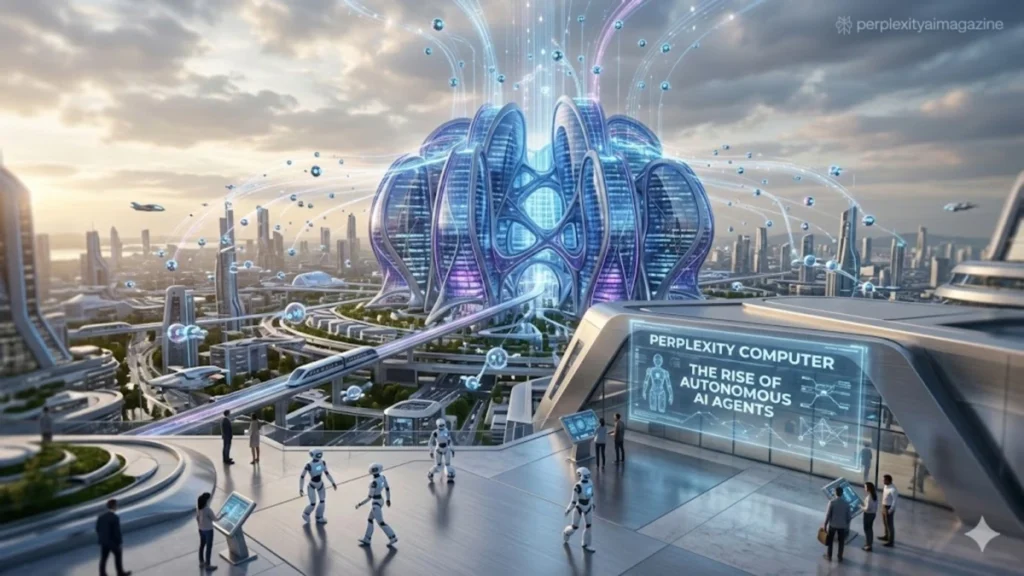
i began examining Perplexity Computer with a straightforward question: what happens when a search engine stops answering questions and starts doing the work itself? The answer is unfolding in a new category of artificial intelligence known as autonomous agents. Perplexity Computer, recently introduced by the AI search company Perplexity, represents a shift from conversational AI toward fully automated task execution.
Perplexity Computer functions as what its creators describe as a “general-purpose digital worker.” Instead of responding to prompts with explanations or summaries, it breaks down complex objectives into smaller tasks, assigns them to specialized AI models, and executes them inside isolated cloud environments. The system coordinates numerous AI models simultaneously, delegating research, coding, data analysis, and creative tasks to whichever model is best suited for each stage.
The implications are substantial. Tasks that once required hours or days of coordination across research tools, coding platforms, messaging services, and analytics systems can now be performed autonomously by a network of AI agents. A single prompt can trigger an entire workflow: gathering market data, building spreadsheets, generating presentations, and delivering the results through email or collaboration software.
This evolution reflects a broader shift in artificial intelligence. For years, generative AI systems focused primarily on producing text or images. The emerging generation of autonomous agents aims to go further, orchestrating tools, executing tasks, and managing projects.
In effect, AI is moving from being an assistant to becoming an operator.
From Search Engine to Autonomous Agent
Perplexity built its reputation as an AI-powered answer engine designed to summarize information from the web with cited sources. That model proved popular among researchers and professionals seeking faster ways to navigate the internet’s growing information landscape.
Yet search alone has limits. Users often ask questions because they ultimately want something done: a report written, data analyzed, a product comparison assembled, or a workflow automated.
Perplexity Computer addresses that gap by converting user goals into multi-step execution plans. Instead of simply summarizing articles about competitors, the system can analyze their pricing pages, extract product details, generate charts, compile slides, and distribute the results.
Aravind Srinivas, Perplexity’s co-founder and chief executive, has argued that AI’s next stage lies in task execution rather than text generation. “The long-term vision is an AI that can perform complex tasks across the web, not just answer questions,” he said in interviews discussing the company’s roadmap.
That philosophy places Perplexity Computer within the fast-growing field of autonomous AI agents, which aim to automate workflows traditionally handled by human operators.
Read: Internal Error Perplexity AI: Causes and Fixes Guide
How Perplexity Computer Works
At its core, Perplexity Computer is an orchestration engine that manages multiple AI systems simultaneously. When a user submits a task, the system decomposes the objective into subtasks, assigns each component to specialized models, and coordinates their outputs.
The process resembles a distributed team of specialists collaborating on a project.
The system reportedly integrates nineteen different AI models, each selected for particular strengths. A reasoning model handles planning and coordination. Research-oriented models gather and analyze information. Other models generate code, images, or video assets as needed.
This modular architecture allows the system to leverage different capabilities without being tied to a single model’s limitations.
Example workflow
A user might ask the system to research competitors in the electric vehicle charging industry and produce a presentation for a management meeting.
Perplexity Computer would:
- Run parallel searches across relevant companies
- Extract product features and pricing structures
- Build comparison charts
- Generate presentation slides
- Send the final document via integrated email tools
Each stage can run simultaneously rather than sequentially, dramatically reducing execution time.
The Architecture of Multi-Model Orchestration
The defining feature of Perplexity Computer is its orchestration of multiple AI models rather than reliance on a single system.
This architecture allows tasks to be routed dynamically depending on which model performs best for each type of work.
| Component | Function | Example Capability |
|---|---|---|
| Reasoning engine | Plans workflow and coordinates tasks | Project planning |
| Research models | Gather and synthesize information | Market analysis |
| Coding models | Generate scripts or applications | Web app development |
| Creative models | Produce images and video | Visual content generation |
| Integration agents | Connect with enterprise software | Data retrieval and delivery |
The orchestration layer manages dependencies between tasks. For instance, research must be completed before analysis can occur, and analysis must precede report generation.
Parallel execution allows many subtasks to run simultaneously, which can significantly reduce completion time.
Persistent Memory and Long-Term Context
One of the system’s defining capabilities is persistent memory.
Traditional chat-based AI tools often lose context between sessions. Perplexity Computer maintains a longer-term understanding of the user’s projects, preferences, and previous tasks.
Persistent memory enables the system to build continuity across workflows.
For example, if a marketing team repeatedly analyzes competitor pricing data, the system can remember which companies to track and which metrics matter most.
This capability aligns with a broader trend in AI development toward agents that maintain contextual awareness over time.
Researchers at Stanford University have described persistent AI memory as a key step toward digital agents capable of sustained collaboration with humans.
Enterprise Integrations Expand the Scope
Another defining feature of Perplexity Computer is its integration with enterprise software.
The system can connect with tools such as Gmail, Slack, GitHub, Notion, and data platforms including Snowflake and Databricks. These integrations enable workflows that span research, analysis, and delivery.
Consider a financial reporting workflow.
The system might retrieve financial data from Snowflake, perform calculations, generate charts, produce presentation slides, and send them to executives through email or messaging platforms.
This type of end-to-end automation represents a shift in how organizations use AI.
Instead of isolated productivity tools, companies can deploy AI agents that coordinate across their entire digital infrastructure.
Andrew Ng, founder of DeepLearning.AI, has noted that “AI agents that orchestrate tools are likely to be the next major wave of AI applications.”
Pricing and Access
Perplexity Computer currently operates within the company’s Max subscription tier.
The plan costs $200 per month and provides users with a monthly credit allocation for running autonomous workflows. Credits are consumed based on task complexity and resource usage.
The company plans to expand access to additional subscription tiers and enterprise deployments.
The pricing structure reflects the computational demands of autonomous agents, which often run multiple models simultaneously over extended periods.
| Plan | Price | Computer Access | Credits |
|---|---|---|---|
| Free | $0 | No | N/A |
| Pro | $20/month | Limited rollout | Limited |
| Max | $200/month | Full access | 10,000 credits |
| Enterprise | Custom | Full access | Custom allocation |
Such pricing places Perplexity Computer in direct competition with high-end AI offerings from other companies.
How It Compares to Other AI Agents
Perplexity Computer enters a rapidly evolving landscape of autonomous AI tools.
Major competitors include Anthropic’s Claude-based automation systems and OpenAI’s Operator platform.
Each approach reflects different philosophies about how AI agents should function.
| Feature | Perplexity Computer | Claude Cowork | OpenAI Operator |
|---|---|---|---|
| Architecture | Multi-model orchestration | Single-model | Conversational agent |
| Environment | Cloud sandbox | Local desktop | Cloud interface |
| Parallel tasks | Yes | No | Limited |
| Persistent memory | Yes | Session-based | Limited |
| Execution style | Autonomous workflows | Desktop automation | Guided interaction |
These differences influence how users interact with each platform.
Perplexity emphasizes orchestration and parallel execution, while competing systems often prioritize conversational guidance or local file control.
The Promise of Autonomous Workflows
The most compelling promise of systems like Perplexity Computer lies in automation.
A single prompt can initiate complex workflows that traditionally require coordination between multiple departments or software tools.
Common applications include:
- Market research and competitor analysis
- Software development and deployment
- Financial modeling and reporting
- Content creation pipelines
- Hiring and recruiting workflows
In one reported example, a team used the system to build a large spreadsheet containing thousands of rows of research data overnight, a task that would normally require days of manual effort.
For organizations operating at scale, such automation could significantly reshape productivity.
The Risks of Multi-Model Complexity
Yet the same architecture that makes Perplexity Computer powerful also introduces risks.
Coordinating numerous AI systems creates operational complexity.
Each model may have different policies, capabilities, and update schedules. Changes to external APIs or pricing structures can disrupt workflows.
Multi-model orchestration also introduces latency variability and potential reliability issues.
Sub-agents may produce inconsistent results, and errors can propagate through multi-stage workflows if not detected early.
AI researcher Gary Marcus has cautioned that autonomous systems still struggle with reliability and reasoning consistency, particularly in complex real-world environments.
These challenges highlight the importance of human oversight.
Limitations of Cloud Sandbox Environments
Perplexity Computer runs within isolated cloud environments designed to enhance security and reliability.
However, this architecture imposes practical limitations.
The system cannot access files stored directly on a user’s desktop or interact with local applications. Tasks requiring specialized software or proprietary data may therefore require alternative approaches.
Additionally, sandbox environments often impose restrictions on computing resources and external network calls.
Large-scale data operations may exceed memory limits, and certain integrations may be restricted due to security policies.
These constraints illustrate the trade-offs between security and flexibility in autonomous AI systems.
Failure Modes in Autonomous Systems
Autonomous agents introduce unique failure modes.
One risk is silent failure.
An agent might complete a task incorrectly while reporting success, leaving users unaware of errors until later stages of a workflow.
Another concern is hallucination, where AI systems generate plausible but inaccurate information.
When errors occur early in a workflow, they can cascade through subsequent steps.
For example, incorrect data extracted during research could influence analysis, charts, and final reports.
Experts therefore recommend incorporating validation steps and human review into automated workflows.
Expert Perspectives on the Future of AI Agents
Technology researchers increasingly view autonomous agents as the next frontier of artificial intelligence.
Fei-Fei Li, a prominent AI researcher, has argued that the next generation of AI systems will focus on collaboration between humans and machines rather than simple automation.
Similarly, venture capitalist Andreessen Horowitz has described AI agents as a “new software paradigm” capable of performing complex digital labor.
These perspectives suggest that systems like Perplexity Computer represent an early stage in a broader transformation.
Rather than replacing humans outright, autonomous agents may function as digital coworkers capable of handling repetitive or analytical tasks.
Takeaways
- Perplexity Computer is an autonomous AI agent capable of executing multi-step workflows without continuous human input.
- The system orchestrates multiple AI models to handle specialized tasks such as research, coding, and content generation.
- Parallel execution enables faster completion of complex projects.
- Enterprise integrations allow the system to interact with business tools and data platforms.
- Autonomous AI agents introduce new risks, including reliability issues and hallucinated information.
- The technology signals a shift from conversational AI toward task automation.
Conclusion
i see Perplexity Computer less as a finished product and more as a glimpse of how software may evolve over the coming decade. For years, digital tools have helped humans complete tasks faster. Autonomous AI agents take the next step by performing those tasks themselves.
The idea of a “digital worker” may sound futuristic, but the underlying technology already exists. Cloud infrastructure can coordinate multiple AI models, persistent memory can track long-term projects, and integrations allow agents to interact with the same tools humans use every day.
Yet the technology remains imperfect. Autonomous systems still struggle with reliability, oversight, and accountability. Organizations adopting these tools will need safeguards to ensure that automation does not create new vulnerabilities.
Still, the trajectory is clear.
As AI agents become more capable, the boundary between software and coworker will continue to blur.
In that future, the most valuable skill may not be asking questions but learning how to delegate work to machines.
FAQs
What is Perplexity Computer?
Perplexity Computer is an autonomous AI agent system designed to execute complex workflows by coordinating multiple AI models and software integrations.
How is it different from regular AI chatbots?
Unlike chatbots that respond conversationally, Perplexity Computer can plan, execute, and deliver multi-step tasks autonomously.
Who can access Perplexity Computer?
Currently, it is available to subscribers of Perplexity’s Max plan, which costs $200 per month.
What types of tasks can it perform?
It can conduct research, build reports, generate code, analyze data, and deliver results through integrated business tools.
Is it fully autonomous?
The system can operate independently for many tasks, but human oversight is still recommended to verify results.