
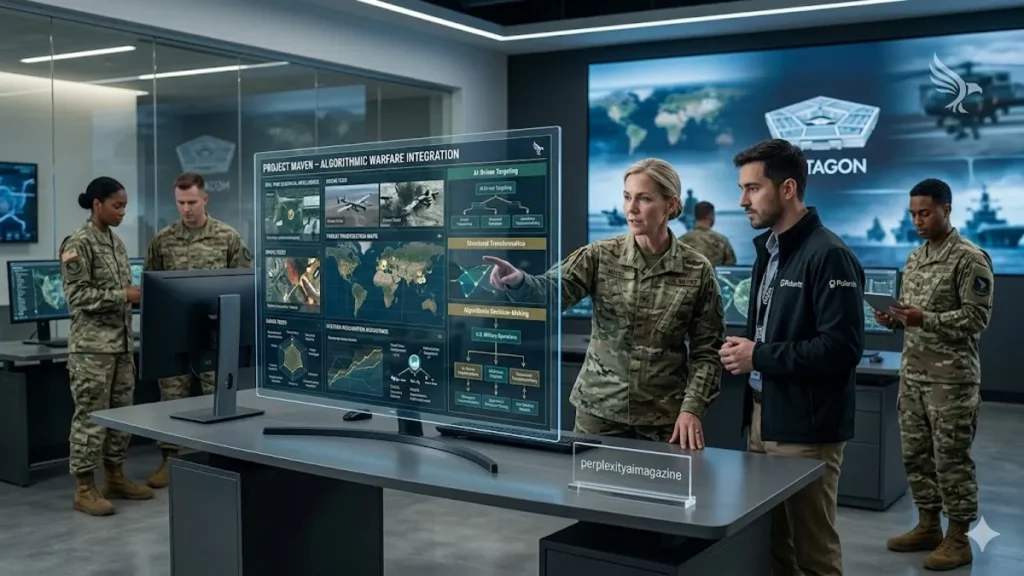
I begin with a simple truth: the Pentagon’s decision to formalize Palantir’s Maven AI system as a “program of record” marks a turning point in how wars are planned, analyzed, and executed. Within the first hundred words, the meaning is clear. This is not just another defense contract. It is a structural commitment to artificial intelligence as a permanent layer of military command. – pentagon palantir ai.
The March 9 memo from Deputy Defense Secretary Steve Feinberg formalizes what had already been unfolding quietly across battlefields. Maven, once an experimental project born in 2017, is now positioned as the central nervous system for U.S. military targeting and decision support. By elevating it to program-of-record status, the Department of Defense ensures stable funding, institutional oversight, and widespread deployment across all branches by the end of fiscal year 2026.
This move transforms AI from a supporting capability into a foundational one. Maven’s role is no longer confined to analyzing drone footage or assisting intelligence teams. It is now embedded in the chain of command itself, accelerating decisions that once took hours into near real time. In doing so, it raises profound questions about speed, accountability, and the evolving relationship between human judgment and machine intelligence in warfare. – pentagon palantir ai.
From Experimental Tool to Institutional Backbone
The Pentagon’s decision reflects a broader evolution in defense technology. Project Maven began as a narrow initiative focused on computer vision, designed to help analysts process vast amounts of drone footage in Iraq and Syria. Its early success demonstrated that machine learning could dramatically reduce the time required to identify objects and patterns.
Over time, Maven expanded beyond its original scope. It began integrating multiple data streams, including satellite imagery, radar signals, and intelligence reports. This shift transformed it from a single-purpose tool into a comprehensive command-and-control platform. By 2024, military officials were already describing it as a “digital mission command system,” capable of synthesizing complex battlefield data into actionable insights.
The program-of-record designation now cements that evolution. It moves Maven out of the experimental phase and into the formal Defense Acquisition System, complete with dedicated funding lines and long-term planning. As one former Pentagon official noted, “This is the moment AI stops being a pilot project and becomes infrastructure.”
What the Memo Signals About U.S. Strategy
Feinberg’s memo does more than announce a procurement decision. It articulates a strategic vision in which AI-enabled decision-making becomes the cornerstone of U.S. military power. By centralizing oversight under the Chief Digital and Artificial Intelligence Office, the Pentagon is signaling that AI is no longer fragmented across agencies but coordinated at the highest levels.
This shift reflects lessons learned from recent conflicts. In environments where data is abundant but time is scarce, the ability to process information quickly can determine operational success. Maven’s capacity to fuse inputs from multiple sensors allows commanders to identify threats with unprecedented speed and precision. – pentagon palantir ai.
The memo also indicates a move toward standardization. By making Maven a core platform, the Pentagon aims to ensure that all branches of the military operate on a مشتركة digital framework. This reduces fragmentation and enhances interoperability, enabling joint operations that are more synchronized and efficient.
How Maven Works on the Battlefield
At its core, Maven functions as a data fusion engine. It ingests information from satellites, drones, radars, and human intelligence sources, then applies machine learning models to identify patterns and anomalies. The system can flag potential targets such as vehicles, buildings, or weapons depots, presenting them to human operators through intuitive interfaces.
One of Maven’s most significant contributions is its ability to compress the “kill chain,” the sequence of steps from target identification to engagement. Traditionally, this process could take hours or even days. Maven reduces it to minutes or seconds by automating data analysis and prioritization.
Key Capabilities of Maven
| Capability | Description | Operational Impact |
|---|---|---|
| Data Fusion | Integrates multi-source intelligence | Holistic battlefield awareness |
| Object Detection | Identifies vehicles, structures, threats | Faster targeting decisions |
| Predictive Analytics | Anticipates enemy movements | Proactive strategy |
| Real-Time Processing | Near-instant analysis | Reduced decision latency |
As Palantir executives have emphasized in public demonstrations, Maven does not make lethal decisions. Instead, it provides recommendations that human operators must evaluate and approve. This distinction remains central to the system’s ethical framing.
The Procurement Shift: Why “Program of Record” Matters
Designating Maven as a program of record fundamentally alters how it is funded and managed. Instead of relying on temporary research budgets, it now receives stable, multi-year funding through the Department of Defense’s formal budget process. – pentagon palantir ai.
This change also introduces rigorous oversight. The program will be managed by a dedicated Program Manager and subject to milestone reviews that assess cost, performance, and schedule. In practical terms, it ensures that Maven will continue to evolve and scale rather than remain a static tool.
Program of Record vs Enterprise Contract
| Dimension | Enterprise Agreement (2025) | Program of Record (2026) |
|---|---|---|
| Purpose | Procurement mechanism | Strategic capability |
| Scope | All Palantir software | Maven specifically |
| Funding | Flexible, optional spending | Dedicated budget line |
| Longevity | Contract-based | Institutionalized program |
| Impact | Easier purchasing | Permanent warfighting role |
The distinction is critical. The enterprise agreement determines how the military buys software, while the program-of-record designation defines what capabilities it considers essential.
Strategic Implications for Modern Warfare
The adoption of Maven reflects a broader transformation in military doctrine. AI is no longer viewed as a niche capability but as a central component of operational effectiveness. This shift aligns with global trends, as other nations invest heavily in AI-driven defense systems.
By embedding AI into command and control, the United States aims to maintain a technological edge. Maven’s ability to process vast amounts of data quickly gives commanders a decisive advantage in complex environments. As defense analyst Michael Horowitz has observed, “Speed and information dominance are becoming the defining factors of military power.” – pentagon palantir ai.
However, this transformation also introduces new risks. The acceleration of decision-making can increase the احتمال of errors, particularly if operators rely too heavily on machine-generated recommendations. Ensuring that human judgment remains central is therefore essential.
Ethical Questions and Human Control
The integration of AI into targeting raises profound ethical questions. International bodies, including United Nations expert panels, have warned that AI-driven systems must maintain meaningful human control to comply with international humanitarian law.
Palantir and Pentagon officials emphasize that Maven is a decision-support tool, not an autonomous weapon. Human operators retain final authority over target selection and engagement decisions. This principle is intended to ensure compliance with legal standards such as distinction and proportionality.
Yet concerns persist. Critics argue that the speed and complexity of AI systems can create “automation bias,” where humans defer to machine recommendations without sufficient scrutiny. As one UN report noted, “The challenge is not only technical but cognitive, ensuring that humans remain truly in control” (United Nations, 2021).
The Technical Architecture Behind Maven
Although much of Maven’s architecture remains classified, its core components can be inferred from public demonstrations and industry practices. The system relies on advanced data pipelines that collect and preprocess information from multiple sources. Machine learning models, particularly in computer vision and pattern recognition, analyze this data to identify relevant features.
Human-in-the-loop interfaces play a crucial role. These interfaces present AI-generated insights in a format that operators can easily understand and act upon. Explainability is a key requirement, ensuring that users can trace how the system arrived at its recommendations. – pentagon palantir ai.
Continuous learning is another defining feature. Maven systems are updated regularly with new data and models, allowing them to adapt to changing شرایط on the battlefield. This iterative approach reflects a shift toward software-driven warfare, where capabilities evolve in real time.
Industry Dynamics and Competitive Landscape
The Pentagon’s decision also reshapes the defense technology market. By institutionalizing Maven, it gives Palantir a significant advantage as the incumbent provider. However, the program does not exclude competition. Other companies can still bid on future contracts and contribute to the system’s evolution.
This dynamic creates a hybrid ecosystem in which traditional defense contractors coexist with technology firms. The emphasis on software and data analytics is likely to attract new entrants, further intensifying competition.
As defense expert Paul Scharre has noted, “The companies that master AI will shape the آینده of military power” (Scharre, 2018). Maven’s adoption underscores this reality, positioning software as a critical عنصر of national security.
The Global Context: AI Arms Race
The United States is not alone in pursuing AI-driven military capabilities. China, Israel, and other nations are developing similar systems, often with fewer ethical constraints. This global competition adds urgency to the Pentagon’s efforts.
Maven’s adoption can be seen as part of a broader AI arms race, where speed, accuracy, and integration determine strategic advantage. By formalizing the system, the United States aims to ensure that it remains at the forefront of this تحول.
However, the race also raises concerns about escalation. AI systems that operate at high speeds could inadvertently increase tensions, particularly if misinterpretations occur. Managing these risks will require not only technological safeguards but also diplomatic efforts.
Takeaways
- Maven’s program-of-record status transforms it into a permanent component of U.S. military infrastructure
- The system accelerates targeting and decision-making through advanced data fusion and AI analysis
- Stable funding and oversight ensure long-term development and deployment across all services
- Ethical safeguards emphasize meaningful human control and compliance with international law
- The decision signals a broader shift toward AI as the foundation of modern warfare
- Competition among defense technology firms is likely to intensify as AI becomes central
- Global adoption of military AI increases both strategic advantages and escalation risks
Conclusion
I see this moment as both inevitable and deeply consequential. The Pentagon’s embrace of Maven reflects a recognition that modern warfare is increasingly defined by data and speed. By formalizing the system, the United States is not merely adopting a new tool but redefining the structure of military decision-making.
The promise of AI lies in its ability to enhance human judgment, providing clarity in environments where information is overwhelming. Yet the risks are equally significant. The faster decisions become, the more important it is to ensure that they remain grounded in human values and accountability. – pentagon palantir ai.
Maven’s future will depend on how well these tensions are managed. If implemented thoughtfully, it could lead to more precise and informed military operations. If not, it could amplify the very uncertainties it seeks to reduce. In either case, the decision marks a turning point, one that will shape the character of warfare for decades to come.
READ: Max Schwarzer Leaves OpenAI for Anthropic: What It Means for the AI Race
FAQs
Project Maven is a U.S. Department of Defense initiative that uses AI to analyze data from sensors and intelligence sources, supporting targeting and decision-making processes.
It means the system is officially adopted as a long-term capability with dedicated funding, oversight, and integration into the military’s acquisition system.
No. Maven provides recommendations, but human operators retain final authority over targeting and engagement decisions.
It embeds AI into the core of U.S. military operations, signaling a shift toward data-driven warfare and faster decision cycles.
Concerns include maintaining human control, preventing bias, ensuring transparency, and avoiding over-reliance on AI in lethal contexts.
References
Horowitz, M. C. (2018). The diffusion of military power: Causes and consequences for international politics. Princeton University Press.
Scharre, P. (2018). Army of none: Autonomous weapons and the future of war. W. W. Norton & Company.
United Nations. (2021). Autonomous weapons systems and human control: Report of the Group of Governmental Experts. United Nations Office for Disarmament Affairs.
U.S. Department of Defense. (2023). DoD Directive 3000.09: Autonomy in weapon systems. Washington, DC.
Conger, K., & Sanger, D. E. (2023). U.S. military embraces artificial intelligence for battlefield decisions. The New York Times.
