
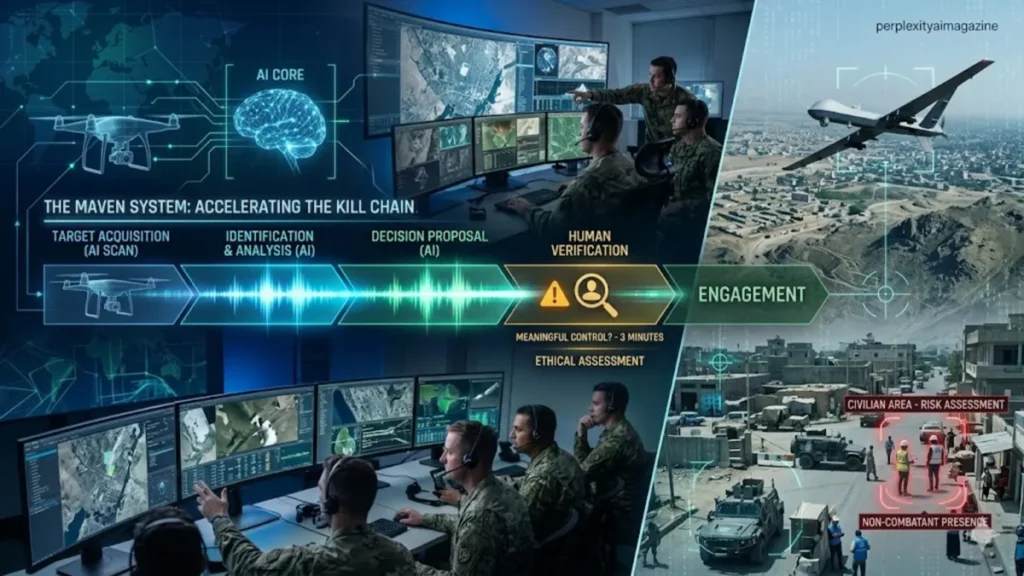
I began reporting on this story with a simple question that now echoes across defense circles and human rights organizations alike: how fast can a modern military decide to kill? The answer, increasingly, is measured not in hours or even minutes, but in clicks. – Palantir AI.
The United States military, working with Palantir Technologies, has deployed an AI-driven system known as the Maven Smart System that dramatically compresses the traditional “kill chain” process. What once required coordination across multiple intelligence platforms and human analysts can now be executed within a single interface, often in minutes. In demonstrations by Pentagon officials, an operator can identify a target, generate options, and select a strike asset with just a handful of interactions.
While the phrase “three clicks to kill” is not an official description, it captures the underlying transformation. Maven does not eliminate humans from the decision loop, but it redefines their role. Instead of painstakingly assembling intelligence, operators increasingly validate AI-generated outputs.
This shift is not merely technical. It is philosophical, legal, and geopolitical. As militaries accelerate toward AI-enabled decision-making, the fundamental nature of warfare is changing, raising urgent questions about responsibility, restraint, and the limits of automation in life-and-death decisions.
The Compression of the Kill Chain
The traditional military kill chain follows a sequence: find, fix, track, target, engage, and assess. Each stage historically required separate systems, teams, and time. Analysts would sift through satellite imagery, signals intelligence, and human reports, often taking hours or days to validate a target.
Maven collapses these steps into a unified workflow. By integrating data from drones, satellites, and other intelligence sources, it presents a fused operational picture. Artificial intelligence models then identify patterns, flag potential targets, and suggest courses of action. – Palantir AI.
A senior defense official described the shift bluntly: “We’ve gone from a process that took hours to one that can happen in minutes, sometimes faster.” The implication is not just efficiency, but scale. When the bottleneck of human analysis is reduced, the number of potential targets that can be processed increases dramatically.
This compression alters the tempo of warfare. Decisions that once allowed for deliberation now occur in rapid succession, creating a battlefield environment where speed becomes both an advantage and a risk.
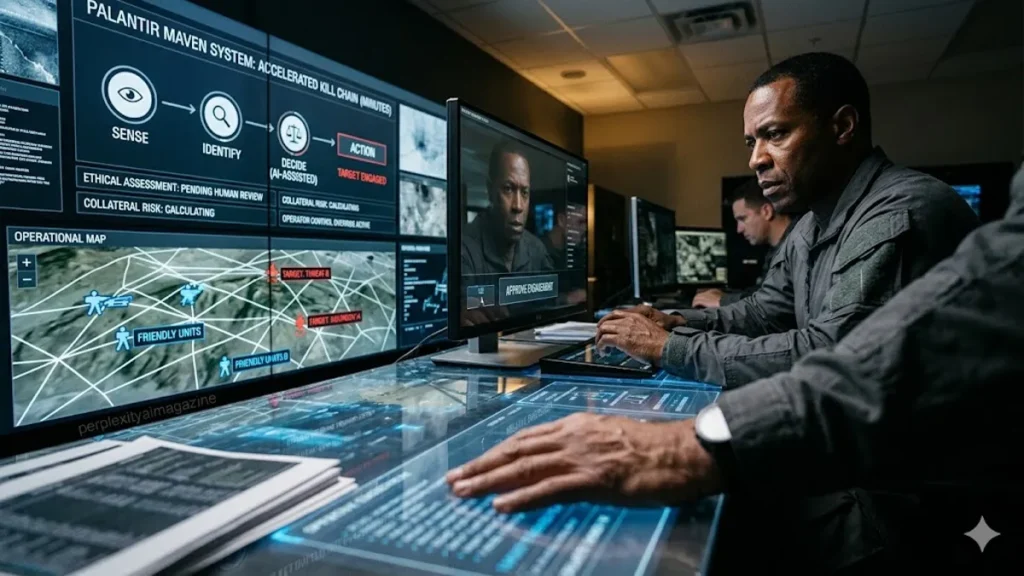
Inside the Maven Smart System
At its core, Maven is not a single tool but an ecosystem. Built on Palantir’s data platforms, it integrates intelligence streams into a structured ontology that organizes entities such as locations, units, and objects.
On top of this data layer sits an AI orchestration system. Large language models and machine learning tools analyze incoming information, generate summaries, and propose actions. These outputs are then presented to human operators through an interface designed for speed and clarity.
The system’s architecture enables a seamless flow from analysis to action. Once a target is validated, data can be transmitted directly to fire-control systems, linking intelligence with weapons platforms.
| Component | Function | Impact |
|---|---|---|
| Data Fusion Layer | Integrates ISR and intelligence feeds | Creates unified battlefield view |
| AI Analysis Engine | Identifies targets and patterns | Speeds up detection and prioritization |
| Workflow Interface | Displays recommendations | Reduces cognitive load on operators |
| Integration Layer | Connects to weapons systems | Enables rapid execution |
This integration is what makes Maven transformative. It is not merely faster analysis; it is the elimination of friction between stages of decision-making.
The Role of Artificial Intelligence in Targeting
Artificial intelligence in Maven functions as both analyst and advisor. It processes vast amounts of data that would overwhelm human teams, identifying anomalies and correlations that might otherwise go unnoticed.
The system can propose target lists, rank them by priority, and even suggest appropriate weapons. It also generates narrative summaries, translating complex data into digestible insights for commanders.
Dr. Paul Scharre, a defense expert and author, has warned about this shift: “The danger is not that machines make decisions alone, but that humans become overly reliant on machine-generated outputs” (Scharre, 2018). – Palantir AI.
This reliance introduces a subtle but critical risk. When AI outputs are presented with high confidence, human operators may be less likely to question them, especially under time pressure.
The “Three Clicks” Narrative
The idea that a kill chain can be completed in “three clicks” has captured public attention, but it oversimplifies a more complex reality. The system does not autonomously execute strikes. Human operators still approve targets and select weapons.
However, the narrative persists because it reflects a genuine transformation. The number of steps required to move from detection to action has been drastically reduced. What once involved multiple systems and approvals can now occur within a single interface. – Palantir AI.
Critics argue that this compression risks turning human oversight into a formality. As one military ethicist noted, “When the process becomes that streamlined, the act of clicking ‘approve’ can replace genuine deliberation.”
The concern is not automation alone, but the speed at which decisions are made.
Civilian Risk and Scale
One of the most significant concerns surrounding AI-enabled targeting systems is their potential impact on civilians. By increasing the speed and scale of targeting, systems like Maven make it possible to conduct large numbers of strikes in short periods. – Palantir AI.
Historical data suggests that even small error rates can lead to significant harm when operations scale. Misidentification of objects or individuals, while statistically rare, becomes inevitable when thousands of targets are processed.
| Scenario | Human-Only Process | AI-Augmented Process |
|---|---|---|
| Targets per day | Dozens | Hundreds to thousands |
| Analysis time | Hours per target | Minutes per target |
| Error rate impact | Limited scale | Amplified across volume |
| Civilian risk | Lower throughput | Higher cumulative exposure |
Human rights organizations have raised alarms about this dynamic. Amnesty International has emphasized that “automation does not remove responsibility for ensuring compliance with international law” (Amnesty International, 2020).
Accountability in Algorithmic Warfare
The introduction of layered AI systems complicates accountability. Maven operates through a stack that includes data providers, software platforms, AI models, and military operators.
When a strike results in unintended harm, determining responsibility becomes challenging. Is it the developer who designed the system, the model provider whose algorithm generated the recommendation, or the operator who approved the action? – Palantir AI.
Rebecca Crootof, a legal scholar specializing in AI and warfare, has noted that “distributed systems diffuse responsibility in ways that existing legal frameworks are not equipped to handle” (Crootof, 2015).
This diffusion risks creating accountability gaps, where no single actor is clearly responsible for the outcome.
Legal and Ethical Frameworks Under Strain
International humanitarian law requires distinction, proportionality, and precaution in the use of force. These principles are difficult to operationalize in systems that rely on automated analysis and rapid decision-making.
There is currently no comprehensive international framework governing AI in warfare. While discussions have taken place at the United Nations, consensus remains elusive.
The absence of clear rules creates a gray area in which technological capabilities outpace legal oversight. As systems like Maven become more widespread, the need for updated frameworks becomes increasingly urgent.
Corporate Power and Military Technology
The development of Maven also highlights the growing role of private companies in military innovation. Palantir’s involvement reflects a broader trend in which defense capabilities are increasingly shaped by commercial technology firms.
This shift raises questions about incentives and governance. Companies operate within market dynamics that may not align with ethical considerations in warfare. – Palantir AI.
Critics have pointed to previous controversies involving defense contracts as evidence of insufficient oversight. The integration of AI into military systems amplifies these concerns, as the consequences of errors become more severe.
The Global Arms Race in AI
The deployment of AI-enabled targeting systems is not occurring in isolation. Other nations are developing similar capabilities, driven by the fear of falling behind.
This dynamic creates an arms race in which speed and automation become competitive advantages. As more actors adopt these technologies, the risk of escalation increases.
Autonomous and semi-autonomous systems also raise the possibility of rapid, unintended conflict escalation. When decisions are made at machine speed, the window for de-escalation narrows.
The Human Role in an Automated Battlefield
Despite advances in AI, humans remain central to the decision-making process. However, their role is evolving from analyst to supervisor.
Operators are increasingly tasked with validating AI-generated recommendations rather than generating them. This shift changes the nature of expertise required in military operations.
It also raises psychological and ethical questions. Approving a strike based on AI recommendations may feel fundamentally different from building a case through manual analysis.
As one defense analyst put it, “The question is not whether humans are in the loop, but whether they are meaningfully in control.”
Takeaways
- AI systems like Maven significantly compress the military kill chain from hours to minutes
- Human operators remain involved, but their role is shifting toward validation rather than analysis
- Increased speed enables larger-scale operations, raising risks to civilians
- Accountability becomes more complex in layered AI systems
- Existing legal frameworks struggle to address AI-driven warfare
- Corporate involvement introduces new ethical and governance challenges
- Global adoption of similar systems may accelerate an AI arms race
Conclusion
I have come to see Maven not as a single system, but as a signal of a broader transformation in warfare. The integration of artificial intelligence into military decision-making is reshaping how conflicts are conducted, measured, and understood.
The promise of efficiency is undeniable. Faster decisions can save lives in certain contexts, protect troops, and improve coordination. Yet the same speed that enables precision also introduces new risks. When decisions are made rapidly and at scale, the margin for error narrows, and the consequences of mistakes multiply.
The challenge moving forward is not simply technical, but moral and legal. How societies choose to govern these systems will determine whether they enhance security or undermine it.
The future of warfare is being written in code and interfaces, but its implications will be felt in human lives.
READ: Google Genie 3 AI Can Generate Playable Games in Minutes
FAQs
What is the Maven Smart System?
It is an AI-driven military platform developed with Palantir that integrates intelligence data and accelerates targeting and decision-making processes.
Does Maven allow fully autonomous killing?
No, human operators still approve targets and actions, though the system significantly automates analysis and recommendations.
Why is it called “three clicks to kill”?
This phrase describes how streamlined the process has become, though it is not an official technical description.
What are the main ethical concerns?
Key issues include reduced human oversight, increased civilian risk, accountability gaps, and lack of clear legal frameworks.
Is this technology unique to the United States?
No, other countries are developing similar AI-enabled military systems, contributing to a global technological arms race.
