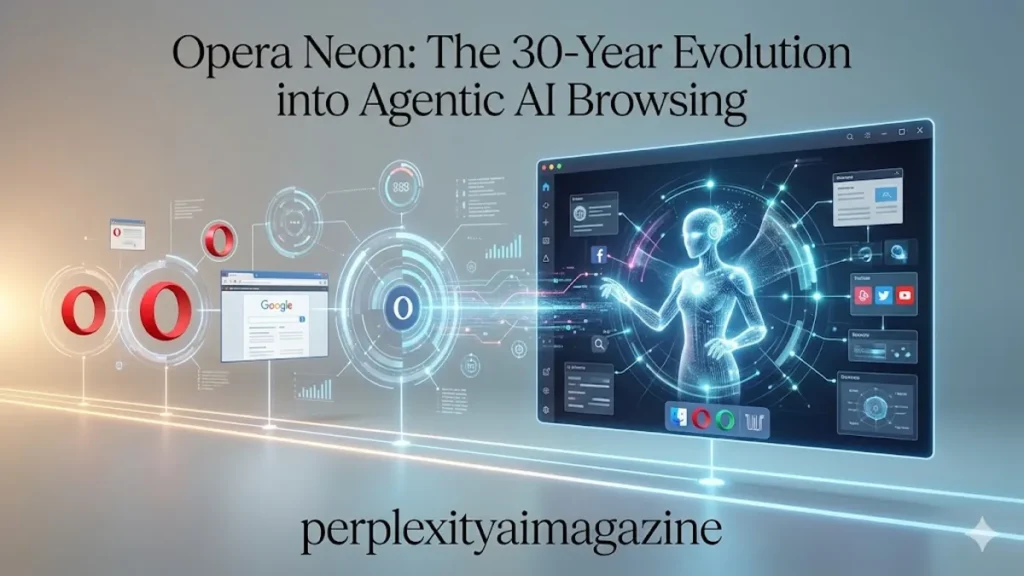
The year 1994 was a different era for the internet—a time of 56k modems and the nascent glow of Netscape Navigator. Within the research labs of Telenor, Norway’s telecommunications giant, a project began that would eventually challenge the hegemony of Silicon Valley’s giants. Thirty years later, Opera has transitioned from a scrappy underdog to a pioneer of “agentic” browsing. With the launch of Opera Neon in late 2025 and its subsequent wide release in 2026, the company is no longer just showing users the web; it is navigating it for them.
Opera Neon represents a fundamental shift in how humans interact with digital information. Unlike traditional browsers that act as passive windows, Neon functions as a proactive agent. It utilizes “Browser Operator” technology to interpret the Document Object Model (DOM) of webpages, allowing it to execute multi-step tasks—such as booking travel or conducting deep market research—entirely within the user’s logged-in session. As the company celebrates its 30th anniversary, Neon arrives as a $19.99-per-month premium offering, targeting “AI power users” who require more than just a chatbot in a sidebar. This long-form exploration delves into Opera’s three-decade legacy and the technical architecture of the browser that aims to redefine the “user” as an “overseer.”
The Thirty-Year Foundation: From Telenor to Neon
Opera’s history is a litany of “firsts” that the modern web now takes for granted. In 1996, when Opera 2.1 was released to the public, it introduced a multiple document interface that allowed users to open several pages within a single window—the precursor to the modern tab. By the time version 4.0 arrived in 2000, tabbed browsing was officially solidified. Over the next two decades, the Oslo-based firm introduced Speed Dial (2007), integrated ad-blocking (2016), and a built-in VPN (2016), consistently out-pacing larger competitors in feature density.
In February 2026, Opera marked its 30th anniversary by launching “Web Rewind,” an interactive archive that allows users to “fast-forward” through three decades of internet culture. This nostalgia, however, serves a strategic purpose. It reminds the market that Opera has the institutional knowledge to handle the web’s structural complexities—a prerequisite for building an AI that can navigate it. While competitors like Google and Microsoft have integrated generative AI to summarize text, Opera’s focus has shifted toward “agency”—the ability for an AI to perform actions rather than just generate words.
Table 1: Opera Innovation Timeline (1994–2026)
| Year | Innovation | Impact on Industry |
| 1994 | Initial Research Project | Born out of Telenor in Oslo, Norway. |
| 2000 | Tabbed Browsing (Opera 4) | Replaced the single-page window paradigm. |
| 2007 | Speed Dial | Revolutionized the browser “New Tab” experience. |
| 2016 | Integrated VPN & Ad-blocker | Native privacy tools became a standard expectation. |
| 2023 | Aria AI Integration | First step into browser-native generative AI. |
| 2025 | Opera Neon Launch | Introduction of agentic AI and Task-based workspaces. |
| 2026 | 30th Anniversary | Launch of “Web Rewind” and wide access to Neon. |
The Mechanics of Agency: How Neon Do Works
The heart of the Opera Neon experience is a feature called “Neon Do.” Traditional automation tools often rely on “pixel analysis” or virtual pointers, which are brittle and break when a website’s layout changes by even a few pixels. In contrast, Neon Do utilizes Browser Operator technology. This system creates “interaction maps” by analyzing the underlying DOM tree and layout data of a webpage. Because the AI understands the functional relationship between elements—knowing that a “Submit” button is connected to a specific form field—it can adapt to dynamic site changes in real-time.
Crucially, Neon Do operates locally. While the “reasoning” (the planning of the task) may involve cloud-based Large Language Models (LLMs), the execution happens within the browser on the user’s device. This architecture ensures that sensitive data, such as cookies and active login sessions, never leave the local environment. When a user asks Neon to “find a flight to Tokyo under $800 and book the best option,” the agent performs the search, compares the data, and fills out the forms using the user’s already-authenticated session. The user remains “in the loop,” able to pause the agent or take over at any moment.
“Opera Neon is a product for people who like to be the first to the newest AI tech. It’s a rapidly evolving project with significant updates released every week.” — Krystian Kolondra, EVP Browsers and European Fintech at Opera.
Tasks and Mini-Browsers: A New UI Paradigm
One of the most radical departures in Neon is the replacement of the standard tab strip with “Tasks.” A Task is a self-contained workspace that groups related tabs, documents, and AI chats under a single context. If a user is researching a new laptop, they might have a Task containing four product pages, two YouTube reviews, and a chat window. The AI within that Task is “context-aware,” meaning it understands that when a user says “summarize the battery life,” it should look across all open tabs within that specific workspace, but ignore the tabs in a separate “Work” or “Travel” Task.
This “mini-browser” approach solves the problem of “context drift,” where AI assistants lose track of what the user is currently doing. In Neon, the AI is tethered to the Task’s intent. For example, within a “Trip Planning” Task, the “Neon Chat” can automatically pull details into a comparison table using “Cards”—pre-defined instructions that act like power-ups for the AI. Users can download these Cards from a community store or create their own to standardize how the browser handles recurring workflows, such as extracting data from LinkedIn or summarizing technical PDFs.
Table 2: Feature Comparison: Opera One vs. Opera Neon
| Feature | Opera One (Standard) | Opera Neon (Premium) |
| Price | Free | $19.99 / month |
| AI Architecture | Sidebar (Aria) | Agentic (Neon Do) |
| Organization | Tab Islands | Task Workspaces |
| Automation | Basic Summarization | Cross-site execution / Form-filling |
| Target User | General Audience | AI Power Users / Researchers |
| Data Privacy | Standard VPN/Ad-block | Local execution of agents |
The Economics of the $20 Browser
The decision to price Opera Neon at $19.99 per month has sparked significant debate in the tech community. For decades, the browser has been viewed as a “free” utility, often subsidized by search engine royalties or data collection. By moving to a subscription model, Opera is betting that productivity gains will outweigh the cost. The subscription doesn’t just cover the software; it provides access to multiple “frontier” LLMs and a dedicated Discord community where power users can directly influence the development roadmap.
Industry analysts suggest that this “Pro” tier is necessary to offset the high compute costs associated with agentic AI. Unlike a simple search query, an agentic task might involve the AI visiting a dozen websites and processing thousands of tokens of data to find a single answer. As of April 2026, the waitlist that characterized the early “Founders” phase in 2025 has been removed, making the browser accessible to anyone willing to pay for what Opera calls “an unfair advantage” in digital efficiency.
“In three decades, the web has evolved from a niche scientific tool to an indispensable part of our entire lives. At Opera, we’ve spent 30 years building a faster, better, and more creative window to the world.” — Jan Standal, Senior Vice President at Opera.
Privacy in the Age of Agents
The primary concern with agentic browsers is security. Granting an AI the ability to “click” and “type” on a user’s behalf introduces risks such as prompt injection, where a malicious website could theoretically trick the agent into performing an unauthorized action. Opera has addressed this by implementing “Human-in-the-Loop” controls. Before Neon Do executes a multi-step plan, it displays the intended steps in a side panel for user approval.
Furthermore, because the agent uses the webpage’s structural data (DOM) rather than screenshots, the amount of visual data sent to servers is minimized. Opera maintains that sensitive information like passwords and credit card details stay on the device. However, the company is transparent about the fact that webpage content relevant to a task is processed by cloud-based models to generate instructions. As Gartner recently warned businesses to vet AI browsers strictly, Opera’s local-execution model serves as a direct response to those corporate security concerns.
“Neon Do works where many other AI assistants can’t—inside your actual browser and not solely in a cloud… There is no need to share passwords with cloud services.” — Official Opera Neon Technical Brief.
Takeaways
- Agentic Shift: Opera Neon moves beyond text generation to “agentic” actions, executing multi-step web tasks autonomously.
- Legacy of Innovation: Celebrating 30 years, Opera continues to pioneer UI standards, having invented tabs and Speed Dial.
- Local Execution: Privacy is maintained by running agent actions locally within authenticated sessions, rather than via cloud-based virtual pointers.
- Task-Centric UI: Tabs are replaced by “Tasks,” which act as mini-browsers with isolated, context-aware AI.
- Premium Model: At $19.99/month, Opera is targeting power users who require high-end AI orchestration.
- The “Make” Engine: Beyond navigation, Neon “Make” allows users to generate digital assets like websites and guides in cloud-hosted sandboxes.
- Direct Control: Users retain oversight with real-time “pause and take over” capabilities during any AI-driven task.
Conclusion
As Opera enters its fourth decade, it finds itself at a crossroads between its history as a standard-setter and its future as an AI agent provider. The transition from a tool that displays the web to an agent that acts upon it is perhaps the most significant change in browser architecture since the introduction of the graphical user interface. Opera Neon is a bold experiment in whether users are willing to pay for a “digital twin” that handles the drudgery of the modern web.
While the $19.99 price point may alienate casual browsers, for the researcher, the developer, or the power user, the value proposition is clear: time. By automating the “juggling of tabs” and the “copy-pasting of data,” Opera is attempting to return the browser to its original purpose—a tool for exploration and creation, rather than a management hurdle. Whether Neon becomes the new standard or remains a niche powerhouse, it has successfully forced the industry to ask what a browser should actually do in 2026. After 30 years, Opera’s “Norwegian engine” is still finding new gears.
READ: Google Internal AI Tool Agent Smith Access Restricted
FAQs
What exactly is an “agentic” browser?
An agentic browser, like Opera Neon, does not just provide an AI chatbot in a sidebar; it can autonomously perform actions on the web. This includes navigating to websites, clicking buttons, filling out forms, and extracting specific data across multiple tabs based on a natural language goal provided by the user.
Is my data safe when using Neon Do?
Opera Neon is designed to execute actions locally on your device. This means it uses your existing, logged-in sessions and does not require you to share passwords with a cloud service. While the AI “plans” its steps in the cloud, the sensitive execution stays within your local browser environment.
How does the “Task” system differ from regular tabs?
Regular tabs are disconnected pages. “Tasks” in Neon are workspaces that group related pages under one context. The AI inside a Task only sees the data from the tabs within that group, preventing it from confusing your personal vacation planning with your professional research.
Can I stop the AI if it makes a mistake?
Yes. Opera Neon features “Human-in-the-Loop” controls. Every action plan is visible before and during execution. Users can pause the AI, edit its plan, or take manual control of the browser at any point to correct or finish a task.
How do I get access to Opera Neon in 2026?
As of late 2025, the waitlist has been removed. You can visit operaneon.com or opera.com/neon, sign up with an email address, and subscribe to the premium tier for $19.99 per month for immediate access on desktop platforms.
References
- Gartner. (2025). Emerging Technologies: Security Risks of AI-Enabled Web Browsers. Gartner Research.
- Opera Limited. (2025, September 30). Opera ships the Opera Neon AI agentic browser. Investor Relations. https://investor.opera.com/news-releases/news-release-details/opera-ships-opera-neon-ai-agentic-browser/
- Opera Software. (2026, February 17). The Opera Browser Turns 30 and Launches “Web Rewind”: A Time Machine for the Internet’s Finest and Weirdest Moments. Press Release. https://press.opera.com/2026/02/17/opera-30-web-rewind-internet-archive/
- Opera Help. (2026). Neon browser AI – FAQ. https://help.opera.com/en/neon-ai-faq/
- ZDNET. (2025, December 12). Opera’s Neon AI browser now available for $20/month – packed with these power user features. ZDNET. https://www.zdnet.com/article/opera-neon-ai-browser-frontier-models-security-risks-cost/
- Wikipedia. (2026). History of the Opera web browser. https://en.wikipedia.org/wiki/History_of_the_Opera_web_browser