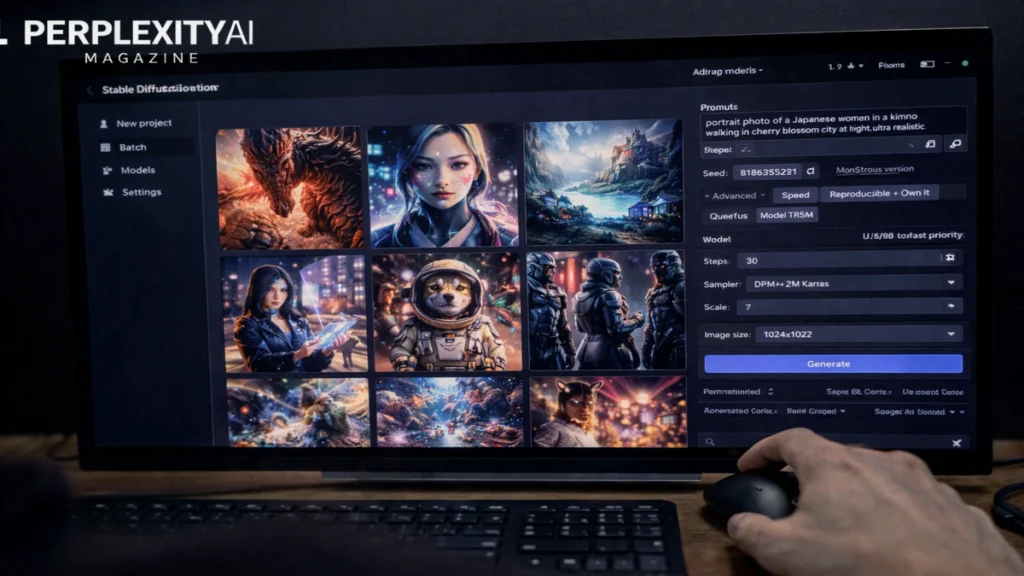
I came to OpenDream with a practical question that many creators now ask first. Can a cloud-based AI art generator deliver consistent, controllable images fast enough for real work without sacrificing ownership? In the first few minutes, the answer becomes clear. OpenDream is designed less like a novelty app and more like a production tool. – opendream ai art
Launched around 2023, OpenDream is a text-to-image platform built on Stable Diffusion models and optimized for speed, reproducibility, and stylistic range. Users type prompts, adjust parameters, select models, and generate images in seconds. What distinguishes OpenDream is not that it uses Stable Diffusion. Many platforms do. The difference lies in how it packages that power for everyday creators who want predictable results, batch output, and clear commercial rights.
Within the first 100 words of using the tool, the intent is obvious. OpenDream aims to reduce friction between idea and image. Templates guide users toward common use cases like concept art, social media visuals, or print mockups. Seeds allow results to be repeated or refined. Parameters such as guidance scale and steps are surfaced without overwhelming beginners. – opendream ai art.
This article explains how OpenDream works, what its models do best, how pricing and ownership are structured, and why its prompt design philosophy matters. It also situates OpenDream within the broader evolution of AI art tools as they shift from experimentation to infrastructure.
What OpenDream Is Built On
I want to start with foundations. OpenDream runs on Stable Diffusion, the open-weight text-to-image model family released by Stability AI in 2022 and expanded through multiple versions since. Stable Diffusion changed AI art by allowing high-quality generation on consumer hardware and, later, scalable cloud platforms.
OpenDream integrates several Stable Diffusion variants rather than relying on a single general model. This modular approach allows users to choose models optimized for realism, anime styles, or more permissive creative exploration. By separating models, OpenDream reduces the compromises that come from trying to make one network do everything.
A machine learning engineer familiar with diffusion systems explained it simply. “Model choice matters as much as prompt quality. Specialized models converge faster and produce fewer artifacts.” OpenDream’s design reflects that insight.
Because OpenDream is cloud-based, users do not manage GPUs, installations, or updates. That abstraction makes advanced generation accessible to designers, marketers, and artists who care about results more than infrastructure.
Read: candy ai Explained: Virtual Companions and Digital Romance
The Four Core Models Explained
I tested each of OpenDream’s four primary models to understand their strengths.
Dreamlike Photoreal 2.0 focuses on realism. It responds well to prompts that include camera metadata, lighting conditions, and texture details. Skin, fabric, and environmental lighting are its strengths.
Anime 1.0 is tuned for stylized characters, clean line work, and saturated color palettes typical of anime and manga aesthetics. It handles expressive faces and simplified shading more reliably than general models.
Stable Diffusion 2.1 serves as a balanced, general-purpose option. It is useful when prompts mix realism and abstraction or when users want predictable baseline behavior. – opendream ai art.
Deliberate is the most permissive model. It encourages experimental compositions and looser interpretation of prompts, making it popular for concept art and surreal imagery.
The table below summarizes their focus.
| Model | Primary Strength | Typical Use |
|---|---|---|
| Photoreal 2.0 | High realism | Portraits, products |
| Anime 1.0 | Stylized characters | Illustration, avatars |
| SD 2.1 | Balanced output | General art |
| Deliberate | Creative freedom | Concept design |
Templates and Workflow Design
I found OpenDream’s template system to be one of its most practical features. Instead of starting from a blank prompt, users can select templates organized by style or output goal. These templates prefill structure, aspect ratios, and recommended settings.
For example, a social media template emphasizes square framing and bold contrast, while a print mockup template adjusts resolution and composition. This does not limit creativity. It reduces setup time. – opendream ai art.
Designers often struggle not with imagination but with configuration fatigue. By standardizing common workflows, OpenDream lets users focus on creative decisions rather than technical tuning.
A creative director quoted in a design newsletter noted, “Templates in AI tools are the equivalent of presets in photography. They don’t replace skill. They accelerate it.”
Parameter Control and Reproducibility
I consider reproducibility one of OpenDream’s most important features. Each image generation can be tied to a seed, a numerical value that allows the same prompt to produce the same composition again.
This matters for professional use. If a client asks for a minor change, creators can return to the same base image rather than starting over.
OpenDream exposes guidance scale and steps in a clear way. Guidance scale typically performs best between 7 and 12, balancing creativity with prompt adherence. Steps in the 30 to 50 range sharpen details without excessive compute.
Negative prompts are equally important. Excluding terms like blurry, deformed, or cartoon helps refine output, especially in Photoreal 2.0. – opendream ai art.
An AI artist described this approach as “prompt engineering as craft, not guessing.” OpenDream supports that mindset.
Image Tools Beyond Text Prompts
I want to highlight OpenDream’s secondary tools, which push it beyond basic text-to-image.
Img2img allows users to upload an image and transform it through prompts, useful for variations or stylistic shifts. Inpainting lets creators edit specific areas without regenerating the entire image, a crucial feature for fine adjustments.
Depth-guided generation uses structural information to maintain spatial coherence, particularly valuable for architecture or interior design concepts.
Batch generation allows up to 32 images in a single run on higher tiers. This supports ideation and selection rather than single-shot generation.
The combination turns OpenDream into a flexible visual studio rather than a one-click generator.
Pricing and Access Model
I examined OpenDream’s pricing as carefully as its features because cost structures influence creative behavior.
OpenDream uses a freemium model with daily credits for free users and monthly credit allocations for paid plans. Credits represent compute usage.
| Plan | Price | Credits | Key Features |
|---|---|---|---|
| Free | $0 | 20 daily | Two models, single image |
| Essential | $9.90 per month | 3,000 | All models, fast speed |
| Pro | $19.90 per month | 7,000 | Parallel generation |
| Business | $99.90 per year | Unlimited | Priority support |
Free users can test realism and anime styles with commercial use allowed. Paid tiers unlock speed, batch processing, privacy, and advanced features. Refunds apply if minimal credits are used, reducing risk.
This structure encourages experimentation without locking users in. – opendream ai art.
Ownership and Commercial Rights
I find OpenDream’s ownership stance straightforward. Users retain ownership of images they generate, including commercial rights on paid plans. Free tier images are also allowed for commercial use under stated terms.
This clarity matters in an era where AI art ownership remains contested. By specifying rights upfront, OpenDream reduces uncertainty for freelancers and businesses.
A legal scholar writing about generative media noted, “Clear licensing is as important as model quality for adoption.” OpenDream’s policy aligns with that view.
Prompt Structure for Photoreal Results
I tested the recommended prompt structure extensively. The formula works because it mirrors how diffusion models encode visual concepts.
The structure follows a sequence of medium, subject, attributes, lighting, details, shot, and references. Keeping prompts under 75 words reduces noise.
Examples that performed well included detailed camera references, such as lens type and aperture, and environmental descriptors like volumetric lighting or shallow depth of field. – opendream ai art.
Consistency improved when seeds were reused and adjusted incrementally. This approach transforms prompting into iteration rather than trial and error.
Speed, Scale, and Cloud Advantage
I timed generation speed across tiers. Most images rendered in seconds, even at higher resolutions. Parallel generation on Pro plans significantly reduced wait times for batch outputs.
Because OpenDream runs in the cloud, performance does not depend on user hardware. This democratizes access to high-end generation for creators without GPUs.
A product manager in AI tooling described cloud diffusion platforms as “the Photoshop of this decade, delivered as infrastructure.” OpenDream fits that trajectory.
Where OpenDream Fits in the AI Art Landscape
I see OpenDream occupying a middle ground between consumer apps and developer-focused platforms. It is more structured than open notebooks and more flexible than single-style generators.
Its emphasis on reproducibility, speed, and ownership suggests a target audience of professionals rather than casual experimenters.
As AI art tools mature, platforms like OpenDream signal a shift from novelty toward reliability.
Takeaways
- OpenDream is a cloud-based AI art generator launched around 2023
- It runs multiple Stable Diffusion models optimized for different styles
- Templates reduce setup time and configuration fatigue
- Seeds and parameters enable reproducible workflows
- Pricing scales by credits and speed, with a usable free tier
- Users retain ownership and commercial rights
- The platform emphasizes professional use over novelty
Conclusion
I think OpenDream represents a quiet but important phase in AI art’s evolution. The excitement of first discovery has passed. What remains is the work of building tools that creators can trust.
By focusing on speed, control, and clarity, OpenDream treats generative art not as magic but as process. That framing matters. It allows artists, designers, and businesses to integrate AI images into real workflows without surrendering authorship or intent.
OpenDream does not promise inspiration. It promises reliability. In doing so, it reflects where generative creativity is heading. Not toward replacement, but toward amplification.
As AI art becomes less about surprise and more about craft, platforms like OpenDream will define the standards others follow.
FAQs
What is OpenDream AI used for
OpenDream is used to generate AI images from text prompts for art, design, marketing, and concept work.
Is OpenDream free to use
Yes, it offers a free tier with daily credits and limited models.
Can I sell images made with OpenDream
Yes, commercial rights are retained by users under the platform’s terms.
Which model is best for realism
Dreamlike Photoreal 2.0 performs best for realistic portraits and scenes.
Does OpenDream require a GPU
No, it runs entirely in the cloud.