
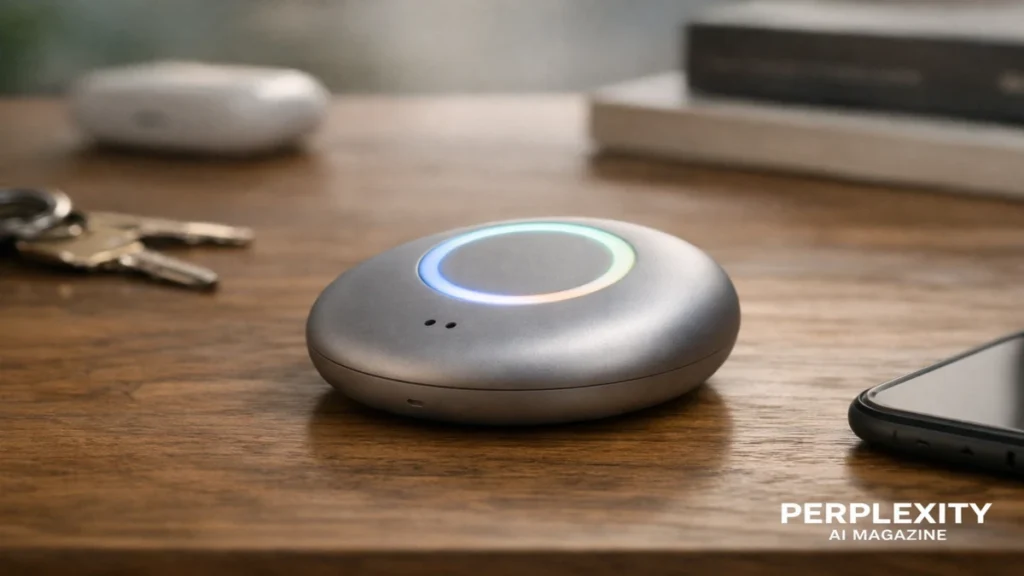
OpenAI is building its first consumer hardware device, a project that marks a decisive expansion beyond software products like ChatGPT and into the physical world of personal technology. The company has confirmed that the device is on track for a reveal in the second half of 2026, positioning it as OpenAI’s debut effort in consumer hardware and a statement of intent about the future of artificial intelligence as an everyday companion. In its earliest descriptions, the device is not a phone, not a laptop, and not a wearable in the conventional sense. Instead, it is envisioned as something quieter and more constant: a small, screenless object that listens, observes, and assists without demanding attention. – openai first ai device
At the center of this effort is a partnership with Jony Ive, the designer whose work helped define the modern smartphone era. OpenAI acquired Ive’s hardware startup, io, in 2025, bringing together a team of former Apple designers and engineers with OpenAI’s researchers and product leaders. The ambition is large. Sam Altman has described the project internally as a potential “third core device,” meant to sit alongside smartphones and laptops while reducing reliance on screens.
In the first 100 words, the search intent is clear: what is OpenAI building, when is it coming, and why does it matter? The answer is a compact, always-on AI device designed for voice and contextual interaction, expected to be unveiled in late 2026. Why it matters is more complex. If successful, the device could reshape how people interact with AI, shifting from apps and prompts to ambient presence. If it fails, it will join a growing list of ambitious AI hardware experiments that struggled to find a place in daily life.
The Origins of OpenAI’s Hardware Push
The move into hardware did not come out of nowhere. As OpenAI’s software products gained scale and cultural relevance, company leaders increasingly argued that existing devices were imperfect vessels for advanced AI. Smartphones, built around screens and touch, were optimized for apps and notifications, not continuous context. Laptops were powerful but stationary. Wearables, while intimate, often lacked the compute or interface flexibility required for rich interaction.
The acquisition of io in 2025 was a turning point. Founded by Jony Ive after his departure from Apple, io was created to explore new forms of AI-native hardware. OpenAI’s purchase of the company, reported at $6.5 billion, was as much about talent and philosophy as prototypes. The deal brought in industrial designers, hardware engineers, and supply-chain veterans accustomed to shipping at global scale.
From the beginning, the mandate was not to build a “ChatGPT gadget,” but to rethink how AI could exist physically in a person’s environment. Internal discussions framed the device as an extension of human memory and perception rather than another screen to check. That framing explains many of the design choices now rumored: no display, minimal controls, and a reliance on voice, sound, and vision.
What the Device Is, and What It Is Not
Descriptions of the prototype converge on a consistent image. The device is small, pocket-sized, and screenless, often compared to an iPod Shuffle or a smooth pebble. It can sit on a desk, clip to clothing, or be carried unobtrusively. There is no touchscreen and no traditional app interface. Interaction is expected to happen primarily through voice, with audio cues and subtle feedback replacing visual notifications.
Crucially, the device is not meant to replace a smartphone. Instead, it is designed to complement existing devices, connecting to phones or computers when needed while handling contextual awareness on its own. This distinction matters. Many failed consumer AI devices attempted to supplant phones outright, forcing users to abandon familiar workflows. OpenAI’s approach suggests a more incremental, supportive role.
The absence of a screen is also philosophical. Screens demand attention; they pull eyes downward and fragment focus. By removing that element, OpenAI and Ive are betting that AI can become more humane, offering assistance without distraction. The risk, of course, is invisibility. A device that does not demand attention must still prove its value through timely, accurate help.
Read: j-reit news: Japan’s Data Center REIT Shift Fueled by AI Infrastructure Boom
Design Principles Shaped by Jony Ive
Jony Ive’s influence is evident in the emphasis on simplicity and restraint. Throughout his career, Ive has argued that good design is not about adding features, but about removing everything unnecessary. Applied to AI hardware, that philosophy translates into fewer controls, fewer alerts, and fewer explicit commands.
The device’s rumored form factor reflects this thinking. Rounded edges, minimal seams, and a neutral material palette are intended to make the object feel less like a gadget and more like a personal artifact. Placement matters. On a desk, it should feel at home beside a notebook or coffee mug. On a person, it should not read as a statement piece. – openai first ai device.
More important than aesthetics, however, is behavior. The device is designed to be polite. It should know when not to speak, when to wait, and when to surface information quietly. Achieving that balance requires not just hardware design, but careful tuning of AI models and interaction patterns.
An expert in human-computer interaction summarized the challenge succinctly: “Ambient intelligence only works if it respects human rhythms. The moment it becomes intrusive, people will reject it.”
Multimodal Sensing and Contextual Awareness
At the technical core of the device is multimodal sensing. Built-in microphones capture speech and ambient sound. Cameras, likely wide-angle and low-resolution to prioritize context over detail, provide visual cues about surroundings. Additional sensors may detect motion, orientation, or proximity.
The goal is not surveillance, but situational understanding. In a meeting, the device might recognize that multiple voices are present and shift into a passive listening mode, offering summaries or reminders later. While traveling, it could detect movement and location changes, adjusting suggestions accordingly. At home, it might learn daily routines and anticipate needs.
This contextual awareness is what differentiates the device from a smart speaker. Smart speakers respond to wake words and commands. OpenAI’s device is intended to operate continuously, learning patterns over time and reducing the need for explicit prompts. That always-on nature is both its greatest promise and its greatest risk. – openai first ai device.
Always-On AI and the Privacy Question
Any device that listens and observes continuously raises immediate privacy concerns. OpenAI’s leadership is acutely aware of this tension. The company’s public statements emphasize safeguards, user control, and transparency, though specifics remain undisclosed.
From a design perspective, several strategies are under discussion. One is local processing for sensitive data, ensuring that raw audio or video does not leave the device unless explicitly permitted. Another is clear physical signals, such as lights or tones, to indicate when sensors are active. A third is granular user control over what types of data are stored, summarized, or discarded. – openai first ai device.
Privacy researchers caution that trust will be fragile. Past AI hardware efforts faltered not only because of technical shortcomings, but because users felt uneasy about being observed. OpenAI’s reputation in AI ethics may help, but reputation alone will not be enough. The device must make its behavior legible and its benefits tangible.
A privacy expert unaffiliated with the project put it bluntly: “People will tolerate always-on technology only if it consistently gives more than it takes.”
Computing Architecture and Model Integration
Although the device is small, it is not computationally trivial. Reports suggest a hybrid architecture combining local processing with cloud-based inference. Local compute would handle immediate tasks, such as wake-word detection or basic contextual classification, while more complex reasoning would be offloaded to OpenAI’s servers.
This approach mirrors trends in smartphones and wearables, but with a stronger emphasis on AI workloads. Advances in model efficiency make it possible to run lightweight versions of large models on modest hardware, reducing latency and preserving battery life. – openai first ai device.
Integration with OpenAI’s latest models is central to the device’s value proposition. The hardware is not an endpoint, but a conduit, providing rich, continuous input to systems capable of understanding language, images, and patterns. Over time, the device could build a form of user memory, recalling preferences, habits, and past interactions to personalize assistance.
Manufacturing and Supply Chain Strategy
Building a prototype is one thing. Manufacturing millions of units is another. OpenAI’s partnership with established suppliers such as Luxshare and Goertek reflects an awareness of that challenge. These companies have experience producing consumer electronics at scale, including audio devices with tight tolerances.
The supply chain strategy also hints at ambition. Sam Altman has reportedly suggested that the device could reach 100 million units faster than any previous consumer product. Whether that projection is realistic remains to be seen, but it underscores the company’s confidence.
Scaling production will require careful coordination, particularly given geopolitical tensions and evolving regulations around advanced technology. OpenAI’s decision to work with experienced partners reduces risk, but it does not eliminate it.
Lessons From Past AI Hardware Attempts
The market is littered with AI hardware experiments that failed to gain traction. The Humane AI Pin is often cited as a cautionary tale. Despite strong design credentials and significant funding, the device struggled with battery life, overheating, and unclear value. Users were unconvinced that it offered enough advantage over smartphones.
OpenAI’s team appears determined to learn from these missteps. Simplicity is a recurring theme. Rather than packing in features, the focus is on doing a small number of things exceptionally well. Integration with existing devices, rather than competition, is another key difference. – openai first ai device.
An industry analyst noted that “the mistake many startups made was trying to be everything at once. If OpenAI succeeds, it will be because they chose restraint.”
How the Device Fits Into Daily Life
Imagining daily use helps clarify the device’s potential. In the morning, it might quietly note calendar events and traffic conditions, offering a spoken reminder only if something changes. During the workday, it could capture action items from meetings without recording verbatim audio. In the evening, it might suggest follow-ups or reflect on the day.
None of these tasks are individually revolutionary. What is new is their integration into a single, persistent object that travels with the user and learns over time. The value lies in continuity, not novelty.
Whether users will embrace that continuity depends on trust, reliability, and perceived benefit. The device must earn its place, day after day, by saving time, reducing cognitive load, or offering insight that feels genuinely helpful.
Comparison of Device Categories
| Category | Primary Interface | Strengths | Limitations |
|---|---|---|---|
| Smartphone | Touch, screen | Versatile, familiar | Screen dependency, distraction |
| Smart speaker | Voice | Hands-free, simple | Fixed location, limited context |
| Wearable | Sensors, glanceable UI | Always present | Small displays, limited input |
| OpenAI device | Voice, context | Ambient awareness, minimal distraction | Privacy concerns, new habits |
| Year | Milestone |
|---|---|
| 2025 | OpenAI acquires io, forms hardware division |
| 2025–2026 | Prototype development and testing |
| Late 2026 | Planned public reveal |
| Post-reveal | Sales timing to be announced |
Expert Perspectives on Ambient AI
Outside the company, experts are divided. Some see the device as a natural evolution of AI interfaces. Others worry that ambient systems risk overreach. A cognitive scientist emphasized the importance of boundaries: “Humans need moments of silence. Any always-on system must learn when to step back.”
A product design professor highlighted the opportunity: “If done well, this could be the first AI device that feels like a companion rather than a tool.”
A systems engineer focused on reliability: “The bar is higher for something that’s always present. Downtime, errors, or awkward interactions will be noticed immediately.”
Together, these perspectives underscore the stakes. OpenAI is not just launching a product; it is testing a new relationship between people and machines.
Takeaways
- OpenAI plans to reveal its first consumer hardware device in the second half of 2026.
- The device is expected to be screenless, pocket-sized, and designed for ambient AI interaction.
- Jony Ive’s design philosophy emphasizes simplicity, restraint, and unobtrusive presence.
- Multimodal sensors enable contextual awareness, but raise privacy challenges.
- The device is intended to complement, not replace, smartphones and laptops.
- Manufacturing partners suggest ambitions for large-scale production.
Conclusion
OpenAI’s first consumer hardware device represents a rare convergence of advanced AI research and iconic industrial design. By rejecting screens and embracing context, the company is attempting to redefine how technology fits into daily life. The ambition is not louder or flashier tech, but quieter intelligence that works in the background.
Success is far from guaranteed. Privacy concerns, technical hurdles, and user skepticism loom large. Yet the project’s very existence signals a shift in thinking about AI’s role. No longer confined to apps and chat windows, AI is edging closer to the rhythms of human life. – openai first ai device.
If OpenAI and Jony Ive succeed, the device could mark the beginning of a new category, one defined less by features than by presence. If they fail, the lessons learned will still shape future attempts. Either way, the late-2026 reveal will be a moment of reckoning for the idea of ambient intelligence.
FAQs
What is OpenAI’s first consumer device?
It is a screenless, pocket-sized AI device designed for voice and contextual interaction, planned for a 2026 reveal.
Who designed the device?
The hardware is being designed with Jony Ive and his former startup, io, which OpenAI acquired in 2025.
Will it replace smartphones?
No. It is intended to complement phones and laptops, not replace them.
How does it interact with users?
Primarily through voice and contextual awareness rather than touchscreens or apps.
What about privacy?
OpenAI has emphasized safeguards and user control, though detailed features have not yet been announced.
