
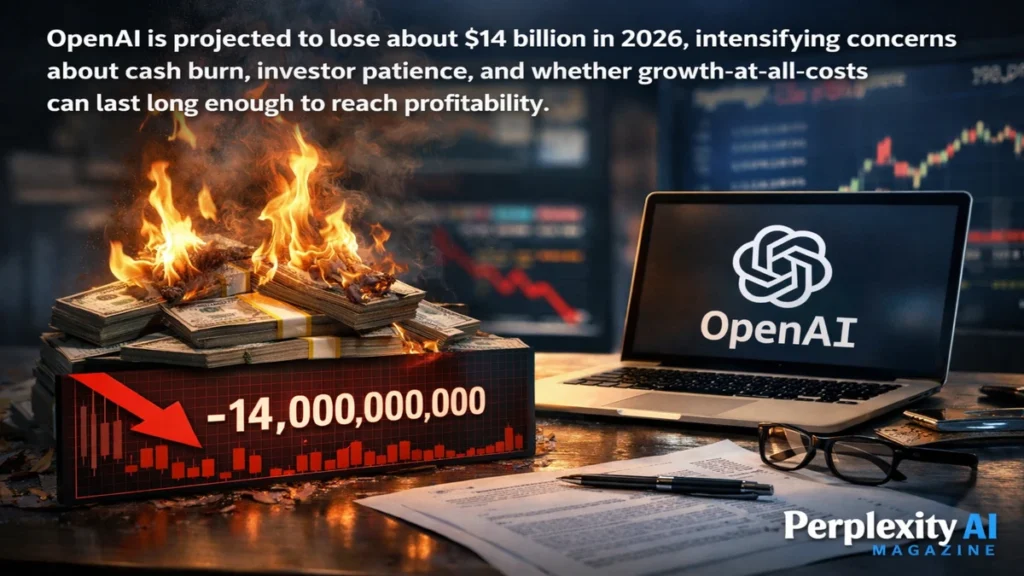
In 2026, OpenAI sits at a paradoxical peak. Its products dominate public awareness of artificial intelligence, its technology underpins a growing share of enterprise experimentation, and its revenue is climbing fast. At the same time, multiple reports indicate the company is on track to lose roughly $14 billion in a single year. The figure has become a flashpoint in debates about whether the most influential AI company of the moment is racing toward sustainability or a financial cliff. – openai $14B loss.
For readers trying to understand what is actually happening, the short answer is this: OpenAI’s losses are the byproduct of extraordinary ambition colliding with extraordinary costs. Internal projections cited by multiple outlets show 2026 losses far exceeding earlier expectations, driven primarily by compute, infrastructure, and aggressive expansion. The same projections assume profitability later in the decade, contingent on revenue scaling to levels rarely achieved by software companies.
This tension defines OpenAI’s current moment. Investors, partners, and competitors are asking whether the company’s growth trajectory can outrun its burn rate, or whether the economics of frontier AI make such losses structurally unavoidable. Supporters argue OpenAI is building the foundation of a multi-hundred-billion-dollar market and that today’s losses are the price of leadership. Critics warn that if revenue growth slows or costs fail to fall, the company’s funding runway could narrow rapidly.
This article examines what the $14 billion loss projection really means, why OpenAI’s costs are so high, how investors are interpreting the numbers, and what options the company has as scrutiny intensifies.
The numbers behind the $14 billion projection
Reports citing internal financial projections show OpenAI losing about $14 billion in 2026, roughly three times higher than estimates circulating just a year earlier. The same materials suggest cumulative losses approaching $44 billion between 2023 and 2028, even as revenue rises sharply over that period.
The projections also include a critical assumption: that OpenAI turns profitable around 2029, generating approximately $14 billion in profit on roughly $100 billion in annual revenue. That forecast implies not only explosive growth but also dramatic improvement in margins, driven by pricing power, enterprise adoption, and efficiency gains in compute. – openai $14B loss.
The scale of these numbers is unusual even by Silicon Valley standards. Losses of this magnitude are typically associated with capital-intensive industries such as manufacturing or energy, not software. OpenAI’s defenders argue that frontier AI resembles infrastructure more than traditional SaaS, with costs and barriers that justify outsized investment. Skeptics counter that the business model remains unproven at the scale implied by the forecasts.
Read: Zero ROI From AI: Why CEOs See No Financial Returns Yet
Why OpenAI’s losses are so large
The primary driver of OpenAI’s losses is infrastructure. Training and operating large-scale AI models requires massive quantities of compute, specialized chips, data storage, and energy. Even with strategic partnerships and cloud credits, the cost of running models at global scale is enormous.
Inference, not just training, has become a major expense. As usage grows, so does the cost of serving responses in real time. Unlike many software products, where marginal costs approach zero, each additional AI interaction carries a real and non-trivial cost. – openai $14B loss.
Beyond compute, OpenAI is spending heavily on talent. The market for elite AI researchers and engineers is fiercely competitive, with compensation packages reflecting the strategic value of expertise. The company is also expanding its physical footprint, opening offices and building teams across multiple regions.
Finally, OpenAI continues to subsidize access. Consumer pricing remains low relative to underlying costs, a deliberate strategy to drive adoption and establish market leadership. The gap between what users pay and what it costs to serve them contributes directly to losses.
Growth versus sustainability
At the heart of the debate is a familiar Silicon Valley question: when does growth justify losses? OpenAI’s strategy resembles that of earlier platform companies that prioritized scale over near-term profitability. The assumption is that once a dominant position is secured, monetization can follow.
In OpenAI’s case, this bet is amplified by the belief that AI will become a foundational layer of the global economy. If that vision proves correct, early leaders could command enormous value. If it proves overly optimistic, the burn rate becomes a liability rather than an investment. – openai $14B loss.
The challenge is timing. OpenAI must raise and deploy capital faster than competitors while convincing investors that future revenues will justify present losses. That requires not just growth, but believable unit economics.
The funding runway question
A projected $14 billion annual loss places intense pressure on funding. Even with substantial backing, such burn rates require repeated, massive capital infusions. Reports suggest OpenAI is seeking additional funding on a scale rarely seen in private markets, testing investor appetite for long-term bets with delayed profitability.
Investor confidence hinges on two factors: revenue momentum and cost trajectories. If revenue continues to accelerate and costs per unit fall, losses can be reframed as temporary. If either stalls, concerns about a cash crunch intensify. – openai $14B loss.
Some analysts warn that without additional capital or meaningful cost reductions, OpenAI could face difficult choices by 2027 or 2028. Those choices could include slowing expansion, reducing subsidies, or restructuring parts of the business.
Valuation under scrutiny
OpenAI’s private-market valuation has been widely discussed, often cited in ranges that assume extraordinary future growth. Such valuations are not anchored in current profitability but in projected dominance of a massive future market.
The risk is compression. If losses remain high and revenue growth slows, later investors may demand lower valuations or more protective terms. Down-rounds, once unthinkable for a company of OpenAI’s prominence, become conceivable in adverse scenarios. – openai $14B loss.
Early investors, sitting on paper gains, would face dilution if new capital comes at lower prices or with preferential rights. The reputational impact of such a shift could further complicate fundraising.
Expert perspectives on the burn rate
Several industry analysts have framed OpenAI’s situation as emblematic of frontier AI economics. One recurring theme is that the technology’s costs are front-loaded and unavoidable at scale.
An asset manager quoted in financial media described the situation as “a race between monetization and physics,” referring to the hard limits imposed by compute and energy costs. A technology economist noted that unlike social media platforms, AI cannot easily decouple usage from cost, making sustained losses more dangerous.
Others argue that OpenAI’s strategy mirrors that of infrastructure builders rather than app developers. In that framing, early losses are expected, and the question is whether the company can eventually extract rents from its position in the stack.
The “financial runaway” concern
The phrase “financial runaway” has gained traction as observers describe a scenario in which spending accelerates faster than revenue, driven by competitive pressure to build ever-larger models. In such a scenario, each new generation of models raises both capability and cost, without guaranteeing proportional monetization.
This dynamic worries investors because it can trap companies in an arms race. If OpenAI slows investment, it risks falling behind. If it continues, losses mount. The equilibrium depends on whether efficiency gains and pricing power can eventually offset scale costs.
Strategic levers OpenAI can pull
OpenAI is not without options. One lever is monetization. Higher-priced enterprise contracts, industry-specific solutions, and potential advertising models could improve revenue per user. Outcome-based pricing and licensing arrangements could also shift economics toward higher margins.
Another lever is cost discipline. Advances in model efficiency, hardware optimization, and inference techniques could reduce costs per interaction. Architectural changes that deliver similar performance with smaller models would directly impact burn.
A third lever is scope. OpenAI could prioritize core offerings and slow expansion into less profitable areas. While politically and culturally difficult, such focus could reassure investors concerned about runaway spending.
The role of strategic partners
Partnerships play a critical role in OpenAI’s financial story. Strategic backers provide not only capital but also infrastructure and distribution. Deeper integration with major partners could reduce standalone costs and stabilize cash flows.
At the same time, dependence on a small number of partners introduces risk. Negotiating power, revenue sharing, and strategic alignment become central questions as losses mount.
What happens if losses persist into 2027
If losses at the scale projected for 2026 continue into 2027, investor behavior is likely to change. Growth-at-all-costs narratives tend to weaken as timelines stretch.
Boards and major backers could push for stricter controls, clearer milestones, and near-term improvements in unit economics. New funding rounds would likely come with tougher terms, including governance rights and spending constraints.
In more extreme scenarios, strategic alternatives emerge. These could include asset sales, spin-offs, or deeper consolidation with partners. While none are inevitable, persistent losses increase their plausibility.
Comparing OpenAI’s trajectory to past tech giants
History offers mixed lessons. Companies like Amazon endured years of losses before achieving profitability at massive scale. Others, equally ambitious, failed when capital markets turned or assumptions proved wrong.
The difference lies in economics. Amazon’s losses were tied to building logistics and scale that eventually delivered high margins. Whether frontier AI can achieve similar margin expansion remains an open question.
OpenAI’s challenge is to convince markets that its future resembles the former, not the latter.
Financial projections at a glance
| Metric | Projection |
|---|---|
| 2026 annual loss | ~$14 billion |
| Cumulative losses (2023–2028) | ~$44 billion |
| Target profitability year | 2029 |
| Assumed annual revenue at profitability | ~$100 billion |
Risks and uncertainties
Several uncertainties loom. Regulatory changes could affect data access and deployment costs. Energy prices and chip supply constraints could alter cost assumptions. Competitive breakthroughs could erode pricing power.
Each of these factors interacts with OpenAI’s financial model. High fixed costs magnify the impact of shocks, making resilience as important as growth.
Takeaways
- OpenAI is projected to lose about $14 billion in 2026, far exceeding earlier estimates.
- Losses are driven primarily by compute, infrastructure, talent, and subsidized access.
- Profitability forecasts hinge on extraordinary revenue growth and margin expansion.
- Investors are increasingly focused on runway, valuation risk, and unit economics.
- Strategic options include faster monetization, cost efficiency, and tighter focus.
- Persistent losses could force tougher funding terms or strategic restructuring.
Conclusion
OpenAI’s projected $14 billion loss in 2026 is not merely a financial statistic. It is a stress test of the entire frontier AI business model. The company’s ambitions are vast, its influence undeniable, and its costs unprecedented for a software enterprise. Whether those costs represent a temporary investment or a structural flaw will define the next phase of the AI industry.
For now, OpenAI remains a company powered by belief: belief that AI demand will scale to extraordinary levels, belief that efficiency gains will bend the cost curve, and belief that market leadership will translate into durable profit. Investors are willing to fund that belief, but not indefinitely.
The coming years will reveal whether OpenAI can convert dominance into discipline. If it succeeds, the losses of 2026 may be remembered as the price of building a new economic layer. If it fails, they may be seen as the moment when ambition outran sustainability.
FAQs
Why is OpenAI projected to lose $14 billion in 2026?
Because its infrastructure, compute, talent, and expansion costs are growing faster than revenue.
Does a $14 billion loss mean OpenAI is failing?
Not necessarily. Losses reflect aggressive growth, but they increase financial risk and scrutiny.
When does OpenAI expect to become profitable?
Projections suggest profitability around 2029, assuming revenue reaches very high levels.
Could OpenAI run out of money?
If losses persist and funding slows, OpenAI would face pressure to raise capital or cut spending.
What could reduce OpenAI’s losses fastest?
Higher-margin monetization and significant reductions in compute and inference costs.
