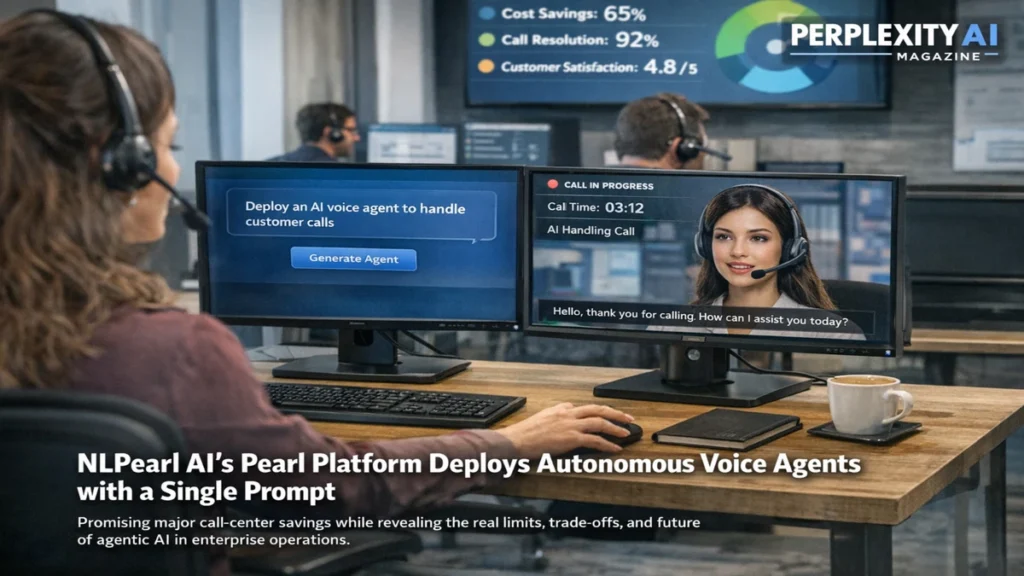
NLPearl AI has entered a crowded and costly corner of enterprise technology with an audacious promise: that a single prompt can deploy an autonomous AI phone agent capable of handling a meaningful share of sales, support, and operational calls. In early marketing, the company has flirted with sweeping claims about “wiping out” the $500 billion global call-center industry. The reality is both more modest and more credible. Pearl, NLPearl’s flagship product, does not eliminate call centers. It reshapes them, automating routine conversations while leaving complex, emotionally sensitive, or high-risk interactions to humans.
For enterprises facing chronic labor shortages, rising wages, and customer expectations shaped by instant digital service, the appeal is obvious. Call centers are expensive to run and difficult to scale. Even well-managed operations struggle with high turnover, inconsistent quality, and long wait times. NLPearl positions Pearl as a pragmatic answer: an autonomous AI phone agent that can be deployed without code, configured through natural language prompts, and integrated directly into customer relationship management systems.
In its most common deployments, Pearl handles between 30 and 50 percent of inbound and outbound call volume at launch, with containment rates improving over time as prompts and integrations are refined. Businesses report that, after optimization, containment can rise into the 70 to 85 percent range for defined use cases such as order status checks, appointment scheduling, simple returns, and lead qualification.
The story of NLPearl AI is not one of instant disruption, but of gradual replacement, careful orchestration, and changing definitions of what “customer service” means when machines can speak, listen, and act in real time.
The Economics of the Call Center Problem
The global call-center industry employs tens of millions of people and absorbs hundreds of billions of dollars annually in wages, infrastructure, and management overhead. Despite decades of investment in automation, most customer service calls are still handled by humans, often supported by rigid scripts and fragmented software systems.
The economics are unforgiving. Average handle times creep upward as products grow more complex. Training costs rise as turnover remains high. Customers, meanwhile, expect faster resolution and personalized service. Traditional interactive voice response systems reduced costs but alienated users with inflexible menus and dead ends.
Voice AI has promised relief for years, but earlier generations lacked conversational fluency and contextual awareness. NLPearl enters this market at a moment when speech-to-speech models, sentiment analysis, and real-time data access have matured enough to support more natural interactions. The company’s claim is not that Pearl replaces humans wholesale, but that it absorbs the repetitive work that drains budgets and morale.
An operations consultant who advises enterprise contact centers put it plainly: “The biggest cost isn’t labor alone. It’s the inefficiency of humans doing tasks that don’t require judgment.”
Read: Higgsfield Fastest Scaling GenAI Company Reaches Unicorn Status
What Pearl Actually Does
Pearl is an autonomous AI phone agent designed to handle live inbound and outbound calls without human intervention. It listens, speaks, asks clarifying questions, and takes action through connected systems. Unlike chatbots that live on websites or apps, Pearl operates entirely through voice, making it accessible to customers who still prefer or require phone support.
At its core, Pearl uses real-time speech-to-speech interaction rather than converting speech to text and back in discrete steps. This reduces latency and allows for more natural pacing. Sentiment analysis runs continuously, enabling the agent to adjust tone, escalate frustrated callers, or soften responses when needed.
The platform supports more than 20 languages and can switch languages dynamically based on caller input. Every call produces a transcript, a structured summary, and metadata such as sentiment score and resolution status. These artifacts are stored and, when integrated, logged directly into CRM systems.
Pearl’s design philosophy emphasizes action, not conversation for its own sake. If a caller asks about an order, the agent queries the relevant system, retrieves the status, and responds verbally. If a refund is requested, it can initiate the workflow. If an issue exceeds defined boundaries, the call is routed to a human or converted into a ticket.
Containment Rates and Realistic Impact
One of the most important metrics in call-center automation is containment: the percentage of calls resolved without human intervention. NLPearl’s reported results align with what practitioners consider credible. Initial deployments typically contain 30 to 50 percent of calls, depending on use case complexity and data quality.
With iteration, containment improves. Companies that invest time in refining prompts, expanding knowledge bases, and tightening integrations report containment rates between 70 and 85 percent for narrow domains. These gains translate directly into cost savings and shorter wait times for customers.
It is here that exaggerated claims deserve correction. Pearl does not eliminate the need for human agents. It changes their role. Humans handle fewer calls, but those calls are more complex, emotionally charged, or financially sensitive. The work becomes harder in some ways, but also more meaningful.
A customer experience researcher summarized the shift: “Automation doesn’t remove labor. It concentrates it.”
Step-by-Step: Deploying Pearl Without Code
NLPearl’s strongest differentiator is speed of deployment. Basic agents can be launched without writing code, using natural language prompts that define scope and behavior.
The process begins with account creation on NLPearl’s platform. After verifying phone number availability and gathering basic business data, users define a core prompt, such as handling e-commerce support, checking order status, processing returns, and escalating complex cases.
Next comes integration. Through the dashboard or API, businesses connect CRMs such as Shopify, HubSpot, Salesforce, Zendesk, or Gorgias. Knowledge bases in PDF or text form can be uploaded to give the agent domain context. Voice, language, and personality traits are configurable.
Testing is emphasized. Before going live, teams simulate calls using real phone numbers, review transcripts, and confirm that actions trigger correctly. Most deployments begin by routing only 10 to 20 percent of live traffic to Pearl. As confidence grows, coverage expands.
Integration as the Real Differentiator
Voice quality matters, but integration is what makes Pearl operationally useful. NLPearl’s API allows agents to pull and push data mid-conversation. During a call, Pearl can fetch an order from Shopify, create a ticket in HubSpot, or update a contact record in Salesforce.
This is accomplished through RESTful endpoints triggered by conversational nodes. Authentication relies on API keys or tokens generated in the NLPearl dashboard. Actions are defined declaratively, linking conversational intent to HTTP requests.
The result is an agent that does more than talk. It acts. That capability distinguishes Pearl from earlier voice bots that could answer questions but required human follow-up for execution.
An enterprise systems architect noted, “The real value isn’t that the AI speaks. It’s that the AI completes the workflow.”
Typical Use Cases Across Industries
Pearl’s most common deployments cluster around predictable, high-volume interactions. In retail and e-commerce, agents handle order tracking, delivery updates, returns, and exchanges. In healthcare administration, they schedule appointments, confirm coverage, and provide directions. In financial services, they answer balance inquiries, route fraud alerts, and pre-qualify leads.
Outbound use cases are growing as well. Pearl can conduct follow-up calls, confirm appointments, or qualify sales leads before passing warm prospects to human representatives. Because it remembers prior interactions, it avoids the repetitive questioning that frustrates customers.
These use cases share a common trait: structured data, clear rules, and limited emotional complexity. Where ambiguity or empathy dominates, human agents remain essential.
Comparing Human and AI Phone Agents
| Dimension | Human Agent | Pearl AI Agent |
|---|---|---|
| Availability | Shift-based | 24/7 |
| Cost per call | High, variable | Low, predictable |
| Language coverage | Limited | 20+ languages |
| Consistency | Variable | High |
| Emotional judgment | Strong | Limited |
| Scalability | Linear | Elastic |
| Deployment Phase | Typical Outcome |
|---|---|
| Initial rollout | 30–50% containment |
| Optimized prompts | 60–70% containment |
| Mature integration | 70–85% containment |
Expert Perspectives on Agentic Voice AI
Outside NLPearl, experts tend to converge on cautious optimism. Voice AI has crossed a threshold where it can handle real work, but not all work.
A labor economist specializing in automation observed, “The displacement effect is real, but it’s uneven. Entry-level, repetitive roles feel the impact first.”
A speech technology researcher emphasized trust: “People forgive mistakes from humans more easily than from machines. Error handling matters as much as accuracy.”
A customer experience strategist added, “Companies that treat AI as augmentation rather than replacement see better outcomes.”
These views reinforce the idea that Pearl’s success depends less on bold claims and more on disciplined deployment.
Security, Compliance, and Risk
Handling phone calls means handling sensitive data. NLPearl addresses this through encrypted communications, role-based access, and configurable data retention policies. Authentication for integrations uses standard API security practices. Error handling is built into workflows, allowing fallback to email or human agents when systems fail.
Regulatory compliance varies by industry and region. Businesses deploying Pearl remain responsible for ensuring adherence to recording consent laws, data protection regulations, and industry-specific requirements. NLPearl provides tooling, not legal cover.
This distinction matters. Autonomous agents magnify both efficiency and risk. Governance frameworks must evolve alongside deployment.
Scaling Beyond the First Agent
Once an organization proves value with a single Pearl agent, expansion is straightforward. Additional agents can be created for new departments, languages, or campaigns by reusing prompts and integrations. Analytics dashboards track containment, handle time, sentiment, and resolution rates.
A/B testing of prompts allows teams to compare outcomes and iteratively improve performance. Over time, organizations build a library of agent behaviors tailored to specific contexts.
The long-term vision is not one omniscient agent, but a fleet of specialized ones.
The Limits of the “One Prompt” Narrative
Marketing slogans about “one prompt replacing an industry” obscure the real work involved. Prompts define intent, but performance depends on data quality, system integration, and ongoing tuning. Organizations that treat deployment as a set-and-forget exercise underperform.
The more accurate framing is that Pearl lowers the barrier to entry. It does not eliminate the need for design, oversight, and iteration. In that sense, NLPearl’s technology democratizes agentic voice AI without trivializing it.
Takeaways
- NLPearl AI’s Pearl automates phone calls using autonomous voice agents.
- Realistic deployments handle 30–50% of calls initially, rising to 70–85% with optimization.
- The platform emphasizes no-code deployment via natural language prompts.
- Integration with CRMs enables real-time action during calls.
- Pearl reshapes call centers rather than eliminating them.
- Human agents remain essential for complex and emotional interactions.
Conclusion
NLPearl AI sits at the intersection of ambition and restraint. Its technology is powerful enough to meaningfully reduce call-center costs and improve customer experience, yet bounded enough to expose the enduring need for human judgment. Pearl does not wipe out an industry. It redraws its contours.
As enterprises grapple with labor pressures and rising service expectations, autonomous voice agents will become less novel and more normal. The winners will be those who deploy them thoughtfully, pairing automation with accountability.
In that future, the phone will still ring. The difference is who answers, and why.
FAQs
What is NLPearl AI?
NLPearl AI is a company offering Pearl, an autonomous AI phone agent platform for sales, support, and operations.
Can Pearl fully replace call centers?
No. Pearl automates routine calls but still relies on humans for complex or sensitive interactions.
How quickly can Pearl be deployed?
Basic agents can be deployed in hours using natural language prompts, with deeper optimization over time.
What systems does Pearl integrate with?
Pearl integrates with major CRMs such as Salesforce, HubSpot, Shopify, Zendesk, and others via API.
Is coding required to use Pearl?
No coding is required for basic deployment, though APIs enable advanced customization.