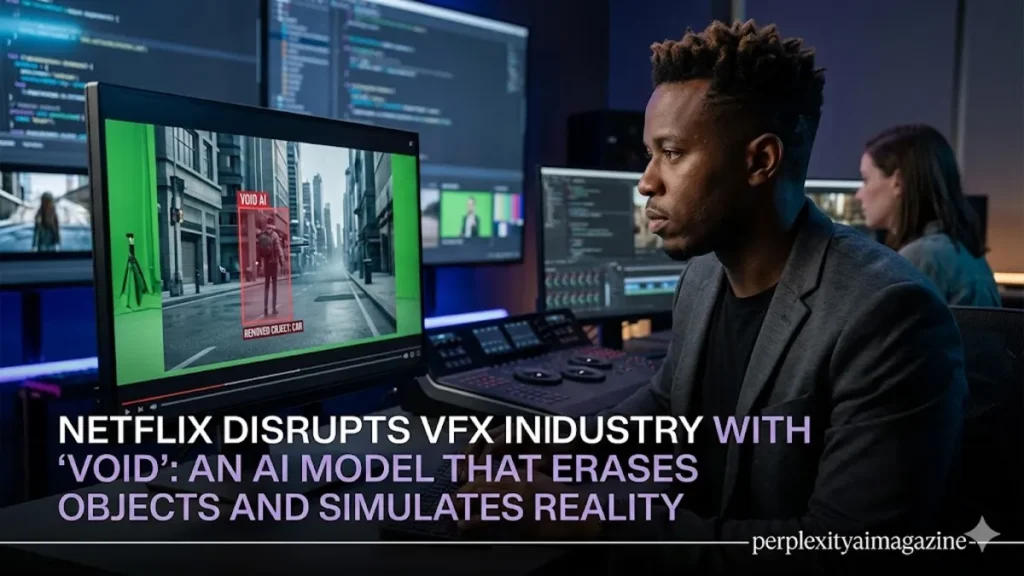
LOS GATOS, CA — Netflix has officially entered the generative AI tools space, releasing its first open-source video editing model, VOID (Video Object and Interaction Deletion), on April 3, 2026. The tool, hosted on Hugging Face and GitHub, allows editors to remove objects from footage while utilizing a sophisticated physics-aware engine to “rewrite” the scene’s reality. Unlike traditional inpainting, VOID doesn’t just fill pixels; it simulates how the environment would behave if the object had never existed, potentially saving thousands of hours in manual visual effects (VFX) work.
A Breakthrough in Physics-Aware Editing
At its core, VOID combines a vision-language model for object identification with a diffusion-based rewriting engine. Its primary innovation is “Interaction Deletion.” In existing tools, removing an object often leaves a static or blurred background. VOID, however, understands the physics of a scene.
For example, in a demonstration provided by the Netflix research team, removing a person holding a guitar results in the guitar realistically falling to the ground according to gravity, rather than floating in mid-air or disappearing entirely. In benchmarks, VOID achieved a 64.8% success rate in maintaining scene consistency, dwarfing the 18.4% success rate of industry-standard competitors like Runway.
Technical Specifications and Availability
Netflix has released the model under the Apache 2.0 license, signaling a commitment to open-source development. The codebase is currently available on GitHub, with model weights and interactive demos accessible via Hugging Face Spaces.
Deployment Requirements
While open-source, VOID is resource-intensive. It is built upon the CogVideoX-Fun-V1.5-5b-InP base and requires:
- Hardware: A minimum of 40GB VRAM is recommended (A100 or H100 GPUs).
- Software: Python 3.10+, PyTorch with CUDA support, and FFmpeg.
- Accessibility: A Google Colab notebook is available for creators without high-end local hardware, though users should expect significant latency on standard T4 GPUs.
Limitations and the “Uncanny Valley”
Despite its high benchmark scores, VOID is not yet a total replacement for human VFX artists. The model excels in “sparse” scenes—footage with clear backgrounds and limited subjects. However, in “dense” environments, such as a crowded city street, the model can struggle with background consistency and edge-case deformations.
Critics and professional editors note that while VOID automates the “grunt work” of rotoscoping, it lacks the precision of manual keyframing. The “quadmask” preprocessing required to guide the AI can also be tedious, and for high-stakes narrative filmmaking, the AI’s tendency toward “physics approximations” can occasionally result in artifacts that fall into the “uncanny valley.”
Detailed Analysis: What This Means for the Industry
The release of VOID represents a strategic pivot for Netflix. By open-sourcing a high-tier VFX tool, Netflix is not just contributing to the community; it is setting the technical standards for the next decade of production.
1. Lowering the Barrier to Entry: Independent filmmakers now have access to “erasing” technology that was previously reserved for high-budget studios. This could lead to a surge in high-quality indie sci-fi and action content. 2. The Shift in VFX Labor: We are seeing the beginning of the end for entry-level rotoscoping jobs. VFX houses will likely transition their workforce toward “AI Orchestration,” where artists spend less time painting frames and more time refining AI-generated outputs. 3. Computational Sovereignty: By hosting the model on Hugging Face, Netflix is challenging the dominance of closed-door AI firms like OpenAI (Sora) and Runway. It forces a move toward transparency in how AI interprets physical laws in cinematography.
CHECK OUT: Hollywood in a Box: The $9 Short Film That Rivals a $50M Production Studio
5 FAQs
1. What does VOID stand for? It stands for Video Object and Interaction Deletion. It is a model designed specifically to remove subjects while simulating the physical consequences of their absence.
2. Is Netflix VOID free to use? Yes. It is released under the Apache 2.0 license, which allows for free commercial and personal use, provided you have the hardware to run it.
3. Where can I download the VOID model? The source code is available on GitHub (github.com/Netflix/void-model) and the model checkpoints are hosted on Hugging Face.
4. Can VOID be used for real-time video editing? No. Due to the complexity of the diffusion models and the 40GB+ VRAM requirements, rendering is currently an offline process and is not yet suitable for real-time applications.
5. How does VOID handle complex physics, like a car crash? VOID uses a diffusion model trained on physical trajectories. If a car is erased from a crash, the model attempts to render the remaining car continuing its path based on the inferred momentum of the scene.