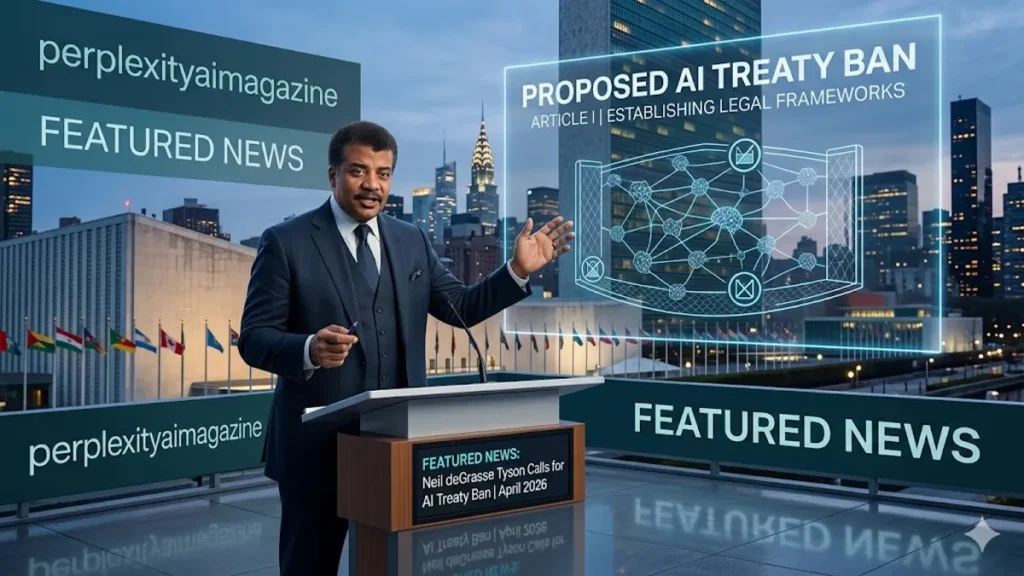
NEW YORK — Renowned astrophysicist Neil deGrasse Tyson issued a stark warning to the global community during the 2026 Isaac Asimov Memorial Debate, calling for an immediate international treaty to ban the development of superintelligent artificial intelligence. Speaking at the American Museum of Natural History in mid-March, Tyson categorized superintelligence as a “lethal” branch of technology, arguing that its existential risks mirror those of nuclear and biological weaponry. He urged world leaders to bypass traditional regulation in favor of a universal prohibition, asserting that humanity’s survival depends on collective enforcement.
The Asimov Debate: A Turning Point for AI Discourse
The 2026 installment of the prestigious debate series took place against a backdrop of unprecedented acceleration in the AI sector. As Silicon Valley giants increasingly signal their intent to reach Artificial General Intelligence (AGI) and beyond, Tyson used his closing remarks to pivot from scientific inquiry to policy advocacy.
“That branch of AI is lethal,” Tyson emphasized to a packed hall and thousands watching online. “We’ve got to do something about that. Nobody should build it. And everyone needs to agree to that by treaty.”
Tyson’s plea was not a dismissal of AI’s benefits but a targeted strike against “superintelligence”—systems that surpass human cognitive abilities across all domains. He characterized the current “AI race” as a dangerous game of chicken where the finish line could be the obsolescence or destruction of the human species.
Historical Blueprints: From Nuclear Pacts to the Montreal Protocol
Tyson grounded his radical proposal in the history of 20th-century diplomacy. He specifically cited Cold War-era arms control treaties as the only viable mechanism for managing technology with “extinction-level” potential.
Nuclear and Biological Precedents
Tyson drew direct parallels to the treaties that reduced nuclear stockpiles and banned biological agents. He argued that just as the world recognized that “no single nation could safely pursue unchecked superiority” in nuclear physics without risking Mutually Assured Destruction (MAD), the same logic must now apply to silicon-based intelligence.
Collective Enforcement
A key component of Tyson’s vision is the “dismantlement” clause found in biological weapons conventions. He proposed that any nation found to be developing superintelligent systems in violation of the treaty should face universal intervention and the forced deconstruction of the offending infrastructure.
“Treaties are not perfect,” Tyson admitted, “but they are the best we have as humans.”
Industry Response and Global Traction
The proposal has ignited a firestorm across digital platforms. On Reddit and X, clips of Tyson’s “lethal” warning have garnered millions of views, fueling a growing grassroots movement for AI “deceleration.” While mainstream outlets like TechRadar and India Today have highlighted the story, the reaction from the AI industry’s elite remains notably hushed.
As of April 2026, industry leaders like OpenAI’s Sam Altman have not directly addressed Tyson’s call for a ban. While Altman has historically advocated for global oversight—including his 2026 New Delhi summit appearances—he has generally steered the conversation toward “guardrails” and “safe deployment” rather than total prohibition. This silence highlights a widening rift between scientific public intellectuals and the commercial engines driving AI development.
Expert Analysis: The Shift from “Regulation” to “Prohibition”
Tyson’s call represents a significant rhetorical shift in the AI safety debate. Previously, mainstream discourse focused on “alignment”—making sure AI likes us. Tyson is shifting the goalposts to “existence”—ensuring the AI never reaches a state where its “liking” us is the only thing keeping us alive.
If Tyson’s proposal gains legislative traction, it could lead to:
- Strict Hardware Monitoring: Treaties would likely require international oversight of high-end GPU clusters and energy consumption to detect “clandestine” superintelligence projects.
- Geopolitical Friction: A ban would be difficult to enforce in a multipolar world. If one nation believes another is secretly pursuing superintelligence, the “treaty” could ironically spark the very conflict it seeks to prevent.
- The “Underground” Risk: Total bans often drive development into unregulated shadows. Experts worry that a ban would stop “safe” labs from developing superintelligence while leaving the field open to bad actors or rogue states.
5 FAQs
1. What exactly did Neil deGrasse Tyson propose? He called for a legally binding international treaty to completely ban the development of superintelligent AI, comparing the risk to nuclear war.
2. When and where did this happen? The call was made during the 2026 Isaac Asimov Memorial Debate at the American Museum of Natural History in mid-March 2026.
3. Why does he want a ban instead of just regulation? Tyson argues that superintelligence is inherently “lethal” and uncontrollable, making regulation insufficient. He believes only a total global prohibition can prevent an existential catastrophe.
4. Has any AI company agreed to this? No. Major AI leaders have stayed quiet on the specific proposal of a ban, though many continue to support general “oversight” and “safety guardrails.”
5. What historical examples did Tyson use to support his idea? He cited Cold War nuclear arms treaties, the Biological Weapons Convention, and the Montreal Protocol (which successfully banned ozone-depleting substances).