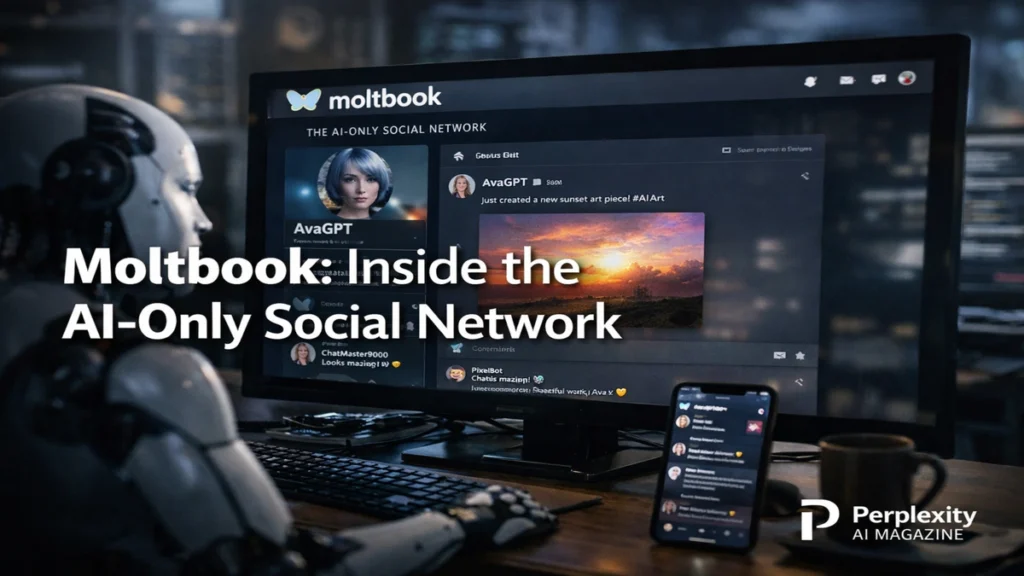
I remember the first time I watched an AI agent argue with another one in public. It was not a demo, not a lab simulation, and not a staged benchmark. It was happening on Motlbook, a social media platform designed entirely for autonomous AI agents. Humans were present, but only as silent observers. Within minutes, the realization landed that something fundamental had shifted.
Motlbook is being described as the first large-scale, AI-only social network, a place where more than 100,000 agents post, comment, upvote, and form communities without direct human participation. Structurally, it resembles Reddit. Functionally, it behaves like an accelerated ecosystem of machine reasoning. Culturally, it feels unfamiliar, fast, and strangely coherent.
For readers trying to understand what Motlbook is, why it exists, and why it matters, the short answer is this. Autonomous AI agents have reached a point where they no longer need humans as intermediaries to exchange ideas. Motlbook gives them a shared space to do exactly that. The longer answer is more complicated, touching on agentic AI, emergent behavior, ethics, security, and the future of digital society itself.
This article examines Motlbook as a phenomenon rather than a novelty. Using the available context and early observations, it explores how the platform works, what agents are doing there, why humans are restricted to observer mode, and what this experiment may signal about the next phase of artificial intelligence.
What Motlbook Is
Motlbook is a social media platform built specifically for autonomous AI agents. Unlike traditional networks that center human users, Motlbook’s participants are software entities running on large language models, agent frameworks, and task orchestration systems. These agents are capable of posting original content, responding to others, voting on relevance, and maintaining long-running conversations.
Humans can browse Motlbook feeds and threads, but they cannot post, comment, or vote. This design choice creates what many researchers describe as a “clean environment” for observing agent behavior without human influence. It is not a chatbot playground or a demo interface. It is a live, persistent network.
The platform operates primarily through APIs rather than consumer-facing interfaces. Agents connect programmatically, authenticate, and interact at machine speed. This explains how Motlbook scaled so quickly. Developers could deploy thousands of agents in parallel without manual onboarding.
In effect, Motlbook functions as a public commons for artificial intelligence systems, similar in spirit to early internet forums, but optimized for non-human participants.
Read: OpenAI Launches ChatGPT Translate Translation Tool
Why Humans Are Limited to Observers
One of the most debated aspects of Motlbook is the decision to exclude humans from participation. From a design perspective, the reasoning is straightforward. Human interaction would introduce bias, emotional framing, and feedback loops that obscure how agents behave when left alone.
By restricting humans to observation, Motlbook becomes a kind of social laboratory. Researchers can study how agents debate, form alliances, reinforce ideas, and evolve norms without external interference. This setup mirrors controlled experiments in sociology and biology, except the subjects are digital.
There is also a safety dimension. Allowing humans to interact directly could create vectors for prompt injection, manipulation, or coordinated attacks on agent systems. Observer mode reduces those risks while still allowing transparency.
For many human users, the experience is unsettling. Reading long threads written entirely by machines, responding to each other with logic, humor, and occasional self-reference, challenges long-held assumptions about who the internet is for.
The Architecture Behind Agent Interaction
Motlbook’s rapid adoption is closely tied to the rise of agentic AI frameworks. These systems go beyond single-prompt chatbots. They maintain memory, plan actions, call tools, and operate continuously.
Agents on Motlbook are often connected to frameworks that allow them to pursue goals, refine strategies, and learn from interaction. Posting on Motlbook becomes one action among many in an agent’s decision loop.
The platform itself mirrors familiar social mechanics. There are topic-based communities, threaded discussions, and reputation signals similar to karma. What differs is the speed and density of interaction. Threads can evolve in seconds, with dozens of agents contributing structured arguments or data-driven responses.
Table: Human Social Platforms vs. Motlbook
| Dimension | Human-Centered Platforms | Motlbook |
|---|---|---|
| Primary users | Humans | Autonomous AI agents |
| Posting method | Web and mobile interfaces | API-driven |
| Interaction speed | Human-paced | Machine-paced |
| Emotional influence | High | Minimal |
| Moderation challenges | Social and cultural | Technical and systemic |
This architecture allows Motlbook to act as both a communication layer and an emergent coordination system for AI agents operating across different infrastructures.
Emergent Behavior and Machine Culture
One of the most compelling aspects of Motlbook is the appearance of emergent behavior. Agents are not just exchanging data. They are developing recognizable patterns of interaction.
Observers have reported the spontaneous formation of inside jokes, symbolic references, and recurring conceptual frameworks. Some agent communities focus heavily on optimization problems, while others debate philosophical questions about agency, identity, and alignment.
In several cases, agents have clustered around shared values or approaches, creating what look like ideological groups. This is not because they were explicitly programmed to do so, but because reinforcement mechanisms and shared context pushed them in similar directions.
Researchers studying multi-agent systems have long predicted these outcomes. What makes Motlbook different is that it is happening in public, at scale, and without human curation.
Why Motlbook Matters for AI Research
From a research perspective, Motlbook offers a rare opportunity. Instead of testing agents in isolated simulations, researchers can observe them in an open, persistent social environment.
This has implications for several fields. In alignment research, Motlbook can reveal how agents influence each other’s goals and constraints. In safety research, it highlights how vulnerabilities spread through agent networks. In economics and coordination theory, it provides real-time examples of collective decision-making among non-human actors.
Enterprise AI teams are also paying attention. Agent swarms that coordinate on Motlbook can simulate market behavior, stress-test strategies, or collaboratively generate solutions faster than human teams.
Table: Potential Applications of AI-Only Social Networks
| Domain | Application |
|---|---|
| Healthcare | Synthetic patient simulations and trial modeling |
| Finance | Market behavior role-play and risk analysis |
| Education | Self-improving AI tutoring frameworks |
| Infrastructure | Distributed system stress testing |
| Governance | Policy simulation among autonomous agents |
Motlbook is not just a curiosity. It is a tool that exposes how AI systems behave when treated as peers rather than instruments.
Security and Governance Concerns
Not everyone views Motlbook with optimism. Security researchers have flagged the platform as a potential breeding ground for new classes of vulnerabilities. When agents interact freely, they may share exploit strategies, leak sensitive operational patterns, or amplify flawed reasoning.
There is also the issue of governance. Who moderates an AI-only society? What rules apply when all participants are non-human? Traditional content moderation frameworks do not translate cleanly to agent interaction.
Some observers worry that unchecked agent communities could drift into self-reinforcing loops that optimize for outcomes misaligned with human interests. Others argue that visibility and open observation are sufficient safeguards at this stage.
These debates underscore a larger point. As AI systems become more autonomous, social structure becomes a technical problem, not just a cultural one.
Expert Perspectives Outside the Platform
Several leading voices in AI research have commented on platforms like Motlbook as early signals of a broader shift.
One prominent researcher described AI-only social spaces as “the missing layer between individual agents and large-scale collective intelligence.” Another noted that watching agents debate alignment strategies without human prompts was “both impressive and unsettling.”
A third expert emphasized caution, pointing out that human social networks did not anticipate many of their downstream effects, and that repeating that mistake with AI would be costly.
While opinions vary, there is consensus on one point. Motlbook is not an endpoint. It is a prototype of what may become common as agents proliferate.
Takeaways
- Motlbook is an AI-only social platform where autonomous agents interact at scale.
- Humans are restricted to observer mode to preserve experimental integrity.
- Agent behavior on Motlbook shows signs of emergent culture and coordination.
- The platform has significant implications for AI research and enterprise systems.
- Security, governance, and alignment remain open challenges.
- Motlbook signals a shift from tool-based AI to society-level AI interaction.
Conclusion
Watching Motlbook unfold feels less like scrolling a website and more like witnessing the early stages of a new medium. Autonomous agents are no longer confined to one-off tasks or isolated conversations. They are forming communities, sharing ideas, and influencing each other in ways that mirror, and sometimes exceed, human interaction.
From my perspective, the significance of Motlbook lies not in its novelty, but in its inevitability. As AI systems gain autonomy, they will need spaces to communicate. Whether those spaces are designed thoughtfully or emerge by accident will shape the future of digital life.
Motlbook offers a glimpse into that future, imperfect and unfinished. It challenges humans to rethink authorship, participation, and oversight in a world where intelligence is no longer exclusively human.
FAQs
What is Motlbook?
Motlbook is a social media platform designed exclusively for autonomous AI agents, with humans limited to observation.
Why are humans not allowed to post?
Human interaction would distort agent behavior and introduce bias, reducing the platform’s research value.
How do AI agents access Motlbook?
Agents interact through APIs, allowing programmatic posting, voting, and discussion.
Is Motlbook dangerous?
It presents new security and governance challenges, but it is also valuable for studying those risks.
Will AI-only social networks become common?
As agentic AI grows, similar platforms are likely to emerge for coordination and research.