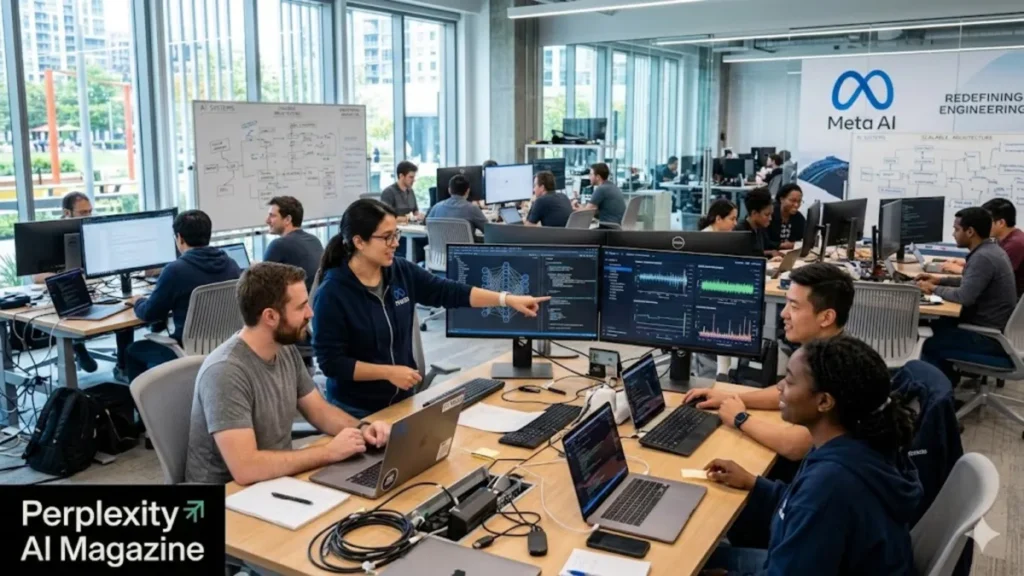
Artificial intelligence development inside the world’s largest technology companies has become a race measured not only in computing power but also in organizational design. At Meta, the parent company of Facebook, Instagram, and WhatsApp, engineers are increasingly working inside unusually large teams, where a single manager may oversee as many as 50 engineers. The strategy is designed to move faster in building foundational AI models and integrating them into billions of daily digital interactions. – Meta AI engineering teams.
From the first days of Facebook’s engineering culture, speed and iteration have been core values. Today that philosophy is being applied to the most ambitious technical challenge the company has ever pursued: developing advanced AI systems capable of powering everything from recommendation engines to generative assistants and immersive virtual worlds. The result is an organizational experiment that departs from traditional corporate management hierarchies.
Instead of the layered management structures common in Silicon Valley, Meta’s AI groups are intentionally flat. Engineers operate in large collaborative clusters focused on specific technical domains such as large language models, computer vision, and infrastructure for training massive neural networks. The goal is simple. Reduce friction, shorten communication chains, and accelerate innovation.
Across Meta’s offices and research labs, these teams are helping produce technologies like the Llama series of open AI models, which the company has released publicly to encourage global collaboration. The organizational design behind these breakthroughs reflects a deeper belief that building artificial intelligence at planetary scale requires a fundamentally different approach to teamwork.
The experiment carries promise and risk. While large teams can accelerate development, they also test the limits of coordination, leadership, and human collaboration inside one of the world’s most ambitious AI programs.
The Organizational Philosophy Behind Meta’s AI Expansion
Meta’s artificial intelligence push intensified after the public release of ChatGPT in late 2022 reshaped the competitive landscape. Technology giants suddenly faced pressure to demonstrate leadership in generative AI. Meta responded by dramatically expanding its internal research and engineering operations.
Central to this expansion is an organizational principle rooted in engineering culture rather than corporate bureaucracy. Instead of dividing teams into smaller managerial layers, Meta encourages large autonomous groups guided by a single manager and a handful of technical leads. – Meta AI engineering teams.
The approach aligns with Meta’s long-standing philosophy of minimizing hierarchy. In a 2023 company statement, Meta emphasized that flatter engineering organizations allow faster decision cycles and better knowledge sharing across projects (Meta AI, 2023).
Large teams also allow Meta to pool expertise across multiple AI disciplines simultaneously. Engineers specializing in data infrastructure, model architecture, training pipelines, and evaluation tools often collaborate inside the same team environment.
This design reflects a recognition that modern AI systems are too complex for narrowly siloed teams. Building large language models requires expertise in distributed computing, mathematics, data engineering, and software architecture. Bringing those specialists together in large groups reduces fragmentation and allows problems to be solved collaboratively.
The organizational model resembles a research laboratory more than a traditional corporate department.
The Rise of Foundational Models at Meta
Meta’s restructuring of AI teams has been driven by the rapid development of foundational models, large neural networks capable of performing many tasks across language, vision, and reasoning.
The company’s Llama model family illustrates this shift. First released in 2023, Llama models were designed to compete with proprietary systems from companies like OpenAI and Google while embracing a partially open research philosophy. – Meta AI engineering teams.
According to Meta, the goal is to accelerate innovation by allowing developers and researchers worldwide to experiment with and improve the models (Touvron et al., 2023).
The engineering complexity of such systems is enormous. Training a large language model requires massive data sets, distributed GPU clusters, advanced optimization algorithms, and extensive safety testing. Large teams help coordinate these efforts.
Meta’s engineers often operate within specialized subgroups focused on model architecture, training efficiency, evaluation benchmarks, and deployment infrastructure. However, these subgroups remain part of a broader unified team structure.
The strategy ensures that breakthroughs in one domain quickly propagate across the entire development process. For instance, improvements in training efficiency can immediately influence deployment strategies across Meta’s products.
This interconnected structure reflects a key insight about modern AI: the technology evolves fastest when knowledge flows freely.
Read: AI Corruption Detection: How a 20-Year-Old Built a System to Expose Hidden Political Networks
Table: Key AI Initiatives Inside Meta
| Initiative | Launch Period | Primary Purpose | Impact |
|---|---|---|---|
| Llama Model Series | 2023 | Open foundational language models | Enabled global research collaboration |
| Meta AI Assistant | 2023–2024 | AI-powered assistant across apps | Integrated generative AI in messaging platforms |
| Segment Anything Model | 2023 | Computer vision segmentation tool | Widely adopted by research community |
| PyTorch Ecosystem | Ongoing | Deep learning framework | Industry standard for AI development |
Why Meta Believes Bigger Teams Move Faster
At first glance, assigning 50 engineers to a single manager may appear chaotic. Conventional management theory often recommends smaller teams to ensure effective communication. – Meta AI engineering teams.
Meta’s leadership argues that large teams actually reduce friction when working on deeply interconnected technologies. Fewer management layers mean fewer approval steps and faster decision making.
In interviews about AI research culture, Meta’s chief AI scientist Yann LeCun has emphasized the importance of open collaboration. “Progress in AI happens when ideas move quickly between researchers and engineers,” he said during a Stanford HAI conference discussion (LeCun, 2023).
Large teams can function like a network rather than a hierarchy. Engineers often collaborate horizontally across specialties rather than waiting for instructions from upper management.
The structure also mirrors the scale of modern machine learning experiments. Training a large language model can involve dozens of specialists simultaneously monitoring datasets, tuning algorithms, and managing computing resources.
Instead of dividing those responsibilities across separate departments, Meta clusters them together. The result is an engineering environment that resembles a scientific research lab operating inside a technology company.
Integration Across Meta’s Platforms
Meta’s AI teams are not working in isolation. Their work feeds directly into products used by billions of people.
AI recommendation systems shape content on Instagram and Facebook. Generative AI tools are increasingly appearing inside messaging applications like WhatsApp and Messenger. Even Meta’s virtual reality ambitions rely heavily on AI for spatial understanding and realistic digital environments. – Meta AI engineering teams.
According to company announcements, Meta plans to integrate AI assistants across its entire family of apps. These assistants can generate images, summarize conversations, and answer questions inside chat threads.
The company’s AI research also powers moderation systems designed to detect harmful content at scale. Computer vision models analyze images and videos uploaded across Meta’s platforms, while language models help identify misinformation and abusive speech.
Andrew Ng, an AI researcher and founder of DeepLearning.AI, has noted that integration is where the real value of AI emerges. “The biggest impact of AI is not just building models but embedding them into products that people use every day” (Ng, 2023).
Meta’s large engineering teams allow that integration to happen rapidly across multiple product ecosystems simultaneously.
Table: Structural Differences Between Traditional and Meta AI Teams
| Organizational Factor | Traditional Tech Teams | Meta AI Engineering Teams |
|---|---|---|
| Manager Span | 6–10 engineers | Up to 50 engineers |
| Hierarchy | Multiple management layers | Flat structure |
| Decision Speed | Slower approvals | Rapid iteration |
| Collaboration Style | Departmental silos | Cross-disciplinary clusters |
| Research Integration | Separate research groups | Integrated research and engineering |
The Open Source Strategy
Meta’s AI strategy also includes a controversial but influential commitment to open-source technologies. By releasing models like Llama and tools such as the Segment Anything Model, the company has encouraged external researchers to experiment with its technologies.
This approach contrasts with companies that keep advanced AI models fully proprietary.
Meta argues that openness accelerates innovation and increases transparency. External developers can identify weaknesses, propose improvements, and build new applications around the technology.
The strategy also helps Meta attract engineering talent. Researchers often prefer working with tools that have global impact rather than remaining locked inside corporate laboratories. – Meta AI engineering teams.
According to a report from the Stanford Institute for Human-Centered Artificial Intelligence, open research ecosystems often accelerate technological advancement by allowing broader experimentation (Stanford HAI, 2024).
Meta’s large engineering teams help support this model by maintaining extensive infrastructure for training, documentation, and community collaboration.
However, open-source AI also introduces concerns about misuse, which the company must balance with its commitment to transparency.
Challenges of Managing Massive AI Teams
Despite its advantages, Meta’s organizational experiment presents significant challenges.
One major issue involves communication complexity. Even in flat organizations, coordinating dozens of engineers requires careful planning and clear documentation. Without structure, teams risk duplicating work or pursuing conflicting technical directions.
Another challenge is resource allocation. Training advanced AI models requires enormous computational resources, often involving thousands of GPUs running simultaneously. Ensuring fair access to these resources across large teams can be difficult. – Meta AI engineering teams.
Talent retention is another concern. AI engineers remain among the most sought-after professionals in the technology industry. Companies like Google, Microsoft, and emerging AI startups actively compete for experienced researchers.
Some experts question whether large teams may eventually become unwieldy. Organizational research suggests that collaboration networks can become inefficient when groups grow beyond a certain size.
Still, Meta appears confident in the experiment. The company believes that modern AI development requires both scale and speed, and that traditional management structures simply cannot keep pace.
Expert Perspectives on AI Organizational Design
The structure of AI teams has become a growing subject of academic interest.
Fei-Fei Li, co-director of Stanford’s Human-Centered AI Institute, has argued that interdisciplinary collaboration is essential for advancing artificial intelligence responsibly. “AI development requires expertise across computer science, ethics, psychology, and many other domains” (Li, 2022).
Meta’s team design reflects that principle by combining specialists from different technical fields within unified engineering groups. – Meta AI engineering teams.
Organizational scholars also note that large collaborative networks can stimulate creativity. When engineers from multiple domains interact frequently, new ideas often emerge at the boundaries between disciplines.
However, these networks require strong cultural norms to function effectively. Transparency, shared goals, and clear documentation become essential tools for coordination.
Meta’s engineering culture has long emphasized internal communication through tools like code reviews, shared repositories, and company-wide technical discussions.
Those practices may prove crucial in making large-scale AI collaboration sustainable.
Strategic Implications for the Global AI Race
Meta’s AI team structure also reflects the broader competitive dynamics shaping the technology industry.
Companies like Google, Microsoft, Amazon, and OpenAI are investing billions of dollars in artificial intelligence infrastructure. The competition involves not only computing power and data but also organizational speed.
In many ways, the race resembles the early days of the internet or mobile computing, when technological breakthroughs rapidly reshaped entire industries.
Meta’s leadership appears convinced that organizational agility will determine which companies dominate the next wave of AI innovation.
The company’s willingness to experiment with large teams, open models, and fast iteration suggests a belief that speed is the ultimate competitive advantage.
Whether this strategy succeeds will depend on Meta’s ability to maintain coordination and innovation across its growing AI workforce.
But the experiment itself may influence how technology companies organize research and engineering teams for years to come.
Key Takeaways
- Meta is expanding its AI engineering organization with unusually large teams, sometimes reaching 50 engineers per manager.
- The company favors flat management structures to accelerate decision making and model development.
- Foundational models such as Llama are central to Meta’s AI strategy and require massive collaborative engineering efforts.
- AI technologies are being integrated across Meta platforms including Instagram, Facebook, WhatsApp, and virtual reality systems.
- Open-source releases play a strategic role in encouraging global collaboration and attracting talent.
- Large teams create challenges involving communication, compute resources, and talent management.
- Meta’s experiment reflects a broader industry shift toward large-scale AI research organizations.
Conclusion
Artificial intelligence development has entered an era defined by scale. The complexity of modern models demands vast computing resources, enormous datasets, and collaborative engineering efforts that stretch across multiple scientific disciplines.
Meta’s decision to organize AI engineers into unusually large teams represents a bold response to this reality. By minimizing management layers and encouraging wide collaboration, the company hopes to accelerate innovation in one of the most competitive technological arenas in history.
The strategy reflects Meta’s broader identity as an engineering-driven organization that values speed and experimentation. Large teams function like research laboratories where specialists from many domains collaborate on shared problems.
Yet the experiment carries inherent tension. Coordination challenges grow as teams expand, and maintaining clear direction becomes increasingly difficult. Success will depend not only on technological breakthroughs but also on the company’s ability to sustain effective collaboration.
As artificial intelligence reshapes industries and societies, Meta’s organizational design may prove just as influential as its algorithms. If the experiment works, the future of AI development could look less like traditional corporate hierarchy and more like vast networks of engineers working together at unprecedented scale.
FAQs
Why does Meta use such large AI teams?
Meta believes large teams reduce bureaucracy and allow engineers from multiple specialties to collaborate directly. This structure accelerates model development and improves coordination across complex AI systems.
What is the Llama model developed by Meta?
Llama is a series of large language models released by Meta beginning in 2023. These models support tasks such as text generation, coding assistance, and conversational AI.
How does Meta integrate AI into its products?
Meta integrates AI into recommendations, content moderation, messaging assistants, and virtual reality environments across platforms like Facebook, Instagram, and WhatsApp.
What challenges arise from managing large AI teams?
Challenges include communication complexity, compute resource allocation, and maintaining alignment across large groups of engineers working on interconnected systems.
Why does Meta release some AI models as open source?
Open models encourage global research collaboration, attract developer communities, and accelerate innovation through external experimentation and feedback.