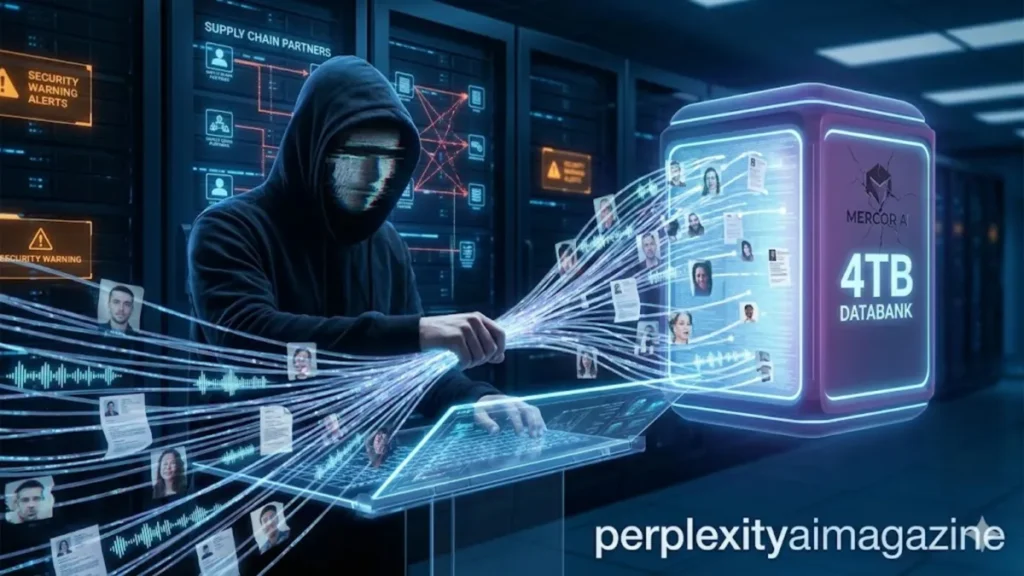
In the high-stakes world of Silicon Valley recruiting, Mercor AI was supposed to be the future—a seamless, AI-driven platform that vetted global talent through automated video interviews and biometric verification. That future darkened in March 2026 when the company confirmed a massive data breach involving the theft of 4 terabytes of sensitive information. The haul was devastating: nearly a terabyte of source code, hundreds of gigabytes of user databases, and most alarmingly, 3 terabytes of storage buckets containing high-definition video interviews and “Know Your Customer” (KYC) identity documents. For the thousands of contractors and job seekers who used the platform, the breach represents a permanent loss of privacy, as their facial features and voice patterns—data that cannot be “reset” like a leaked password—are now reportedly being auctioned on the dark web.
The breach was not a direct frontal assault on Mercor’s servers but a sophisticated supply-chain compromise targeting LiteLLM, an open-source library ubiquitous in AI-cloud environments. By poisoning the very tools developers trust to build modern software, the attackers gained a foothold that allowed them to bypass traditional defenses. The implications are staggering, as the stolen data includes passports, ID scans, and mannerism-rich video footage perfectly suited for generating deepfakes or conducting sophisticated impersonation attacks. As the industry grapples with the fallout, the Mercor incident serves as a chilling case study in the vulnerability of the AI gold rush, where the race to collect “biometric-adjacent” data has outpaced the security infrastructure meant to protect it.
The Anatomy of an Infiltration
The technical genesis of the disaster lies in a vulnerability now cataloged as CVE-2026-33634. In late March 2026, threat actors successfully compromised the CI/CD pipeline of LiteLLM, a popular Python package used to interface with various large language models. The attackers injected a malicious payload into versions 1.82.7 and 1.82.8, which included a hidden .pth file. This file was designed to execute automatically upon any Python interpreter startup, effectively turning every local development environment and server using the library into a conduit for credential theft. Once active, the script scanned for environment variables, AWS tokens, and SSH configurations, silently exfiltrating them to attacker-controlled domains.
Armed with these stolen credentials, the hackers—linked by some analysts to the notorious Lapsus$ collective—gained entry to Mercor’s Tailscale VPN. This gave them lateral movement capabilities within the startup’s internal network, allowing for the systematic exfiltration of 4 terabytes of data. The sheer volume of the theft suggests the attackers spent considerable time mapping the infrastructure before the final “smash and grab” operation. By the time the malicious LiteLLM packages were removed from PyPI, the damage was done, and the foundation of Mercor’s intellectual property and user trust had been hollowed out.
Technical Breakdown of Stolen Assets
| Data Category | Size / Volume | Potential Impact |
| Source Code | ~939 GB | Full exposure of proprietary AI algorithms and logic. |
| User Database | ~211 GB | PII, employment history, and contact information. |
| Storage Buckets | ~3 TB | Video interviews, passport scans, and KYC docs. |
| Credentials | Unknown | AWS/GCP tokens, internal VPN access keys. |
A New Era of Extortion
The involvement of a group tied to Lapsus$ signals a return to the “loud” extortion tactics that defined the early 2020s. Unlike traditional ransomware groups that quietly encrypt files and wait for a ransom, Lapsus$ thrives on public shaming and the auctioning of high-value source code and biometric data. “The goal isn’t just a payout from the victim company,” notes cybersecurity analyst Marcus Thorne. “The goal is to monetize the data through multiple channels—selling the source code to competitors and the biometric data to identity theft rings.” This multi-pronged approach makes the Mercor breach particularly difficult to contain.
Expert opinions suggest that the focus on video interviews is the most concerning aspect of the heist. “We are seeing the commoditization of the human face,” says Dr. Elena Rossi, a digital forensics expert. “A video interview isn’t just a recording; it’s a blueprint for a deepfake. With 3 terabytes of this material, attackers can create synthetic personas that are virtually indistinguishable from the real candidates, capable of bypassing voice-based banking security or social engineering their way into other corporate networks.” This shift from stealing data to stealing “identity blueprints” marks a pivotal moment in the evolution of cybercrime.
Timeline of the LiteLLM and Mercor Incident
| Date (2026) | Event | Action Taken |
| March 24 | Malicious LiteLLM v1.82.7/8 pushed to PyPI. | Attackers begin harvesting credentials globally. |
| March 25 | Mercor AI internal credentials compromised via VPN. | Exfiltration of 4TB of data begins. |
| March 28 | Threat actors list Mercor data for auction on dark web. | Security researchers flag the breach. |
| March 30 | Mercor confirms the breach and starts forensic audit. | Notification sent to affected users and regulators. |
The Biometric Fallout
For the candidates who sought jobs through Mercor, the breach is a life-altering event. Unlike a credit card number, one’s voice and facial mannerisms are immutable. The theft of KYC documents alongside video footage provides a “starter kit” for total identity takeover. Security professionals are now advising affected individuals to treat their digital presence with extreme caution. The risk isn’t just immediate financial fraud; it’s the long-term threat of being impersonated in professional and personal contexts for years to come. This incident highlights the inherent danger in the current trend of startups requiring high-friction biometric verification for low-stakes applications.
“This is the supply-chain nightmare we’ve been warning about,” says Sarah Jenkins, a lead engineer at a major cloud security firm. “When you use an open-source library, you aren’t just trusting the code; you’re trusting every tool the maintainers use to build that code. In this case, a compromise in a security-scanning tool used by the LiteLLM team led to a cascading failure that ended with the theft of millions of people’s biometrics.” The industry’s reliance on these interconnected, often under-guarded dependencies has created a house of cards that the Mercor breach has effectively toppled.
Remediation and the Road Ahead
Mercor has stated it is working with external forensic experts to determine the full scope of the exposure. However, for many, the response is too little, too late. The company must now navigate a landscape of tightening biometric privacy laws, such as Illinois’ BIPA or the EU’s AI Act, which could impose massive fines for such a comprehensive failure to protect sensitive data. Beyond the legal ramifications, the breach raises fundamental questions about whether AI hiring platforms should be allowed to store such intimate data at all, or if the risk of centralized “identity honeypots” is simply too high for society to bear.
In the wake of the attack, the cybersecurity community is pushing for more rigorous “Software Bill of Materials” (SBOM) standards and enhanced monitoring for CI/CD pipelines. The LiteLLM compromise proves that even sophisticated organizations can be blindsided by a tainted dependency. Until the industry moves toward a model of “zero-trust” even for the libraries they import, breaches like the one at Mercor will likely become more frequent. For now, the victims are left to watch the dark web, hoping their voices and faces don’t reappear in a script they didn’t write.
Key Takeaways
- Massive Data Loss: Roughly 4TB of data, including 3TB of video and KYC documents, was stolen from Mercor AI.
- Supply-Chain Entry: The breach originated from a malicious update to the LiteLLM Python library (CVE-2026-33634).
- Biometric Risk: Stolen video interviews enable voice cloning and deepfake impersonation, posing permanent identity risks.
- Lapsus$ Connection: The tactics used—VPN access and dark web auctions—align with the high-profile extortion group Lapsus$.
- Persistence of Payload: The malicious LiteLLM file persists even after an upgrade; it requires manual deletion of the
.pthhook. - Call to Action: Affected users must rotate all credentials, enable hardware-based MFA, and monitor for targeted social engineering.
Reflecting on the Digital Mirror
The Mercor AI breach is more than a corporate failure; it is a warning shot for an era where our physical identities are increasingly converted into digital assets. As we outsource the “human” element of hiring to algorithms, we inadvertently centralize our most private traits into databases that become prime targets for the world’s most sophisticated actors. The efficiency gained by AI-driven vetting is now being weighed against the catastrophic cost of a total identity compromise.
Moving forward, the tech industry must decide if the convenience of automated biometrics is worth the liability. This event should serve as a catalyst for a “security-first” shift in AI development, emphasizing the minimization of data collection rather than the maximization of data storage. For the individuals whose data is now adrift in the digital underground, the lesson is somber: in the digital age, your face and voice are the ultimate currency, and once they are spent by a third party, they cannot be reclaimed.
READ: GitHub Copilot 2026 Policy Update: How to Opt Out of AI Training
FAQs
How do I know if my data was stolen in the Mercor AI breach?
Mercor is currently notifying affected individuals via the email addresses associated with their accounts. If you participated in a video interview or uploaded identity documents to their platform prior to March 2026, you should assume your data was part of the 4TB exfiltration and take immediate protective measures.
Can I just update LiteLLM to fix the security hole?
No. Because the malicious version installs a persistent .pth file in your Python environment, simply upgrading the package is insufficient. You must manually locate and delete the litellm_init.pth file from your site-packages directory and rotate all API keys and cloud credentials that were active on that machine.
What is the specific risk of “biometric-adjacent” data being leaked?
Unlike a password, your facial structure and voice cadence cannot be changed. Hackers can use the 3TB of stolen video footage to train AI models that mimic you. This can lead to “synthetic media” attacks where an attacker poses as you in a video call to gain access to your bank or employer.
Was the Lapsus$ group involved in this specific attack?
Initial threat intelligence suggests the methods—targeting VPNs and using high-pressure public auctions—are consistent with the Lapsus$ playbook. While the group has been fragmented by arrests in the past, new cells or copycat groups using their infrastructure often claim responsibility for such high-profile thefts.
What immediate steps should I take if I am a victim?
First, change all passwords and enable non-SMS multi-factor authentication (like a YubiKey or Authenticator app). Second, place a credit freeze on your files to prevent identity thieves from opening accounts using your stolen ID scans. Finally, be hyper-vigilant regarding “vishing” (voice phishing) calls.
References
- CISA. (2026). Alert (AA26-085A): Malicious Activity Targeting Open-Source AI Libraries. Cybersecurity and Infrastructure Security Agency.
- LiteLLM Security Team. (2026). Incident Report: Supply Chain Compromise of PyPI Packages 1.82.7 and 1.82.8. GitHub Repository.
- National Institute of Standards and Technology. (2026). CVE-2026-33634 Detail. NVD.
- Smith, J. (2026, March 29). The Return of Lapsus? Analyzing the Mercor AI Exfiltration. Cyber Defense Magazine.
- Wired Staff. (2026, March 31). AI Hiring Startup Mercor Confirms Massive Biometric Data Theft. Wired.