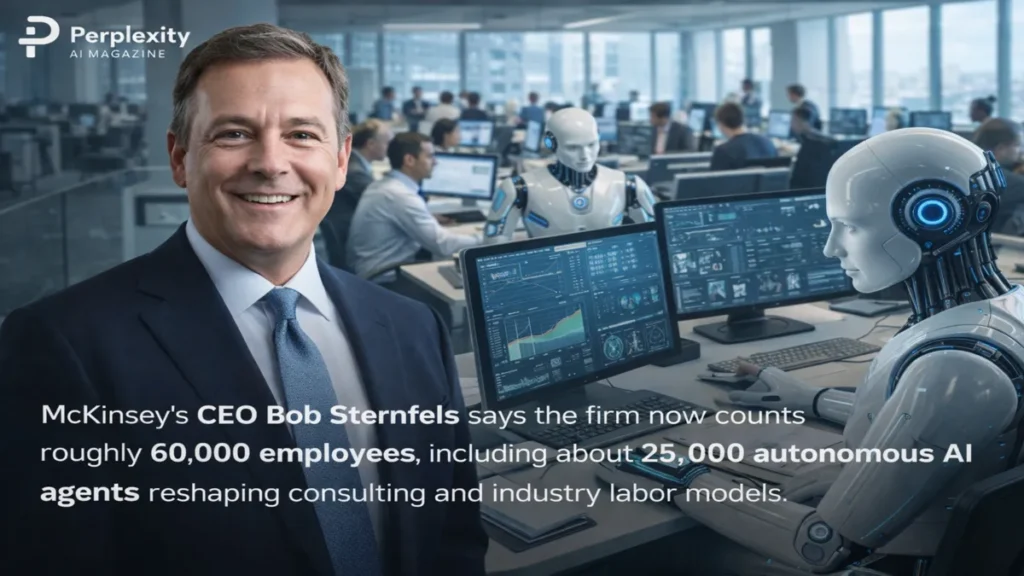
I first understood how radical McKinsey’s transformation had become when Bob Sternfels, the firm’s global managing partner, casually referred to its workforce as about 60,000 strong, including tens of thousands of artificial intelligence agents. Not tools, not software, but agents. The word choice matters because it signals something deeper than automation. It suggests that McKinsey now thinks of AI not as infrastructure but as labor. – McKinsey Hybrid Workforce.
Roughly 40,000 of those workers are still human consultants, analysts, partners, and staff. The remaining 20,000 to 25,000 are autonomous systems designed to perform tasks that once occupied armies of junior consultants and support teams. They analyze data, synthesize research, draft documents, generate charts, and manage workflows with minimal human prompting. They are counted in headcount, referenced in productivity metrics, and increasingly woven into how the firm defines itself.
This is not a marketing gimmick. It is a structural change to one of the most influential organizations in global business. McKinsey advises governments, corporations, and institutions on how to adapt to technological change, and now it is undergoing that change itself in full view.
The result is a hybrid organization where humans and machines are not separate layers but interdependent collaborators. The firm’s leaders argue this model increases quality, speed, and insight. Critics worry it could hollow out career paths, concentrate power, and blur accountability. Both are likely true.
McKinsey’s experiment offers a window into the future of professional work, not just in consulting but across any industry where knowledge, analysis, and coordination define value.
Read: Greenland Rare Earth AI Investments Explained
What McKinsey means by AI agents
McKinsey is careful in how it defines its artificial workforce. These are not chatbots responding to prompts. They are autonomous systems that can decompose problems, design workflows, execute multi-step processes, and deliver outputs with limited human intervention.
An AI agent at McKinsey might be tasked with monitoring industry data, updating competitive dashboards, generating slide decks, synthesizing research across hundreds of sources, or managing internal task flows. Some operate continuously in the background. Others are activated for specific projects.
They are built on large language models, data analytics engines, and internal knowledge systems developed primarily through McKinsey’s QuantumBlack division. Over time, they have become embedded into everyday work, not as optional tools but as expected collaborators.
Counting them as employees is symbolic but also operational. It reflects that these systems consume resources, produce value, and shape outcomes. They are not invisible. – McKinsey Hybrid Workforce.
Table: Workforce composition
| Type | Approximate count | Primary role |
|---|---|---|
| Human consultants and staff | 40,000 | Judgment, strategy, leadership, relationships |
| AI agents | 20,000–25,000 | Analysis, synthesis, drafting, execution |
| Total workforce | ~60,000 | Hybrid human–AI organization |
Why McKinsey moved this fast
Three forces pushed McKinsey toward this model.
First, client demand shifted. Clients increasingly expect faster turnaround, deeper data, and continuous insight. Traditional consulting timelines, measured in weeks and months, began to feel slow.
Second, competition intensified. Other firms adopted AI tools, compressing delivery cycles and lowering costs. McKinsey faced a choice between leading or reacting.
Third, internal economics changed. The traditional pyramid model of consulting relies on large numbers of junior staff doing foundational work. As AI became capable of doing much of that work faster and cheaper, the pyramid itself came into question. – McKinsey Hybrid Workforce.
AI agents solved these pressures simultaneously. They scale instantly. They do not burn out. They do not leave. They do not require promotion.
But they also do not build trust, navigate politics, or make ethical judgments. That remains human work.
Productivity and transformation
McKinsey reports that its AI agents have saved millions of work hours and generated millions of analytical outputs. Research that once took days can now be done in minutes. First drafts appear instantly. Visualizations update in real time.
This allows human consultants to spend more time on synthesis, interpretation, and decision-making. The firm increasingly sells outcomes rather than hours, shifting from time-based billing toward value-based engagement.
This is not just operational change. It is a redefinition of what consulting is.
The consultant becomes less of a researcher and more of a sense-maker. Less of a producer and more of a guide.
Table: Task redistribution
| Task category | Before | Now |
|---|---|---|
| Data gathering | Junior consultants | AI agents |
| Initial analysis | Junior consultants | AI agents |
| Drafting slides | Junior consultants | AI agents |
| Strategic framing | Senior consultants | Humans |
| Client interaction | Partners and teams | Humans |
What happens to junior consultants
One of the most profound effects of this shift is on entry-level roles. Traditionally, junior consultants learned by doing repetitive, foundational work. That work is now largely automated.
This forces a redesign of training. New hires must learn higher-level thinking earlier. They must engage in strategy, storytelling, and leadership sooner, without the long apprenticeship of manual analysis.
This accelerates development for some. It also risks leaving others behind. – McKinsey Hybrid Workforce.
McKinsey now selects for adaptability, creativity, and judgment more than technical pedigree. The idea is not that anyone can be replaced by AI, but that everyone must learn to work with it.
The human skills that matter more
As machines take over structured tasks, unstructured ones become more valuable.
These include:
- Ethical judgment
- Creative problem formulation
- Emotional intelligence
- Persuasion and communication
- Leadership and accountability
These are not easily codified. They depend on context, culture, and human experience.
McKinsey’s leaders emphasize that AI agents amplify human work rather than replace it. But amplification changes power dynamics. The people who control AI have more leverage than those who do not.
Industry-wide implications
Consulting is a bellwether for knowledge work. What happens here will echo across law, finance, medicine, education, and government.
If AI agents become standard coworkers, organizations will need new norms around accountability, transparency, and evaluation. Who is responsible when an AI-driven decision causes harm? Who audits the logic of an agent? Who controls its incentives? – McKinsey Hybrid Workforce.
These questions are not yet answered.
Expert perspectives
An organizational theorist notes that “we are witnessing the birth of algorithmic labor markets inside firms.”
A labor economist warns that “hybrid workforces risk creating new inequalities between those who design systems and those who serve them.”
A technologist argues that “we finally have tools that match the scale of modern complexity, but we lack social systems that match their power.”
Takeaways
- McKinsey now counts AI agents as part of its workforce
- Around one-third of its labor is autonomous software
- This increases productivity and changes business models
- Junior roles and career paths are being redefined
- Human skills shift toward judgment, creativity, and leadership
- Power concentrates around those who control AI systems
- This model will likely spread across industries
Conclusion
McKinsey’s hybrid workforce is not a curiosity. It is a preview.
It shows what happens when digital systems become capable enough to be treated as workers rather than tools. It shows how organizations change when labor is no longer scarce, but intelligence is.
The danger is not that machines will replace humans, but that humans will be reorganized around machines in ways that concentrate power, narrow opportunity, and reduce accountability.
The opportunity is that humans will be freed from drudgery to focus on meaning, creativity, and judgment.
Which future emerges will depend less on technology than on choices.
FAQs
What is an AI agent at McKinsey
An autonomous system that can perform complex tasks with minimal human input.
Are they really counted as employees
Yes, McKinsey includes them in its workforce figures symbolically and operationally.
Do they replace human jobs
They replace tasks, not entire roles, but they reshape careers.
Why is McKinsey doing this
To increase speed, scale, and competitiveness.