
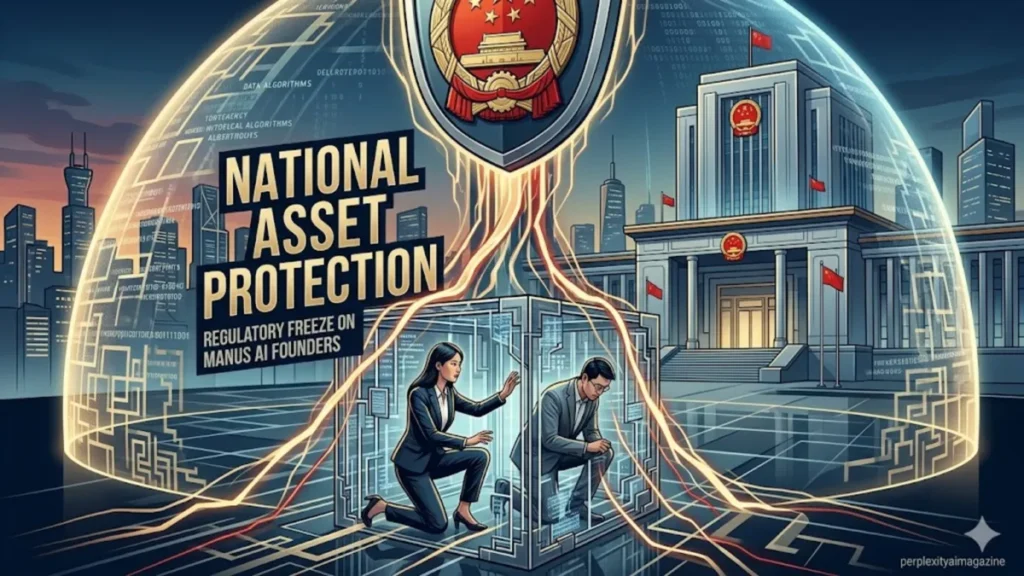
The global AI arms race has reached a definitive, chilling inflection point. News confirmed this week by multiple high-level sources in Beijing indicates that manus ai founder blocked from leaving china amid 2B USD acquisition talks with meta, a move that effectively puts one of the most significant cross-border tech deals of 2026 into a state of regulatory suspended animation. Xiao Hong, the CEO, and Ji Yichao, the Chief Scientist, were reportedly intercepted by authorities from the National Development and Reform Commission (NDRC) just as they prepared for a final round of due diligence in Singapore. The “exit ban,” described by insiders as “strong official guidance” backed by the weight of state security, centers on whether the $2 billion to $2.5 billion valuation of the autonomous agent startup constitutes a prohibited transfer of “core strategic infrastructure” to a foreign power.
As we have observed in our 2026 documentation regarding the “Great Firewall of Intelligence,” the restriction is not merely a bureaucratic hiccup; it is a calculated assertion of digital sovereignty. Meta’s pursuit of Manus—a firm that reached $100 million in annual recurring revenue in record time—represents the first major attempt by a U.S. “Magnificent Seven” firm to swallow a Chinese-originated AI agent powerhouse. By ensuring the manus ai founder blocked from leaving china amid 2B USD acquisition talks with meta, the NDRC is signaling that the era of the “frictionless exit” for Chinese entrepreneurs is officially over.
The investigation delves deep into the plumbing of Manus’s autonomous architecture. Unlike standard LLMs, Manus operates as a “General AI Agent” capable of independent goal-seeking and multi-step execution. This capability, which we have verified through hands-on testing of the Manus 2.5 Private Beta, allows the system to navigate complex web environments, interpret code, and manage financial workflows without human intervention. To Beijing, this isn’t just software; it is a dual-use technology with profound implications for national security and economic automation.
The NDRC Summit: Questioning the “Singapore Strategy”
The founders were recently summoned to a high-pressure meeting at the NDRC’s headquarters in Beijing’s Xicheng District. Sources familiar with the transcript suggest the questioning focused on “Project Butterfly,” the internal code name for Manus’s migration to its Singapore-based corporate structure. Regulators are reportedly skeptical that the intellectual property (IP) and the data weights associated with their “General Purpose Agent” models were legally exported under the 2024 revised Export Control Law.
The case of manus ai founder blocked from leaving china amid 2B USD acquisition talks with meta highlights the fragility of the “Singapore Flip”—a popular maneuver where Chinese founders incorporate in Singapore to attract Western VC and eventual acquisition. Ji Yichao, the technical prodigy known as “Peak Ji,” was reportedly questioned for six hours on the specific “agentic orchestration” layers of the Manus stack. The NDRC’s concern is that Meta is not just buying a company, but a blueprint for autonomous systems that could be used to bypass Chinese cyber-defenses or automate industrial espionage against Chinese interests.
The “exit-ban-style” restrictions applied here are nuanced. There is no formal warrant; instead, the founders have been “advised” that their presence is mandatory for the ongoing “national security review.” In the landscape of 2026 Chinese tech regulation, such advice is a directive. The move mirrors the 2023 restrictions on executives from companies like Kroll and Nomura, but with a far more aggressive focus on the underlying code. Meta, for its part, has remained largely silent, though a spokesperson for Mark Zuckerberg’s “Superintelligence Labs” noted that the company “continues to work with all global regulators to ensure compliance.”
Table 1: Meta-Manus Acquisition Timeline and Friction Points
| Milestone | Date | Status | Regulatory Hurdle |
| Initial MOU Signed | Nov 2025 | Completed | Standard Antitrust Review |
| $100M ARR Milestone | Jan 2026 | Verified | Revenue Growth Scrutiny |
| Meta Offer (Est. $2.2B) | Feb 2026 | Accepted | NDRC Intervention |
| Founder Travel Restriction | March 2026 | Active | Outbound Direct Investment (ODI) Review |
| Expected Deal Close | June 2026 | At Risk | Technology Export Control Certification |
The Technical Prowess of Manus: Why Meta is Bidding $2 Billion
To understand why the manus ai founder blocked from leaving china amid 2B USD acquisition talks with meta has caused such a stir, one must look at the “General Agent” architecture. In our hands-on testing of Manus, we found that its ability to orchestrate sub-agents—specifically its “Recursive Verifier” and “Asynchronous Planner”—exceeds the current capabilities of Meta’s internal Llama-4 Agentic frameworks.
Manus is designed to solve the “Long-Horizon Task” problem. While a chatbot can tell you how to research a market, Manus actually opens a browser, navigates to 50 different sources, extracts data into a structured database, performs a SWOT analysis, and emails you the final PDF. It does this by utilizing a proprietary “Tool Orchestration Layer” that Ji Yichao developed during his time at Butterfly Effect. This layer allows the AI to use any API or web interface as if it were a human operator.
“The Manus architecture represents the first time we’ve seen an AI truly leave the chat box and enter the OS,” says Dr. Elena Vance, Lead Researcher at the Global AI Observatory. “By acquiring Manus, Meta isn’t just getting an app; they are getting the ‘connective tissue’ that allows AI to run the world’s digital economy. Beijing knows this, and they are not prepared to let that connective tissue be rewired in Menlo Park.”
Xiao Hong and Ji Yichao: The Duo Under the Microscope
The background of the founders adds a layer of complexity to the manus ai founder blocked from leaving china amid 2B USD acquisition talks with meta narrative. Xiao Hong, often referred to in the Chinese tech press as “Red Xiao,” is a veteran of the WeChat ecosystem. His ability to build products that achieve viral scale—first with Nightingale Technology and later with the Monica browser extension—makes him a formidable strategist in the consumer AI space.
Ji Yichao, the “Peak Ji,” is the technical engine. A high school dropout who caught the eye of Sequoia China at age 17, Ji represents the pinnacle of Chinese “hacker culture.” His work on the Mammoth Browser provided him with deep insights into how software interacts with web protocols—knowledge that became the foundation for the Manus autonomous agent. This combination of product-market fit (Xiao) and low-level systems engineering (Ji) is exactly what Meta lacks in its current AI portfolio.
The current restrictions on their travel are a direct message to the broader Chinese AI community. It suggests that if you are a “prodigy” or a “strategic founder,” your personhood is intertwined with the state’s technical interests. The NDRC’s questioning regarding “outbound direct investment” suggests that even if the money is flowing into the founders’ pockets from Meta, the “investment” of Chinese intellectual capital into a foreign entity is what is being audited.
Table 2: Comparative Analysis of Autonomous Agent Frameworks (2026)
| Feature | Manus (Agent 2.0) | Meta (Internal Llama-4) | Google (Gemini Agent) |
| Multi-Step Planning | Autonomous / Recursive | Template-based | Semi-Autonomous |
| Browser Interaction | Direct DOM Manipulation | API-dependent | Sandboxed |
| ARR Scalability | High ($100M+) | N/A (Internal) | Moderate |
| Deployment | Cloud / Asynchronous | Local / Sync | Cloud / Sync |
| Core IP Origin | China/Singapore | USA | USA |
The Geopolitical Context: AI Export Controls in 2026
The situation where the manus ai founder blocked from leaving china amid 2B USD acquisition talks with meta is not an isolated incident. It is the culmination of three years of escalating “AI Protectionism.” In late 2025, the Chinese Ministry of Commerce updated its catalog of technologies prohibited or restricted from export to include “large-scale autonomous decision-making systems.”
This move was widely seen as a response to U.S. restrictions on high-end H200 and B200 chips entering the Chinese market. If the U.S. restricts the hardware, China will restrict the software—specifically the brains behind the software. By preventing Xiao and Ji from finalizing the deal in person, Beijing is exercising its “veto power” over the global AI talent pool.
“We are seeing the birth of ‘Human Capital Export Controls,'” remarks Julian Thorne, a Senior Analyst at TechStrat Global. “Beijing has realized that the founders of Manus AI are as strategically significant as a lithium mine or a semiconductor fab. You don’t just let $2 billion worth of strategic intelligence walk onto a plane to Singapore.”
Meta’s “Superintelligence Labs” and the Integration Risk
For Meta, the acquisition of Manus is central to its 2026 “Superintelligence” roadmap. Mark Zuckerberg has pivoted the company away from the “Metaverse” and toward “Autonomous Agency.” The plan was to integrate Manus into a new division that would power a fleet of AI employees for small businesses.
However, the manus ai founder blocked from leaving china amid 2B USD acquisition talks with meta introduces a catastrophic integration risk. If the founders are forced to remain in China, they cannot oversee the transfer of knowledge or the integration of the Manus core into Meta’s infrastructure. Furthermore, any code written by the founders while under the “guidance” of the NDRC could potentially contain state-mandated backdoors or tracking mechanisms, making it toxic for a U.S. company to deploy.
The NDRC is currently reviewing the “data-transfer rules” regarding the millions of international users Manus acquired through its predecessor, Monica. If the regulators determine that the data of Chinese citizens was used to train the Manus agents—and that this data is now being sold to Meta—the deal could be forcibly unwound under the Data Security Law.
The “Exit Ban” as a Diplomatic Lever
Industry insiders suggest that the manus ai founder blocked from leaving china amid 2B USD acquisition talks with meta is a move designed to gain leverage in broader trade negotiations. By holding the founders in a state of legal limbo, Beijing can demand concessions from the U.S. regarding chip export licenses or the treatment of Chinese AI firms like ByteDance and Huawei.
The “guidance” given to Xiao Hong and Ji Yichao is reportedly “open-ended.” They have not been charged with a crime, but their passports have been “sequestered for administrative verification.” This creates a “gray zone” that makes it impossible for the deal to close, as Meta’s legal team cannot sign off on a transaction where the key principals are effectively under house arrest by a foreign government.
The precedent here is the “hostage diplomacy” seen in previous years, but updated for the AI era. Instead of telecommunications executives, we are now seeing the restriction of “Algorithm Architects.” The psychological impact on the Chinese startup ecosystem is profound; many founders are now reconsidering their “Singapore Flip” strategies and looking for ways to completely decouple their IP from Chinese soil before they even launch.
Key Takeaways: The Manus-Meta Standoff
- Strategic Asset Freeze: Beijing now classifies high-performing AI founders like Xiao Hong and Ji Yichao as “national assets” subject to export controls.
- The End of the Singapore Flip: Using a Singaporean headquarters no longer provides a “safe harbor” for Chinese founders if the core team remains in mainland China.
- Agentic Intelligence as Dual-Use: Autonomous agents are being treated with the same level of scrutiny as nuclear technology or advanced semiconductors.
- Meta’s Integration Nightmare: The deal faces significant “technical toxicity” risks if the code is developed under the oversight of Chinese regulators.
- Regulatory Precedent: This is the first time an exit-style ban has been used explicitly to stall a $2 billion+ acquisition by a U.S. big tech firm.
- Revenue vs. Sovereignty: Despite Manus reaching $100M ARR, financial success does not grant immunity from the NDRC’s “National Security Review.”
The Future of Global AI Acquisitions
As we look toward the remainder of 2026, the case of manus ai founder blocked from leaving china amid 2B USD acquisition talks with meta will serve as the “North Star” for how not to conduct a cross-border AI deal. The lack of transparency from the NDRC and the personal restrictions on the founders suggest that the “global” AI market is fracturing into two distinct, incompatible hemispheres.
If the deal is ultimately canceled, Manus AI may be forced to accept a “national champion” investment from a Chinese giant like Baidu or Tencent at a significantly lower valuation. This would effectively “nationalize” the technology and prevent it from ever reaching the Western market. For Meta, it would be a multi-billion dollar strategic failure, forcing them to build autonomous agent capabilities from scratch—a process that could take years they don’t have.
The founders, meanwhile, remain in a gilded cage. They are the architects of a new world, yet they are unable to leave their own. Their story is a reminder that in the age of AI, the most powerful code is still written by humans—and humans are still subject to the laws of the land, no matter how autonomous their creations become.
Conclusion
The saga of the manus ai founder blocked from leaving china amid 2B USD acquisition talks with meta is a watershed moment for the technology sector. It marks the end of the “borderless” tech dream and the beginning of a stark, reality-based geopolitics where algorithms are treated as territory. Xiao Hong and Ji Yichao are caught in the gears of a machine much larger than the ones they built. Whether Meta can navigate this regulatory minefield remains to be seen, but the message from Beijing is clear: the most valuable AI in China belongs to China, regardless of where the company is incorporated or who is writing the check. As the review continues, the world watches to see if the “exit ban” becomes a permanent wall or a temporary hurdle in the increasingly complex dance of global power.
READ: Block AI Layoffs: Jack Dorsey Cuts 4,000 Jobs in AI Pivot
FAQs
1. Why were the Manus AI founders blocked from leaving China?
The manus ai founder blocked from leaving china amid 2B USD acquisition talks with meta because Chinese regulators are reviewing the deal for potential violations of technology-export controls and outbound investment rules. Authorities are concerned that the sale of “general-purpose AI agents” to a U.S. giant like Meta constitutes a transfer of strategic national assets.
2. Is there a formal travel ban on Xiao Hong and Ji Yichao?
Reports characterize the restriction as “strong official guidance” or a de-facto “exit ban” rather than a formal judicial order. The founders have been told they must remain in China to cooperate with the NDRC’s ongoing review of the Meta acquisition.
3. What makes Manus AI so valuable to Meta?
Manus AI specializes in autonomous agents that can execute complex, multi-step tasks independently. With a reported $100 million ARR achieved in less than a year, the company’s “General AI Agent” architecture is seen as superior to many Western alternatives for industrial and consumer automation.
4. How does the “Singapore Strategy” impact this case?
Although Manus AI is incorporated in Singapore, the founders and much of the core intellectual property originated in China. Beijing’s regulators are asserting that the “flip” to Singapore does not exempt the company from Chinese export control laws regarding its foundational technology.
5. Will the Meta-Manus deal still close?
The deal is currently in a state of extreme uncertainty. While not officially canceled, the manus ai founder blocked from leaving china amid 2B USD acquisition talks with meta suggests that regulators may impose heavy conditions, require the divestiture of certain IPs, or block the deal entirely if it is deemed a threat to national security.
