Manufacturing is entering a phase in which software intelligence no longer merely supports operations but actively shapes how physical production unfolds. Across automotive, electronics, biotech, and industrial equipment sectors, artificial intelligence is transforming factories into adaptive systems that sense, reason, and respond continuously. This shift is being driven by three converging technologies: humanoid robots capable of performing human-scale tasks, agentic AI systems that autonomously plan and coordinate operations, and digital twins that simulate and optimize physical processes in real time. – manufacturing ai news.
The result is a manufacturing environment that behaves less like a static assembly line and more like a responsive organism. Machines adjust themselves when conditions change, supply chains reroute when disruptions occur, and production parameters refine automatically to reduce waste and defects. This transition reflects growing pressure on manufacturers to cope with labor shortages, rising quality expectations, fragile global logistics, and increasingly complex products.
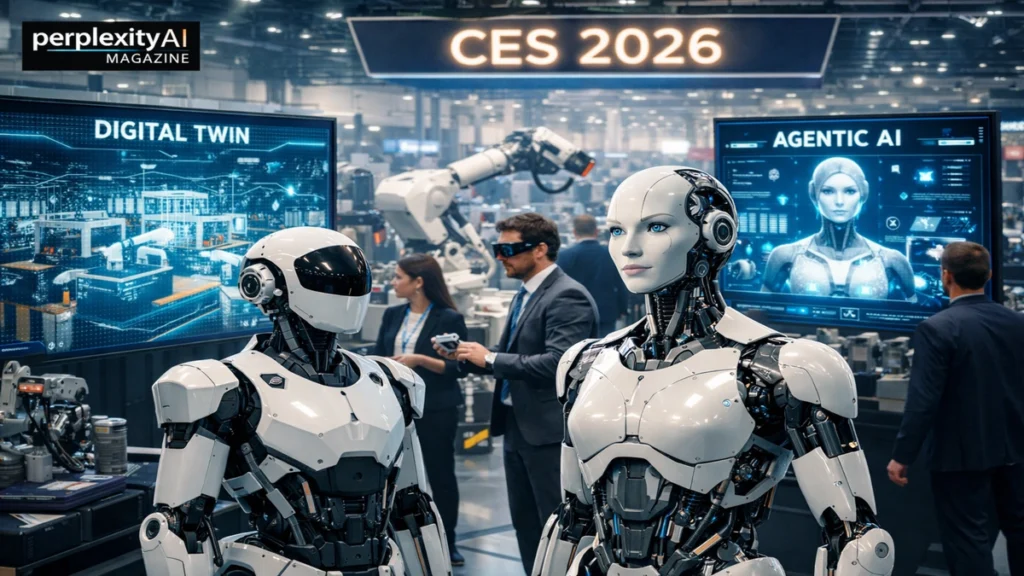
Humanoid robots such as Boston Dynamics’ Atlas are now being tested directly on factory floors, performing material handling and sequencing tasks once reserved for humans. Agentic AI systems automate scheduling, maintenance, and logistics decisions that once required layers of managerial coordination. Digital twins replicate entire factories virtually, allowing companies to test changes, detect risks, and correct errors before they affect physical output.
Together, these systems are redefining what a factory is. No longer just a site of production, it becomes a network of intelligent components that continuously negotiate efficiency, resilience, and precision. The manufacturing sector is not simply adopting AI — it is reorganizing itself around it.
Read: blackrock ai consortium aligned data centers $20 billion deal news Explained
The Emergence of Humanoid Robotics in Industrial Work
Humanoid robots represent a new class of automation designed not for isolated tasks, but for integration into human-centered environments. Unlike traditional industrial robots that operate in fenced-off zones performing repetitive motions, humanoid robots are built to move through factory spaces, interact with human workers, and adapt to varying tasks. – manufacturing ai news.
Boston Dynamics’ Atlas humanoid robot has entered factory testing environments, initially focusing on parts handling and sequencing. These robots are expected to scale toward industrial production volumes, with capacity targets reaching tens of thousands of units per year. The strategic purpose is not to replace human workers outright but to offload physically demanding, repetitive, or hazardous tasks while allowing humans to focus on supervision, design, and problem-solving.
Humanoid robots excel in environments that are unpredictable or spatially complex. Warehouses, assembly lines with variable product configurations, and maintenance-heavy facilities benefit from machines that can navigate stairs, grasp irregular objects, and operate tools originally designed for human hands. This flexibility allows manufacturers to automate without redesigning entire factories around machines.
The integration of humanoids also addresses labor shortages in manufacturing regions where aging populations and declining industrial workforces create operational risks. Robots become a stabilizing labor layer, ensuring continuity even when human staffing fluctuates.
Agentic AI as the Brain of the Factory
Agentic AI systems differ fundamentally from conventional automation software. Rather than executing fixed workflows, they operate as autonomous decision-makers that perceive data, model outcomes, select actions, and execute them with minimal human intervention.
In manufacturing, this autonomy enables systems to manage scheduling dynamically, reroute supply chains during disruptions, and initiate maintenance before failures occur. An agentic system does not simply alert managers to a problem; it proposes and executes solutions within defined boundaries.
For example, agentic AI can monitor supplier performance, transportation delays, and inventory levels simultaneously. If a shipment is delayed, the system can identify alternate suppliers, recalculate production schedules, and adjust logistics without waiting for human approval. Similarly, in predictive maintenance, AI agents detect patterns indicating wear or failure and trigger service actions before breakdowns happen.
This shift transforms operations from reactive to anticipatory. Instead of responding to failures, factories continuously steer away from them. Over time, the AI learns from outcomes, refining its models and improving future decisions.
Agentic systems thus function as the cognitive layer of the factory, coordinating machines, people, and resources into a coherent operational whole. – manufacturing ai news.
Digital Twins as the Factory’s Nervous System
Digital twins are virtual replicas of physical systems that update in real time using sensor data, simulations, and historical performance records. They allow manufacturers to observe, test, and optimize production without interfering with live operations.
A digital twin enables three core capabilities. First, real-time monitoring compares live sensor data to ideal models, instantly flagging deviations such as dimensional errors, vibration anomalies, or temperature shifts. Second, predictive analytics simulate future conditions and detect risks before they materialize. Third, closed-loop optimization feeds inspection results back into the system, triggering automatic adjustments.
For instance, if a CNC machine begins producing parts slightly outside tolerance, the digital twin detects the drift and automatically adjusts feed rates or offsets. In biomanufacturing, twins simulate bioreactor conditions and correct anomalies in pH or temperature before batches are compromised.
Digital twins thus act as the nervous system of the factory, continuously sensing, interpreting, and responding to internal conditions. – manufacturing ai news.
Table: Core Functions of Digital Twins
| Function | Role in Manufacturing | Outcome |
|---|---|---|
| Real-time monitoring | Detect deviations instantly | Reduced defects |
| Predictive analytics | Forecast failures and risks | Less downtime |
| Closed-loop control | Automatically correct processes | Higher yields |
Industrial Investment and Strategic Commitment
Manufacturers are backing AI transformation with significant investment. Bosch has committed €2.9 billion toward AI by 2027, focusing on quality detection, predictive maintenance, and adaptive supply chains. Samsung Biologics has deployed AI and digital twins in its advanced biomanufacturing plants to optimize precision and regulatory compliance. Siemens and NVIDIA are collaborating on virtual factory simulation tools that allow manufacturers to test production scenarios digitally before implementing them physically.
These investments reflect recognition that AI is not a peripheral upgrade but a structural foundation for future competitiveness. Companies that fail to embed intelligence across their operations risk falling behind in efficiency, resilience, and quality.
Table: Major AI Investments in Manufacturing
| Company | Focus Area | Strategic Goal |
|---|---|---|
| Bosch | Quality, maintenance, logistics | Factory-wide intelligence |
| Samsung Biologics | Biomanufacturing twins | Precision and compliance |
| Siemens & NVIDIA | Virtual factories | Flexible automation |
Expert Perspectives
“Agentic AI changes manufacturing from rule-based automation into adaptive orchestration,” says a senior manufacturing strategy advisor. “It enables factories to respond to complexity instead of being overwhelmed by it.”
“Digital twins give manufacturers foresight,” notes an industrial systems engineer. “They turn production from a process of control into one of continuous learning.”
“Humanoid robots represent not just a technical leap but an organizational one,” adds a robotics researcher. “They require companies to rethink safety, training, and human-machine collaboration.”
Takeaways
- Humanoid robots are entering factories to perform flexible, human-scale tasks
- Agentic AI enables autonomous planning, coordination, and decision-making
- Digital twins create real-time virtual models for monitoring and optimization
- Major manufacturers are investing billions to embed AI across operations
- Intelligent factories shift manufacturing from reactive to adaptive systems
Conclusion
Manufacturing is no longer defined solely by machines, materials, and labor. It is becoming an information-driven system where data, models, and intelligence shape every action. Humanoid robots extend physical capability, agentic AI provides cognitive coordination, and digital twins deliver continuous awareness and optimization.
Together, these technologies form an integrated architecture that transforms factories into adaptive environments capable of navigating uncertainty, complexity, and change. This evolution does not eliminate human roles but reshapes them, shifting workers toward supervision, creativity, and strategic judgment. – manufacturing ai news.
The future factory is not simply automated. It is aware, responsive, and continuously learning. In that sense, artificial intelligence is not just transforming manufacturing — it is redefining what manufacturing is.
FAQs
What is a humanoid robot in manufacturing
A humanoid robot is a human-shaped machine designed to perform flexible physical tasks in factory environments.
What is agentic AI
Agentic AI refers to systems that autonomously plan, decide, and act within defined operational boundaries.
What is a digital twin
A digital twin is a real-time virtual model of a physical system used for monitoring, prediction, and optimization.
Why are manufacturers investing in AI
To improve efficiency, resilience, quality, and responsiveness while managing labor and supply challenges.
Will AI replace human workers
AI shifts human roles rather than eliminating them, emphasizing oversight, creativity, and complex decision-making.