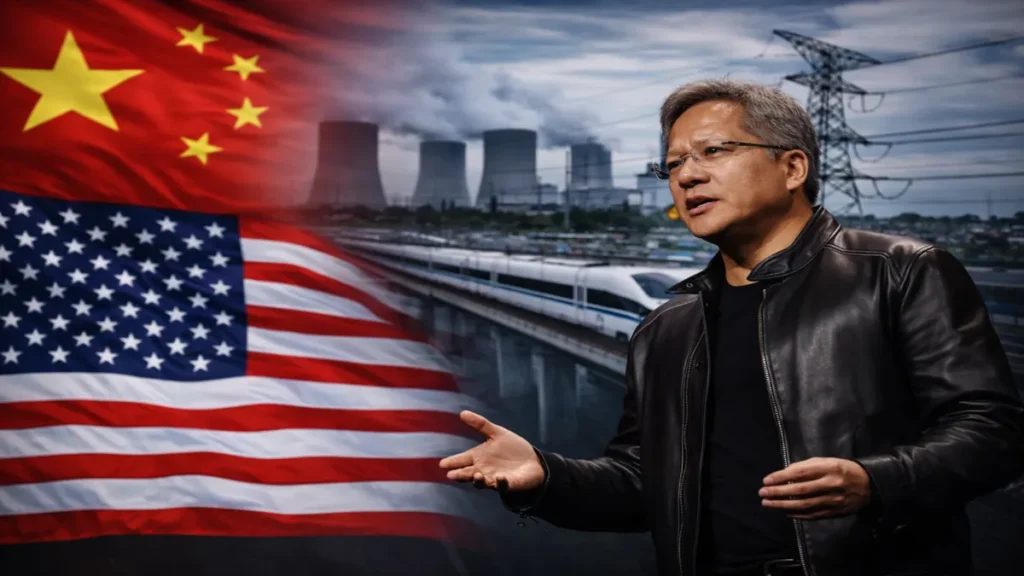
I have been watching Jensen Huang’s warnings about China’s artificial intelligence expansion with growing attention, because they reveal something deeper than a routine corporate comment or a passing geopolitical soundbite. What Huang is pointing to is a structural shift in how AI power is built, scaled, and ultimately controlled. China is not necessarily winning the race for the most advanced chips, but it is racing ahead in the less glamorous, more decisive layers of the AI stack: energy, infrastructure, and deployment speed. While American companies still design the world’s most sophisticated processors, China is building the physical systems that allow AI to exist at national scale — power plants, grids, data centers, and regulatory pathways that turn policy into construction in months rather than years. – jensen huang china ai concerns.
This difference matters because artificial intelligence is no longer just software running on silicon; it is an industrial system that consumes land, electricity, water, capital, and political coordination. Huang’s concern is not that China is smarter or more innovative, but that it is faster, more centralized, and more willing to treat AI infrastructure as strategic infrastructure, comparable to ports, highways, or defense assets. In that framing, AI becomes not merely a technology race but a civilizational one — about which societies can mobilize resources at scale, tolerate long-term investment, and absorb the social and environmental costs of industrial expansion.
His remarks triggered controversy because they challenge a comforting assumption in the West: that technological superiority alone guarantees leadership. If AI depends on physical systems as much as intellectual ones, then the winners will be those who can build and power intelligence, not just design it. Huang’s warning, at its core, is that the future of AI dominance may be decided less in research labs and more in energy ministries, construction permits, and grid-planning offices.
The Origin of Jensen Huang’s Concerns
Jensen Huang’s comments emerged at a moment when the global AI narrative was still dominated by chips, models, and breakthroughs in generative systems. His intervention shifted attention away from algorithms toward infrastructure. He acknowledged that the United States remains ahead in advanced semiconductor design, yet emphasized that China is “nanoseconds behind” in chips while being years ahead in scaling capacity.
This reframing unsettled both policymakers and investors because it implied that leadership in AI may not belong to those who invent the most powerful tools, but to those who can deploy them fastest and most widely. In that sense, China’s advantage is not intellectual but organizational. It lies in its ability to align state policy, industry, energy production, and land use into a single strategic direction. – jensen huang china ai concerns. – jensen huang china ai concerns.
By drawing attention to construction speed, regulatory freedom, and energy expansion, Huang redefined what it means to “win” the AI race. The competition is no longer confined to laboratories and startups. It now includes grid operators, environmental regulators, provincial governments, and state-owned utilities.
Infrastructure as the New Battleground
AI at scale requires data centers, and data centers require power, land, cooling, transmission lines, and regulatory approval. These are not abstract resources. They are physical systems that must be planned, built, and maintained over decades.
China’s ability to construct large data centers in months rather than years reflects a governance structure that prioritizes national objectives over local resistance or procedural delay. Provincial governments compete for designation as national AI or energy pilot zones, accelerating approvals and mobilizing investment.
In contrast, the U.S. model emphasizes decentralization, environmental review, and local consent. These safeguards protect communities and ecosystems but also slow infrastructure development. Huang’s concern is not that this model is wrong, but that it may be strategically mismatched to the scale and speed AI now demands.
Read: Sora 2 Explained: OpenAI’s Text-to-Video Model
Energy as Strategic Capital
Electricity is the lifeblood of AI. Large language models, training clusters, and inference systems consume enormous amounts of power, making energy availability a limiting factor in AI growth. – jensen huang china ai concerns.
China’s massive capacity expansion, particularly in renewables, gives it a structural advantage. Solar, wind, hydro, and nuclear investments ensure not just energy abundance, but energy predictability. Once installed, renewable infrastructure offers near-zero marginal cost electricity, making large-scale AI economically viable.
By treating energy as solved infrastructure rather than a constraint, China enables faster AI deployment regardless of chip restrictions. Even if advanced chips are limited, abundant power allows China to maximize whatever compute it possesses.
Regulatory Freedom and Speed
Regulation defines tempo. In China, environmental and zoning regulations are streamlined under national directives, enabling fast execution. In the United States, environmental protection laws and community review processes introduce friction.
Neither system is morally superior in isolation. But in a race where speed matters, friction becomes a disadvantage. Huang’s warning implicitly challenges the U.S. to rethink whether its regulatory architecture is aligned with its strategic ambitions. – jensen huang china ai concerns.
The AI + Energy Policy Model
China’s integration of AI and energy policy represents a new form of industrial strategy. AI is not treated as a standalone sector but as a component of grid management, industrial planning, and economic growth.
By using AI to forecast demand, optimize dispatch, manage renewables, and coordinate storage, China turns AI into a tool for governing infrastructure itself. This recursive loop — using AI to build the systems that power AI — accelerates deployment even further.
Strategic Implications
The implications of Huang’s concerns extend beyond Nvidia or even the tech sector. They touch national security, economic competitiveness, climate policy, and social organization.
If AI becomes as fundamental as electricity or transportation, then leadership in AI shapes leadership in everything else: manufacturing, defense, finance, science, and governance. The country that builds the largest, most efficient, and most resilient AI infrastructure gains leverage across all domains.
Two Perspectives in Tension
The Technological Optimist View
The U.S. will remain dominant because innovation thrives in open, decentralized societies with strong universities, startups, and capital markets.
The Infrastructure Realist View
Innovation without infrastructure cannot scale. The future belongs to those who can build systems, not just ideas.
Huang’s concerns align with the second view, not because innovation is unimportant, but because it is no longer sufficient.
Key Comparative Overview
| Dimension | China | United States |
|---|---|---|
| Energy expansion | Massive, rapid | Slower, constrained |
| Construction speed | Months | Years |
| Regulatory model | Centralized | Decentralized |
| AI deployment focus | Infrastructure-first | Innovation-first |
Expert Reflections
One energy analyst summarized the shift simply: “Compute is now an industrial input like steel or cement.”
A policy researcher observed: “China’s advantage is not intelligence but coordination.”
A data center architect noted: “We don’t lack technology. We lack permission.”
Takeaways
• AI is now an industrial system, not just a digital one
• Energy and infrastructure determine scale
• Regulation shapes speed
• Chips matter, but power matters more
• Coordination can outweigh innovation
• AI leadership is a civilizational choice
• The future belongs to builders as much as inventors
Conclusion
Jensen Huang’s concerns are not warnings of decline but invitations to rethink. They ask whether the frameworks that built yesterday’s technological leadership are suited to tomorrow’s challenges. If artificial intelligence is becoming a foundational infrastructure like electricity or transportation, then societies must decide how much they are willing to invest, coordinate, and change in order to lead.
China has chosen speed, scale, and central planning. The United States has chosen innovation, decentralization, and regulation. Neither path is inherently superior, but they produce different outcomes. The question is not whether one model will replace the other, but whether the U.S. can adapt its strengths to a world where physical systems matter as much as intellectual ones.
The AI race is no longer only about who is smartest. It is about who is most organized.
FAQs
Why is Jensen Huang concerned about China’s AI growth?
Because China is scaling infrastructure and energy faster than the U.S., enabling rapid AI deployment.
Does China lead in chip technology?
No, but it is closing gaps while expanding deployment capacity.
Why does energy matter so much for AI?
AI systems consume vast electricity, making power a limiting resource.
Is regulation a disadvantage?
It protects society but can slow strategic infrastructure.
Can the U.S. adapt?
Yes, but it requires policy, grid, and permitting reform.