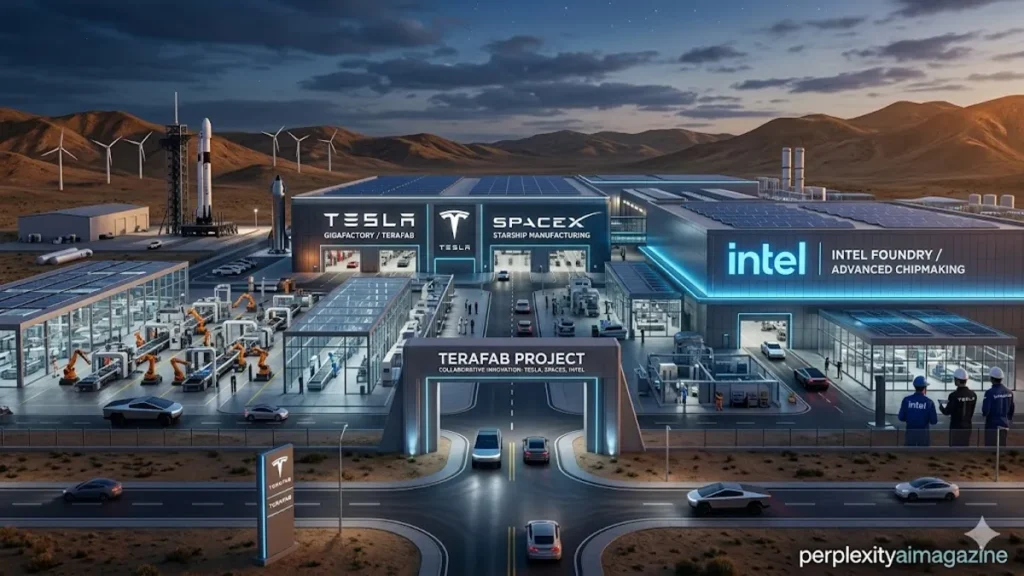
AUSTIN, TX — In a landmark agreement that could reshape the global semiconductor landscape, Intel Corporation officially announced on April 7, 2026, that it is joining Elon Musk’s ambitious Terafab project. Partnering alongside Tesla, SpaceX, and xAI, Intel will serve as the primary foundry co-pilot for a $25 billion vertically integrated chip manufacturing complex. The initiative, first unveiled by Musk in late March at Giga Texas, aims to produce a staggering 1 terawatt of annual compute capacity—a figure representing roughly 50 times the world’s current total AI output.
Intel’s entry provides the “missing link” for the project: decades of high-volume manufacturing expertise and advanced packaging capabilities. This partnership ensures that Musk’s ecosystem—ranging from Tesla’s Optimus robots to SpaceX’s orbital data centers—secures a domestic, high-speed supply of custom silicon amid persistent global shortages.
Refactoring the Fab: A New Era of Vertical Integration
The Terafab project is designed to dismantle the “pure-play” foundry model dominated by giants like TSMC. Instead of shipping designs across the globe for fabrication and testing, Terafab consolidates every stage—design, lithography, fabrication, memory production, and advanced packaging—under a single roof at the Tesla Giga Texas North Campus.
- Recursive Improvement Loops: By housing design and fabrication in the same facility, engineers can iterate on chip masks in days rather than months.
- The 2nm Target: The facility is optimized for 2-nanometer process technology, with an initial output goal of 100,000 wafer starts per month, eventually scaling to one million.
- Energy Efficiency: The chips are specifically designed for edge AI (Tesla FSD) and high-radiation environments (SpaceX), where power efficiency is a critical constraint.
Intel CEO Lip-Bu Tan described the collaboration as a transformative “refactoring” of silicon technology. “Elon has a proven track record of reimagining entire industries,” Tan stated. “Terafab represents a step-change in how silicon logic, memory, and packaging will get built in the future.”
Powering the Future: From Robotaxis to Orbital AI
The immediate beneficiaries of the Intel-Terafab alliance are Tesla’s autonomous vehicle programs. The project will prioritize the production of Tesla’s AI5 inference chips, the hardware backbone for the upcoming Cybercab and Robotaxi fleets.
Simultaneously, the partnership will accelerate xAI’s efforts to deploy “orbital data centers.” These facilities require specialized radiation-hardened D3 processors that can operate at higher temperatures to minimize the need for heavy cooling radiators in space. By leveraging Intel’s advanced packaging, these chips can be produced at a scale previously thought impossible for specialized aerospace components.
Expert Analysis: What This Means for the Industry
The Intel-Terafab partnership marks the end of the “fabless” era for top-tier tech titans. For years, companies like Tesla and Apple have designed their own chips but remained beholden to external foundries for physical production. By bringing Intel directly into the Musk ecosystem, Terafab creates a “Captive Foundry” model that is entirely decoupled from the geopolitical risks of the Taiwan Strait.
For Intel, this is a massive strategic win. After years of struggling to compete with Nvidia and TSMC, securing Musk as an anchor client validates Intel’s “Foundry-First” turnaround strategy. For the broader industry, this signals a shift toward “Compute Sovereignty.” If Terafab successfully hits its 1-terawatt goal, the United States will house the most concentrated pocket of AI processing power on Earth, fundamentally changing the economics of both space exploration and terrestrial robotics.
CHECK OUT:
Mercor AI Data Breach: 4TB of Biometric Data Stolen
Frequently Asked Questions (FAQs)
1. What is the main goal of the Terafab project?
The goal is to build a vertically integrated facility capable of producing 1 terawatt of annual AI compute capacity to support Tesla vehicles, Optimus robots, and SpaceX satellites.
2. Why did Intel join the project instead of Musk building it alone?
While Musk excels at rapid scaling, chip fabrication is a highly specialized field. Intel provides 58 years of manufacturing experience, proprietary process nodes, and the advanced packaging technology required to reach 2nm precision.
3. Where is Terafab being built?
The initial prototype and primary operations are located at the Tesla Giga Texas North Campus in Austin, Texas.
4. When will the first chips from Terafab be ready?
Small-batch production of Tesla’s AI5 chips is targeted for late 2026, with high-volume manufacturing expected to ramp up throughout 2027.
5. How does this impact the global chip shortage?
By creating a massive, domestic, vertically integrated supply chain, Terafab reduces the reliance of SpaceX and Tesla on global foundries, freeing up capacity elsewhere while ensuring Musk’s companies are not slowed by external supply chain bottlenecks.